Costruzione e analisi psicometrica di un nuovo strumento per la misura della qualità delle relazioni lavorative negli operatori sanitari

Titolo Rivista PSICOLOGIA DELLA SALUTE
Autori/Curatori Monica Giuli, Costanza Gori, Maria Anna Donati, Emanuele Baroni, Laura Belloni, Daniela Matarrese, Caterina Primi
Anno di pubblicazione 2026 Fascicolo 2026/1
Lingua Italiano Numero pagine 22 P. 139-160 Dimensione file 227 KB
DOI 10.3280/PDS2026-001009
Il DOI è il codice a barre della proprietà intellettuale: per saperne di più clicca qui

Qui sotto puoi vedere in anteprima la prima pagina di questo articolo.

Se questo articolo ti interessa, lo puoi acquistare (e scaricare in formato pdf) seguendo le facili indicazioni per acquistare il download credit. Acquista Download Credits per scaricare questo Articolo in formato PDF
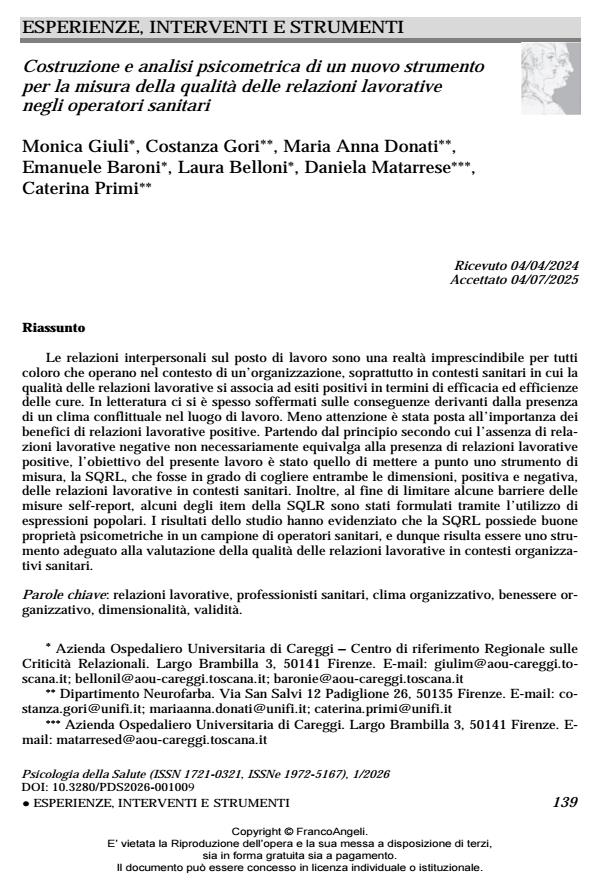
Anteprima articolo

FrancoAngeli è membro della Publishers International Linking Association, Inc (PILA), associazione indipendente e non profit per facilitare (attraverso i servizi tecnologici implementati da CrossRef.org) l’accesso degli studiosi ai contenuti digitali nelle pubblicazioni professionali e scientifiche.

Le relazioni interpersonali sul posto di lavoro sono una realtà imprescindibile per tutti coloro che operano nel contesto di un’organizzazione, soprattutto in contesti sanitari in cui la qualità delle relazioni lavorative si associa ad esiti positivi in termini di efficacia ed efficienze delle cure. In letteratura ci si è spesso soffermati sulle conseguenze derivanti dalla presenza di un clima conflittuale nel luogo di lavoro. Meno attenzione è stata posta all’importanza dei benefici di relazioni lavorative positive. Partendo dal principio secondo cui l’assenza di relazioni lavorative negative non necessariamente equivalga alla presenza di relazioni lavorative positive, l’obiettivo del presente lavoro è stato quello di mettere a punto uno strumento di misura, la SQRL, che fosse in grado di cogliere entrambe le dimensioni, positiva e negativa, delle relazioni lavorative in contesti sanitari. Inoltre, al fine di limitare alcune barriere delle misure self-report, alcuni degli item della SQLR sono stati formulati tramite l’utilizzo di espressioni popolari. I risultati dello studio hanno evidenziato che la SQRL possiede buone proprietà psicometriche in un campione di operatori sanitari, e dunque risulta essere uno strumento adeguato alla valutazione della qualità delle relazioni lavorative in contesti organizzativi sanitari.

Parole chiave:relazioni lavorative, professionisti sanitari, clima organizzativo, benessere organizzativo, dimensionalità, validità. Construction and psychometric analysis of a new instrument for measuring the quality of work relationships among healthcare professionals

  1. Allen, T. D., Eby, L. T., Poteet, M. L., Lentz, E., & Lima, L. (2004). Career benefits associated with mentoring for protégés: A meta-analysis. Journal of applied psychology, 89(1): 127-136. DOI: 10.1037/0021-9010.89.1.12
  2. Aiken, L. H., & Patrician, P. A. (2000). Measuring organizational traits of hospitals: The revised nursing work index. Nursing Research, 49(3): 146–153. DOI: 10.1097/00006199-200005000-0000
  3. Almost, J., Wolff, A. C., Stewart-Pyne, A., McCormick, L. G., Strachan, D., & D’Souza, C. (2016). Managing and mitigating conflict in healthcare teams: an integrative review. Journal of advanced nursing, 72(7): 1490-1505.
  4. Bartunek, J. M. (2011). Intergroup relationships and quality improvement in healthcare. BMJ Quality & Safety, 20(Suppl 1): i62–i66.
  5. Baumeister, R. F., & Leary, M. R. (1995). The need to belong: Desire for interpersonal attachments as a fundamental human motivation. Psychological Bulletin, 117(3): 497–529. DOI: 10.1037/0033-2909.117.3.497
  6. Beale, D., & Leather, P. (2015). Working with care – improving working relationships in health and social care: Self-assessment tools for health and social care teams. London, UK: Royal College of Nursing.
  7. Berman, E. M., West, J. P., & Richter, Jr, M. N. (2002). Workplace relations: Friendship patterns and consequences (according to managers). Public administration review, 62(2): 217-230. DOI: 10.1111/0033-3352.0017
  8. Bowling, N. A., &Beehr, T. A. (2006). Workplace harassment from the victim’s perspective: a theoretical model and meta-analysis. Journal of applied psychology, 91(5): 998. DOI: 10.1037/0021-9010.91.5.99
  9. Calamai, M., Baroni, E., Romoli, D., & Belloni, L. (2015). Prendersi cura delle organizzazioni sanitarie: relazioni che curano e cura delle relazioni. Gruppi, (2): 9–19. DOI: 10.3280/GRU2015-00200
  10. Chang, T. F., Chen, C. K., & Chen, M. J. (2017). A study of interpersonal conflict among operating room nurses. Journal of Nursing Research, 25(6): 400-410. DOI: 10.1097/JNR.000000000000018
  11. Cortina, L. M., & Magley, V. J. (2003). Raising voice, risking retaliation: Events following interpersonal mistreatment in the workplace. Journal of occupational health psychology, 8(4): 247-265. DOI: 10.1037/1076-8998.8.4.24
  12. D’amour, D., & Oandasan, I. (2005). Interprofessionality as the field of interprofessional practice and interprofessional education: An emerging concept. Journal of interprofessional care, 19(sup1): 8-20. DOI: 10.1080/1356182050008160
  13. Duddle, M., & Boughton, M. (2007). Development and psychometric testing of the Nursing Workplace Relational Environment Scale (NWRES). Journal of Clinical Nursing, 16(9): 1667–1675.
  14. Dunn, T. J., Baguley, T., & Brunsden, V. (2014). From alpha to omega: A practical solution to the pervasive problem of internal consistency estimation. British Journal of Psychology, 105(3): 399-412.
  15. Dutton, J. E., Dukerich, J. M., & Harquail, C. V. (1994). Organizational images and member identification. Administrative science quarterly, 239-263. DOI: 10.2307/239323
  16. Elena Losa Iglesias, M., & Becerro de Bengoa Vallejo, R. (2012). Conflict resolution styles in the nursing profession. Contemporary Nurse, 43(1): 73-80.
  17. Erickson, J. I., & Duffy, M. E. (2009). Development and psychometric evaluation of the Revised Professional Practice Environment (RPPE) scale. Journal of Nursing Administration, 39(5): 236–243.
  18. Estabrooks, C. A., Squires, J. E., Cummings, G. G., Birdsell, J. M., & Norton, P. G. (2009). Development and assessment of the Alberta Context Tool. BMC Health Services Research, 9, 234. DOI: 10.1186/1472-6963-9-23
  19. Feeley, T. H., Hwang, J., & Barnett, G. A. (2008). Predicting employee turnover from friendship networks. Journal of Applied Communication Research, 36(1): 56-73. DOI: 10.1080/0090988070179979
  20. Gittell, J. H., Fairfield, K. M., Bierbaum, B., Head, W., Jackson, R., Kelly, M., & Zuckerman, J. (2000). Impact of relational coordination on quality of care, postoperative pain and functioning, and length of stay: A nine-hospital study of surgical patients. Medical Care, 38(8): 807–819. DOI: 10.1097/00005650-200008000-0000
  21. Gupta, N., & Sharma, V. (2016). The relationship between corporate social responsibility and employee engagement and its linkage to organizational performance: A conceptual model. IUP Journal of Organizational Behavior, 15(3): 59-75.
  22. Heaphy, E. D., & Dutton, J. E. (2008). Positive social interactions and the human body at work: Linking organizations and physiology. Academy of management review, 33(1): 137-162.
  23. Hocking, B. A. (2006). Using reflection to resolve conflict. AORN journal, 84(2): 249-259. DOI: 10.1016/S0001-2092(06)60492-
  24. Hu, L. T., & Bentler, P. M. (1998). Fit indices in covariance structure modeling: Sensitivity to under parameterized model misspecification. Psychological methods, 3(4): 424-453. DOI: 10.1037/1082-989X.3.4.42
  25. Ilies, R., Johnson, M. D., Judge, T. A., & Keeney, J. (2011). A within-individual study of interpersonal conflict as a work stressor: Dispositional and situational moderators. Journal of Organizational Behavior, 32(1), 44-64.
  26. Ives Erickson, J., Duffy, M. E., Ditomassi, M., & Jones, D. (2017). Development and Psychometric Evaluation of the Professional Practice Work Environment Inventory. The Journal of Nursing Administration, 47(5): 259–265. DOI: 10.1097/NNA.000000000000047
  27. Jaramillo, F., Mulki, J. P., & Boles, J. S. (2011). Workplace stressors, job attitude, and job behaviors: is interpersonal conflict the missing link?. Journal of personal selling & sales management, 31(3): 339-356. DOI: 10.2753/PSS0885-313431031
  28. Kline, R. B. (2013). Assessing statistical aspects of test fairness with structural equation modelling. Educational Research and Evaluation, 19(2–3): 204–222. DOI: 10.1080/13803611.2013.767624
  29. Kostova, T., & Roth, K. (2003). Social capital in multinational corporations and a micro-macro model of its formation. Academy of management review, 28(2): 297-317.
  30. Kramer, R. M. (1991). Intergroup Relations and Organizational Dilemmas-The role of categorization processes. Research in organizational behavior, 13: 191-228.
  31. Lake, E. T. (2002). Development of the practice environment scale of the Nursing Work Index. Research in Nursing & Health, 25(3): 176–188.
  32. Lanham, H. J., McDaniel, R. R., Crabtree, B. F., Miller, W. L., Stange, K. C., Tallia, A. F., & Nutting, P. A. (2009). How improving practice relationships among clinicians and nonclinicians can improve quality in primary care. Joint Commission Journal on Quality and Patient Safety, 35(9): 457–466. DOI: 10.1016/S1553-7250(09)35063-3
  33. Lease, S. H., Shuman, W. A., & Gage, A. N. (2020). Female and male coworkers: Masculinity, sexism, and interpersonal competence at work. Psychology of Men & Masculinities, 21(1): 139-147.
  34. Liden, R. C., Wayne, S. J., & Sparrowe, R. T. (2000). An examination of the mediating role of psychological empowerment on the relations between the job, interpersonal relationships, and work outcomes. Journal of applied psychology, 85(3): 407-416. DOI: 10.1037/0021-9010.85.3.40
  35. Litwin, G. H., & Stringer, R. A., Jr. (1968). Motivation and organizational climate. Boston: Division of Research, Graduate School of Business, Harvard University.
  36. Mainiero, L. A. (1989). Office romance: Love, power, and sex in the workplace. New York: Rawson Associates.
  37. Maassen, S. M., Weggelaar Jansen, A. M. J. W., Brekelmans, G., Vermeulen, H., & van Oostveen, C. J. (2020). Psychometric evaluation of instruments measuring the work environment of healthcare professionals in hospitals: A systematic literature review. International Journal for Quality in Health Care, 32(8): 545–557.
  38. McDonald, R. P. (2013). Test theory: A unified treatment. New York, NY: Psychology Press.
  39. Nicolucci, A., Giorgino, R., Cucinotta, D., Zoppini, G., Muggeo, M., Squatrito, S., Corsi, A., Lostia, S., Pappalardo, L., Benaduce, E., Girelli, A., Galeone, F., Maldonato, A., Perriello, G., Pata P., Marra, G. & Coronel, G. A. (2004). Validation of the Italian version of the WHO-Well-Being Questionnaire (WHO-WBQ) and the WHO-Diabetes Treatment Satisfaction Questionnaire (WHO-DTSQ). Diabetes, nutrition & metabolism, 17(4): 235-243.
  40. Okello, D. R. O., & Gilson, L. (2015). Exploring the influence of trust relationships on motivation in the health sector: A systematic review. Human Resources for Health, 13(1): 16.
  41. Payton, J. (2014). Conflict in the dialysis clinic. Nephrology Nursing Journal, 41(4): 365-368.
  42. Primi, C., Giuli, M., Baroni, E., Zurkirch, V., Galanti, M., Belloni, L., Gori, C., & Donati, M. A. (2023). The Individual- and Organization-Related Stressors in Pandemic Scale for Healthcare Workers (IOSPS-HW): Development and Psychometric Properties of a New Instrument to Assess Individual and Organizational Stress Factors in Periods of Pandemics. International Journal of Environmental Research and Public Health, 20(5): 4082.
  43. Rafferty, A. M., Philippou, J., Fitzpatrick, J. M., & Ball, J. (2017). Development and testing of the ‘Culture of Care Barometer’ (CoCB). Journal of Research in Nursing, 22(4): 228–248. DOI: 10.1177/174498711770781
  44. Reid, K., & Courtney, M. (2007). A model for clinical practice within a managed practice environment: The Brisbane Practice Environment Measure (B-PEM). Contemporary Nurse, 25(1-2): 118–129.
  45. Reich, T. C., & Hershcovis, M. S. (2011). Interpersonal relationships at work. In: Zedeck, S. (ed.), Handbook of industrial and organizational psychology (Vol. 3). Washington, DC: American Psychological Association, pp. 223-248.
  46. Schroder, C., Medves, J., Paterson, M., Byrnes, V., Chapman, C., O’Riordan, A., & Kelly, C. (2011). Development and pilot testing of the Collaborative Practice Assessment Tool. Journal of Interprofessional Care, 25(3): 189–195. DOI: 10.3109/13561820.2010.53262
  47. Spector, P. E., & Jex, S. M. (1998). Development of four self-report measures of job stressors and strain: interpersonal conflict at work scale, organizational constraints scale, quantitative workload inventory, and physical symptoms inventory. Journal of occupational health psychology, 3(4): 356-367. DOI: 10.1037/1076-8998.3.4.35
  48. Stahl, M., & Schirmer, M. (2017). Development of the Picker Employee Questionnaire for midwives. Midwifery, 55: 16–23.
  49. Sutherland, J. M., Liu, G., Crump, R. T., & McGrail, K. M. (2022). Good working relationships: How healthcare system proximity influences trust between healthcare workers. Health Policy, 126(2): 99–107.
  50. Sveningsson, S., & Alvesson, M. (2003). Managing managerial identities: Organizational fragmentation, discourse and identity struggle. Human relations, 56(10): 1163-1193. DOI: 10.1177/0018726703561000
  51. Terraciano, A., McCrae, R. R., & Costa Jr, P. T. (2003). Factorial and construct validity of the Italian Positive and Negative Affect Schedule (PANAS). European journal of psychological assessment, 19(2): 131. DOI: 10.1027/1015-5759.19.2.13
  52. Tsui, P. L. (2021). Would organizational climate and job stress affect wellness? An empirical study on the hospitality industry in Taiwan during covid-19. International Journal of Environmental Research and Public Health, 18(19): 10491.
  53. Williams, K. D. (2002). Ostracism: The power of silence. New York, NY: Guilford Press.

Monica Giuli, Costanza Gori, Maria Anna Donati, Emanuele Baroni, Laura Belloni, Daniela Matarrese, Caterina Primi, Costruzione e analisi psicometrica di un nuovo strumento per la misura della qualità delle relazioni lavorative negli operatori sanitari in "PSICOLOGIA DELLA SALUTE" 1/2026, pp 139-160, DOI: 10.3280/PDS2026-001009