Maltrattamento istituzionale dei minorenni accolti fuori famiglia: strumenti di concettualizzazione e responsabilità
Titolo Rivista MALTRATTAMENTO E ABUSO ALL’INFANZIA
Autori/Curatori Petra Filistrucchi, Giuseppe Aversa, Michele Aversa, Marianna Giordano
Anno di pubblicazione 2026 Fascicolo 2026/2
Lingua Italiano Numero pagine 19 P. 51-69 Dimensione file 97 KB
DOI 10.3280/MAL2026-002004
Il DOI è il codice a barre della proprietà intellettuale: per saperne di più
clicca qui
Qui sotto puoi vedere in anteprima la prima pagina di questo articolo.
Se questo articolo ti interessa, lo puoi acquistare (e scaricare in formato pdf) seguendo le facili indicazioni per acquistare il download credit. Acquista Download Credits per scaricare questo Articolo in formato PDF
FrancoAngeli è membro della Publishers International Linking Association, Inc (PILA), associazione indipendente e non profit per facilitare (attraverso i servizi tecnologici implementati da CrossRef.org) l’accesso degli studiosi ai contenuti digitali nelle pubblicazioni professionali e scientifiche.
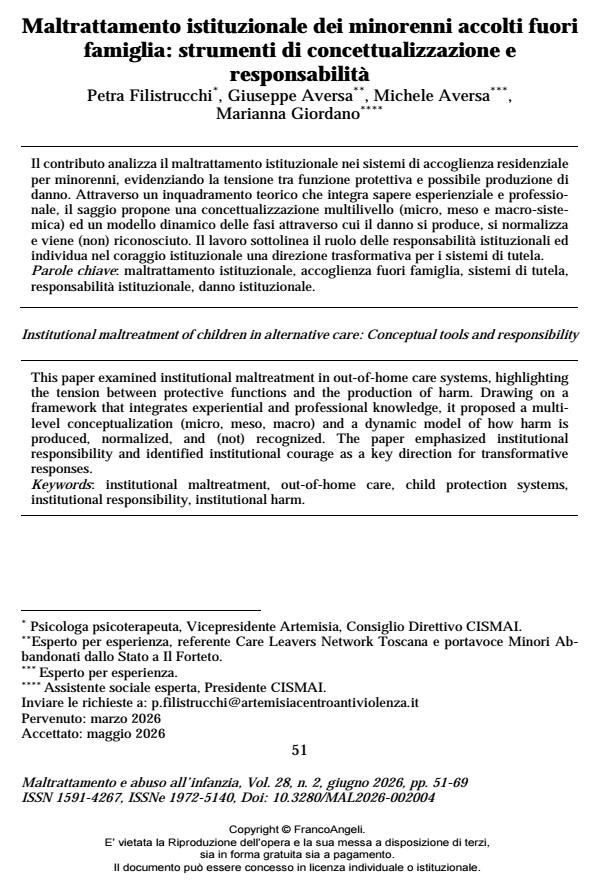
Il contributo analizza il maltrattamento istituzionale nei sistemi di accoglienza residenziale per minorenni, evidenziando la tensione tra funzione protettiva e possibile produzione di danno. Attraverso un inquadramento teorico che integra sapere esperienziale e professionale, il saggio propone una concettualizzazione multilivello (micro, meso e macro-sistemica) ed un modello dinamico delle fasi attraverso cui il danno si produce, si normalizza e viene (non) riconosciuto. Il lavoro sottolinea il ruolo delle responsabilità istituzionali ed individua nel coraggio istituzionale una direzione trasformativa per i sistemi di tutela.
Parole chiave:maltrattamento istituzionale, accoglienza fuori famiglia, sistemi di tutela, responsabilità istituzionale, danno istituzionale.
- Aversa, M. (2024). Quale diritto alla cura nelle storie di abuso e maltrattamento? Intervento al Convegno conclusivo Progetto DREAM A Occhi Aperti, Firenze (disponibile online: https://youtu.be/zfSX4nQnQDQ).
- Aversa, G., & Aversa, M. (2023). The effects of biased listening and not being heard in child protection proceedings: Consequences on life and identity. British Journal of Social Work, 53(3), 1809-1815.
- Aversa, G., & Filistrucchi, P. (2023). Why didn’t anyone understand? Why didn’t anyone ever stand in the way? Detecting child abuse in out-of-home care setting: The role of safeguard and protection systems and social workers. British Journal of Social Work, 53(3), 1465-1482.
- Aversa, G., Corso, M., Mameli, M., Filistrucchi, P., & Zullo, F. (2021). It can be different: Listening to voices of adult survivors of child abuse in out-of-home care settings. Paper presented at the ISPCAN International Congress, Milan.
- Aversa, G., Aversa, M., & Filistrucchi, P. (2025). Institutional abuse and the child protection system: Building a shared understanding between survivors and professionals. Paper presented at the ISPCAN Congress, Vilnius.
- Bastianoni, P., Ciriello, M., & Fucili, A. M. (2016). Comuni care in comunità per minori. Bergamo: Edizioni Junior.
- Bastianoni, P., & Taurino, A. (2009). Le comunità per minori: Modelli di formazione e supervisione clinica. Roma: Carocci Editore.
- Brown, B. (2012). Daring greatly: How the courage to be vulnerable transforms the way we live, love, parent, and lead. Sheridan, Wyoming: Gotham Books.
- Daly, K. (2014a). Conceptualising responses to institutional abuse of children. Current Issues in Criminal Justice, 26(1), 5-29.
- Daly, K. (2014b). Redressing institutional abuse of children. London: Palgrave Macmillan.
- Daly, K. (2024). Stepping out of the shadow of transitional justice: Towards institutional justice. International Journal of Transitional Justice, 18(1), 1239-1275. DOI: 10.1080/15564886.2024.2391478
- Dworsky, A., Heffernan, M. E., Rodriguez, J. A., Kim, H., Schneider, W., & Smith, J. (2025). Child Maltreatment Among Children in Out-of-Home Care. Child Maltreatment. DOI: 10.1177/10775595251356281
- Erooga, M., Allnock, D., & Telford, P. (2012). Towards safer organisations II: Using the perspectives of convicted sex offenders to inform organisational safeguarding of children. London: NSPCC.
- Filistrucchi, P., Bucarelli, P., Aversa, G., & Bianchi, D. (2023). Giving voice to the survivors of childhood institutional abuse. In M. Roth, R. Alfandari, & G. Crous (Eds.), Participatory research on child maltreatment with children and adult survivors: Concepts, ethics, and methods. Leeds, England: Emerald Publishing.
- Fricker, M. (2007). Epistemic injustice: Power and the ethics of knowing. Oxford: Oxford University Press.
- Gil, D. G. (1975). Unraveling child abuse. Cambridge, MA: Schenkman.
- Gil, D. G. (1982). Institutional abuse of children in out-of-home care. Child & Youth Services, 4(1-2), 7-13.
- Higgins, D. J. (2002). A case study of child sexual abuse within a church community. Journal of Religion & Abuse, 3(1-2), 5-19.
- Kaufman, K. L., Erooga, M., & Mathews, B. (2012). Contextualizing the prevention of child sexual abuse: An organizational perspective. International Journal of Children’s Rights, 20(2), 256-28
- McAlinden, A.-M. (2006). Setting ‘em up’: Personal, familial and institutional grooming in the sexual abuse of children. Social & Legal Studies, 15(3), 339-362. DOI: 10.1177/0964663906066613
- McAlinden, A. M. (2012). Grooming and the sexual abuse of children: Institutional, internet and familial dimensions. Oxford: Oxford University Press.
- McAlinden, A. M. (2013). An inconvenient truth: Barriers to truth recovery in the aftermath of institutional child abuse in Ireland. Legal Studies, 33(2), 189-214.
- McAlinden, A. M. (2022). Grooming and institutional sexual abuse: The manipulation of organisational structures. Journal of Sexual Aggression, 28(1), 1-17.
- McAlinden, A. M., Keenan, M., & Gallen, J. (2025). Transforming justice responses to non-recent institutional abuses. Oxford: Oxford University Press.
- McNeish, D., & Scott, S. (2023). Key messages from research on child sexual abuse in institutional contexts. Centre of Expertise on Child Sexual Abuse.
- Morrison, E. W., & Milliken, F. J. (2014). Organizational silence: A review and integration. Annual Review of Organizational Psychology and Organizational Behavior, 1, 99-123.
- Morrison, Z. (2005). Reporting the abuse of children and young people and responding to adult sexual assault. Adelaide: Anglican Church of Australia.
- Parkinson, P., Oates, K., & Jayakody, A. (2009). Study of reported child sexual abuse in the Anglican Church.
- Rogers, J., Wilson, S., & Dixon, J. (2026). Exploring the prevalence, forms, risk factors, and interventions associated with violence against children in alternative care settings: A scoping review. Children and Youth Services Review, 82, 108766.
- Roth, M., Antal, I., Dávid-Kacsó, A., & László, E. (2019). Forms, impact, and consequences of violence against children in Romanian child protection settings. In M. Reis & M. S. Isidóriio (Eds.), Human rights for children and youth (pp. 99-131). Leeds, England: Emerald.
- SASCA Project. (2019). Report on interviews with adult survivors of child abuse. (disponibile online: http://www.sasca.eu/wp-content/uploads/2019/05/Report-Interviews-Adult-Survivors.pdf).
- Serra, B. G., & Santanera, F. (1973). Il Paese dei Celestini. Istituti di assistenza sotto processo. Torino: Einaudi.
- Sherr, L., Roberts, K. J., & Gandhi, N. (2017). Child violence experiences in institutionalised/orphanage care. Psychology, Health & Medicine, 22(1), 31-37. DOI: 10.1080/13548506.2016.1271951
- Smidt, A. M., Adams-Clark, A. A., & Freyd, J. J. (2023). Institutional courage buffers against institutional betrayal and workplace harm. PLOS ONE, 18(1), e0278830.
- Smith, C. P., & Freyd, J. J.(2013). Dangerous safe havens: Institutional betrayal exacerbates sexual trauma. Journal of Traumatic Stress, 26(1), 119-124.
- Stanley, N., Manthorpe, J., & Penhale, B. (1999). Institutional abuse: Perspectives across the life course. London: Routledge.
- Werner, T., & Tschan, W. (2007). Towards a safe institution: How to prevent sexual abuse in the institutional setting. Paper presented at the ISPCAN Conference, Lisbon.
- Williams, A. (2015). Child sexual victimisation: Ethnographic stories of stranger and acquaintance grooming. Journal of Sexual Aggression, 21(1), 28-42. DOI: 10.1080/13552600.2014.94808
- Wright, K. (2017). Remaking collective knowledge: An analysis of the complex and multiple effects of inquiries into historical institutional child abuse. Child Abuse & Neglect, 74, 10-22.
Petra Filistrucchi, Giuseppe Aversa, Michele Aversa, Marianna Giordano, Maltrattamento istituzionale dei minorenni accolti fuori famiglia: strumenti di concettualizzazione e responsabilità in "MALTRATTAMENTO E ABUSO ALL’INFANZIA" 2/2026, pp 51-69, DOI: 10.3280/MAL2026-002004