Il fenomeno del burnout come disequilibrio del rapporto persona-lavoro-prestazione: inquadramento storicoconcettuale
Titolo Rivista QUADERNI DI ECONOMIA DEL LAVORO
Autori/Curatori Azio Barani
Anno di pubblicazione 2026 Fascicolo 2022/116
Lingua Italiano Numero pagine 10 P. 87-96 Dimensione file 83 KB
DOI 10.3280/QUA2022-116005
Il DOI è il codice a barre della proprietà intellettuale: per saperne di più
clicca qui
Qui sotto puoi vedere in anteprima la prima pagina di questo articolo.
Se questo articolo ti interessa, lo puoi acquistare (e scaricare in formato pdf) seguendo le facili indicazioni per acquistare il download credit. Acquista Download Credits per scaricare questo Articolo in formato PDF
FrancoAngeli è membro della Publishers International Linking Association, Inc (PILA), associazione indipendente e non profit per facilitare (attraverso i servizi tecnologici implementati da CrossRef.org) l’accesso degli studiosi ai contenuti digitali nelle pubblicazioni professionali e scientifiche.
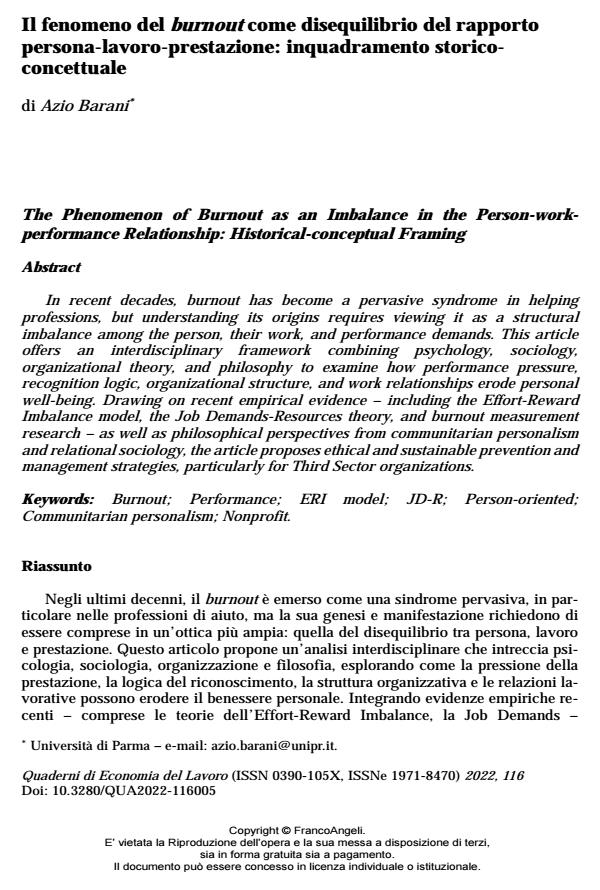
Negli ultimi decenni, il burnout è emerso come una sindrome pervasiva, in particolare nelle professioni di aiuto, ma la sua genesi e manifestazione richiedono di essere comprese in un’ottica più ampia: quella del disequilibrio tra persona, lavoro e prestazione. Questo articolo propone un’analisi interdisciplinare che intreccia psicologia, sociologia, organizzazione e filosofia, esplorando come la pressione della prestazione, la logica del riconoscimento, la struttura organizzativa e le relazioni lavorative possono erodere il benessere personale. Integrando evidenze empiriche recenti – comprese le teorie dell’Effort-Reward Imbalance, la Job Demands –Resources e la misurazione del burnout – con la riflessione filosofica del personalismo comunitario e la sociologia relazionale, si delineano strategie di prevenzione e gestione etiche e sostenibili, particolarmente rilevanti per le organizzazioni del Terzo Settore.
Parole chiave:Burnout; prestazione; Effort-Reward Imbalance; Job Demands-Resources; Person-oriented; personalismo comunitario; Terzo Settore.
- Bakker A.B. e Demerouti E. (2017). Job demands-resources theory: Taking stock and looking forward. Journal of Occupational Health Psychology, 22(3): 273-285.
- Barello S., Caruso R., Palamenghi L. e Graffigna G. (2021). Workload and burnout in healthcare during COVID-19: The role of emotional coping. Frontiers in Psychology, 12, 637624.
- Bhatt P. e Ramani K. (2016). Burnout and its organizational effects: A study on literature review. International Research Journal of Management and Marketing, 6(7): 34-45. -- https://econjournals.com/index.php/irmm/article/view/9398.
- Cherniss C. (1983). La sindrome del burnout. Torino: CST.
- Dall’Ora C., Ball J., Reinius M. e Griffiths P. (2020). Burnout in nursing: a theoretical review. Human Resources for Health, 18: 41. -- Testo disponibile al sito: https://doi.org/10.1186/s12960-020-00469-9.
- Deng H., Huang J., Cheung S.-F. e Zhang L. (2021). Job demands and resources, burnout, and psychological distress of employees in the Chinese non-profit sector. Frontiers in Psychology.
- Donati P. (2011a). Relational Sociology. A New Pradigm for the Social Sciences. London-New York: Routledge.
- Donati P. (2011b). Sociologia della riflessività. Come si entra nel dopo-moderno. Bologna: il Mulino.
- Edú-Valsania S., Laguía A. e Moriano J.A. (2022). Burnout: A review of theory and measurement. International Journal of Environmental Research and Public Health, 19(3): 1780.
- El Mouedden H., Vanhaecht K. e Panella M. (2022). Job Demands-Resources theory in health professions and education. BMC Medical Education, 22: 631.
- Freudenberger H.J. (1974). Staff Burn-out. Journal of Social Issues, 30(1): 159-165.
- Freudenberger H.J. (1983). Burnout: Contemporary issues, trends and concerns. In: Farber B.A., a cura di, Stress and burnout in the human service professions, pp. 1-20. Elmsford, NY: Pergamon Press.
- Green F. (2004). Work intensification, discretion, and the decline in well-being at work. European Sociological Review, 20(4): 345-361. -- Testo disponibile al sito: https://doi.org/10.1093/esr/jch022.
- Lee J. e Carter M. (2016). The person-oriented approach to burnout: A systematic review. Burnout Research, 3: 1-11.
- Leiter M.P. e Maslach C. (2016). Latent burnout profiles: A new approach to understanding the burnout experience. Burnout Research, 3: 89-100. -- Testo disponibile al sito: https://doi.org/10.1016/j.burn.2016.08.002.
- Lubbadeh A. (2020). Understanding burnout in the helping professions: A literature review. Journal of Workplace Behavioral Health, 35(3): 210-230. -- Testo disponibile al sito: https://doi.org/10.1080/15555240.2020.1788880.
- Maritain J. (1942). Integral Humanism. London: Sheed & Ward.
- Maritain J. (1947). Man and the State. Chicago: University of Chicago Press.
- Maslach C. e Jackson S.E. (1981). The measurement of experienced burnout. Journal of Occupational Behaviour, 2: 99-113. -- Testo disponibile al sito: https://doi.org/10.1002/job.4030020205.
- Maslach C. e Jackson S.E. (1984). Burnout in organizational settings. In: Rowland K. e Ferris G., a cura di, Applied Social Psychology Annual, 5: 133-153.
- Maslach C. e Leiter M.P. (1997). The truth about burnout: How organizations cause personal stress and what to do about it. San Francisco: Jossey-Bass.
- Maslach C. e Leiter M.P. (2001). Organizational causes of burnout. In: Golembiewski R.T., a cura di, Handbook of organizational behavior, 2nd ed., pp. 245-257. New York: Dekker.
- Mounier E. (1936). Manifeste au service du personnalisme. Paris: Plon.
- Patel R., Sekhon H. e Sharma R. (2016). Job Burnout: A literature review. Paripex Indian Journal of Research, 5(9): 1-8. -- Testo disponibile al sito: https://www.worldwidejournals.com/paripex/recent_issues_pdf/2016/September/job-burnout-a-literature-review_September_2016_5996591050_0206815.pdf.
- Pines A. e Aronson E. (1988). Career burnout: Causes and cures. New York: Free Press.
- Pines A. e Kafry D. (1978). Occupational tedium in the social service. Social Work, 23(6): 499-507.
- Schaufeli W.B. e Enzmann D. (1998). The burnout companion to study and practice: A critical analysis. London: Taylor & Francis.
- Schaufeli W.B., Leiter M.P. e Maslach C. (2009). Burnout: 35 years of research and practice. Career Development International, 14(3): 204-220. -- Testo disponibile al sito: https://doi.org/10.1108/13620430910966406.
- Shoman Y., Rousson V., Bianchi R. e Guseva Canu I. (2022). Emotional exhaustion as the core of burnout: A meta-analytical and longitudinal reappraisal. Frontiers in Psychology.
- Yuan Z., Yu D., Zhao H., Wang Y., Jiang W., Chen D., Liu X. e Li X. (2021). Burnout of healthcare workers based on the Effort-Reward Imbalance model: A cross-sectional study in China. International Journal of Public Health, 66.
Azio Barani, Il fenomeno del burnout come disequilibrio del rapporto persona-lavoro-prestazione: inquadramento storicoconcettuale in "QUADERNI DI ECONOMIA DEL LAVORO" 116/2022, pp 87-96, DOI: 10.3280/QUA2022-116005