Aristotele e l’indignazione: una passione virtuosa?
Titolo Rivista RIVISTA DI STORIA DELLA FILOSOFIA
Autori/Curatori Cristina Viano
Anno di pubblicazione 2026 Fascicolo 2026/1
Lingua Italiano Numero pagine 13 P. 17-29 Dimensione file 199 KB
DOI 10.3280/SF2026-001002
Il DOI è il codice a barre della proprietà intellettuale: per saperne di più
clicca qui
Qui sotto puoi vedere in anteprima la prima pagina di questo articolo.
Se questo articolo ti interessa, lo puoi acquistare (e scaricare in formato pdf) seguendo le facili indicazioni per acquistare il download credit. Acquista Download Credits per scaricare questo Articolo in formato PDF
FrancoAngeli è membro della Publishers International Linking Association, Inc (PILA), associazione indipendente e non profit per facilitare (attraverso i servizi tecnologici implementati da CrossRef.org) l’accesso degli studiosi ai contenuti digitali nelle pubblicazioni professionali e scientifiche.
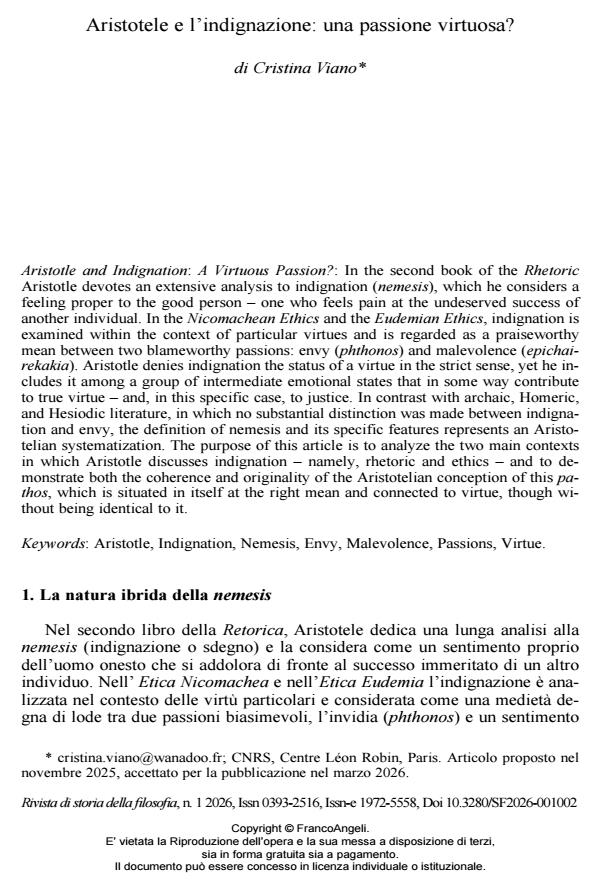
In the second book of the Rhetoric Aristotle devotes an extensive analysis to indignation (nemesis), which he considers a feeling proper to the good person – one who feels pain at the undeserved success of another individual. In the Nicomachean Ethics and the Eudemian Ethics, indignation is examined within the context of particular virtues and is regarded as a praiseworthy mean between two blameworthy passions: envy (phthonos) and malevolence (epichai- rekakia). Aristotle denies indignation the status of a virtue in the strict sense, yet he in- cludes it among a group of intermediate emotional states that in some way contribute to true virtue – and, in this specific case, to justice. In contrast with archaic, Homeric, and Hesiodic literature, in which no substantial distinction was made between indigna- tion and envy, the definition of nemesis and its specific features represents an Aristo- telian systematization. The purpose of this article is to analyze the two main contexts in which Aristotle discusses indignation – namely, rhetoric and ethics – and to de- monstrate both the coherence and originality of the Aristotelian conception of this pa- thos, which is situated in itself at the right mean and connected to virtue, though wi- thout being identical to it.
Parole chiave:Aristotle, Indignation, Nemesis, Envy, Malevolence, Passions, Virtue.
Cristina Viano, Aristotele e l’indignazione: una passione virtuosa? in "RIVISTA DI STORIA DELLA FILOSOFIA" 1/2026, pp 17-29, DOI: 10.3280/SF2026-001002