Povertà, plebe e indignazione nella società civile hegeliana
Titolo Rivista RIVISTA DI STORIA DELLA FILOSOFIA
Autori/Curatori Giorgio Cesarale
Anno di pubblicazione 2026 Fascicolo 2026/1
Lingua Italiano Numero pagine 19 P. 181-199 Dimensione file 222 KB
DOI 10.3280/SF2026-001011
Il DOI è il codice a barre della proprietà intellettuale: per saperne di più
clicca qui
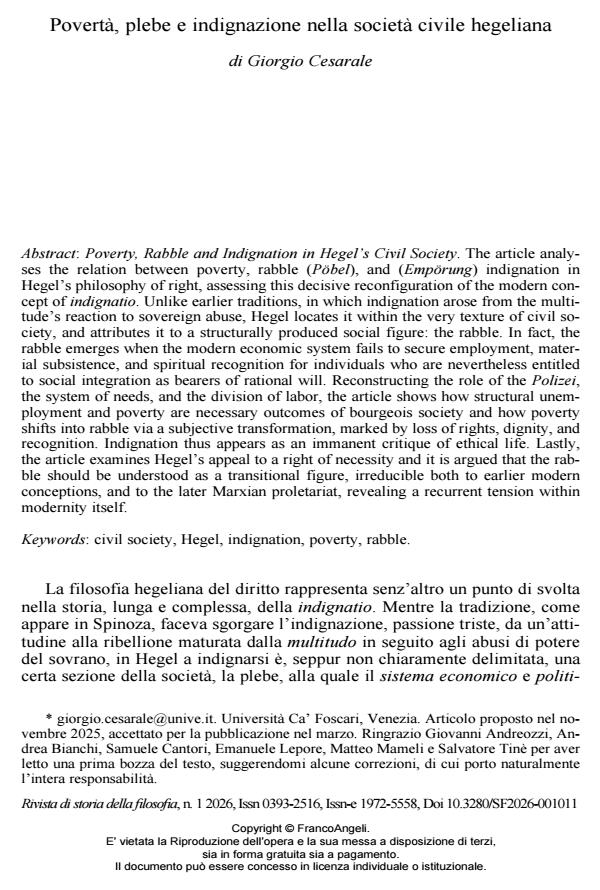
Qui sotto puoi vedere in anteprima la prima pagina di questo articolo.
Se questo articolo ti interessa, lo puoi acquistare (e scaricare in formato pdf) seguendo le facili indicazioni per acquistare il download credit. Acquista Download Credits per scaricare questo Articolo in formato PDF
FrancoAngeli è membro della Publishers International Linking Association, Inc (PILA), associazione indipendente e non profit per facilitare (attraverso i servizi tecnologici implementati da CrossRef.org) l’accesso degli studiosi ai contenuti digitali nelle pubblicazioni professionali e scientifiche.
The article analy- ses the relation between poverty, rabble (Pöbel), and (Empörung) indignation in Hegel’s philosophy of right, assessing this decisive reconfiguration of the modern con- cept of indignatio. Unlike earlier traditions, in which indignation arose from the multi- tude’s reaction to sovereign abuse, Hegel locates it within the very texture of civil so- ciety, and attributes it to a structurally produced social figure: the rabble. In fact, the rabble emerges when the modern economic system fails to secure employment, mater- ial subsistence, and spiritual recognition for individuals who are nevertheless entitled to social integration as bearers of rational will. Reconstructing the role of the Polizei, the system of needs, and the division of labor, the article shows how structural unem- ployment and poverty are necessary outcomes of bourgeois society and how poverty shifts into rabble via a subjective transformation, marked by loss of rights, dignity, and recognition. Indignation thus appears as an immanent critique of ethical life. Lastly, the article examines Hegel’s appeal to a right of necessity and it is argued that the rab- ble should be understood as a transitional figure, irreducible both to earlier modern conceptions, and to the later Marxian proletariat, revealing a recurrent tension within modernity itself.
Parole chiave:civil society, Hegel, indignation, poverty, rabble.
Giorgio Cesarale, Povertà, plebe e indignazione nella società civile hegeliana in "RIVISTA DI STORIA DELLA FILOSOFIA" 1/2026, pp 181-199, DOI: 10.3280/SF2026-001011