Profili motivazionali e condizioni oggettive del lavoro: leggere la disconnessione valoriale attraverso la turnover intention
Titolo Rivista SOCIOLOGIA DEL LAVORO
Autori/Curatori Adriana Cerasuolo, Giuseppe Gargiulo
Anno di pubblicazione 2026 Fascicolo 2026/174
Lingua Italiano Numero pagine 40 P. 136-175 Dimensione file 641 KB
DOI
Il DOI è il codice a barre della proprietà intellettuale: per saperne di più
clicca qui
Qui sotto puoi vedere in anteprima la prima pagina di questo articolo.
Se questo articolo ti interessa, lo puoi acquistare (e scaricare in formato pdf) seguendo le facili indicazioni per acquistare il download credit. Acquista Download Credits per scaricare questo Articolo in formato PDF
FrancoAngeli è membro della Publishers International Linking Association, Inc (PILA), associazione indipendente e non profit per facilitare (attraverso i servizi tecnologici implementati da CrossRef.org) l’accesso degli studiosi ai contenuti digitali nelle pubblicazioni professionali e scientifiche.
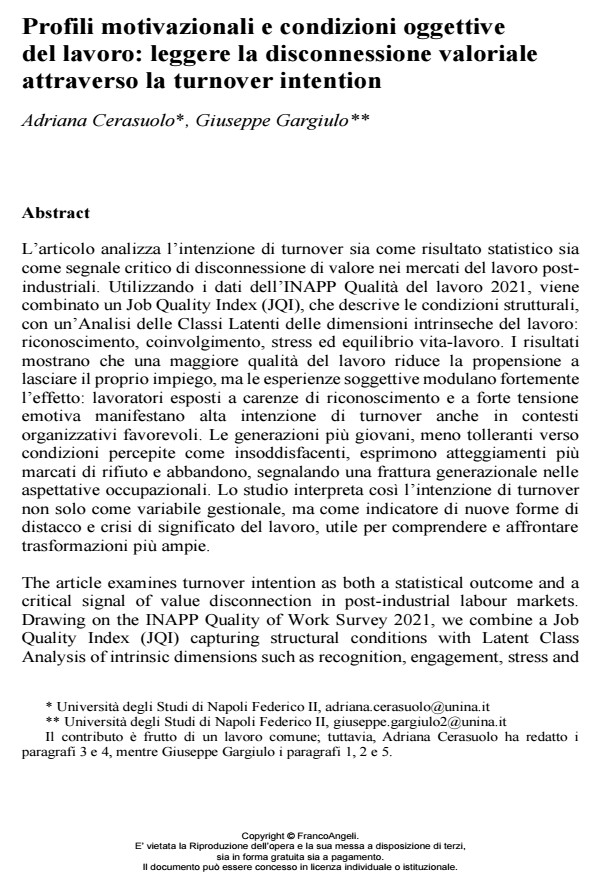
L’articolo analizza l’intenzione di turnover sia come risultato statistico sia come segnale critico di disconnessione di valore nei mercati del lavoro post-industriali. Utilizzando i dati dell’INAPP Qualità del lavoro 2021, viene combinato un Job Quality Index (JQI), che descrive le condizioni strutturali, con un’Analisi delle Classi Latenti delle dimensioni intrinseche del lavoro: riconoscimento, coinvolgimento, stress ed equilibrio vita-lavoro. I risultati mostrano che una maggiore qualità del lavoro riduce la propensione a lasciare il proprio impiego, ma le esperienze soggettive modulano fortemente l’effetto: lavoratori esposti a carenze di riconoscimento e a forte tensione emotiva manifestano alta intenzione di turnover anche in contesti organizzativi favorevoli. Le generazioni più giovani, meno tolleranti verso condizioni percepite come insoddisfacenti, esprimono atteggiamenti più marcati di rifiuto e abbandono, segnalando una frattura generazionale nelle aspettative occupazionali. Lo studio interpreta così l’intenzione di turnover non solo come variabile gestionale, ma come indicatore di nuove forme di distacco e crisi di significato del lavoro, utile per comprendere e affrontare trasformazioni più ampie.
Parole chiave:qualità del lavoro, turnover intention, condizioni lavorative, significato del lavoro, analisi delle classi latenti
- Armano E., Bove A., and Murgia A., a cura di (2017). Mapping precariousness, labour insecurity and uncertain livelihoods: Subjectivities and resistance. London: Routledge.
- Boltanski L. and Chiapello È. (1999). Le nouvel esprit du capitalisme. Paris: Gallimard.
- Bourdieu P. (1998). Acts of Resistance: Against the Tyranny of the Market. New York: New Press.
- Breen R., Karlson K. B. and Holm A. (2013). Total, direct, and indirect effects in logit and probit models. Sociological Methods & Research, 42(2): 164-191. DOI: 10.1177/0049124113494572
- Castel R. (1995). Les métamorphoses de la question sociale. Paris: Gallimard.
- Cavalca G., Mingione E., and Pugliese E. (2024). Il lavoro. Dalla rivoluzione industriale alla transizione digitale. Roma: Carocci Editore.
- Chen I.H., Brown R., Bowers B.J. and Chang W.Y. (2015). Job demand and job satisfaction in latent groups of turnover intention among licensed nurses in taiwan nursing homes. Research in Nursing & Health, 38(5):342-56.
- Clark A. E. (2015). What makes a good job? Job quality and job satisfaction. IZA World of Labor, No. 215. Bonn: Institute for the Study of Labor (IZA).
- Coin F. (2023). Le grandi dimissioni. Il nuovo rifiuto del lavoro e il tempo di riprenderci la vita. Torino: Einaudi Editore.
- Colamedici M., Gancitano I. (2023). Ma chi me lo fa fare? Come il lavoro ci ha illuso: la fine dell’incantesimo. Milano: HarperCollins.
- Côté J. E., Levine C. G. (2002). Identity, Formation, Agency, and Culture: A Social Psychological Synthesis (1st ed.). Mahwah, NJ: Psychology Press.
- Dardot P., Laval C. (2009). La nouvelle raison du monde: Essai sur la société néolibérale. Paris: La Découverte.
- Deranty J. P., MacMillan C. (2012). The ILO’s decent work initiative: Suggestions for an extension of the notion of “decent work”. Journal of Social Philosophy, 43(4): 386-405.
- Dubet F. (2009). Le travail des sociétés. Paris: Le Seuil.
- Esping-Andersen G. (1990). The three worlds of welfare capitalism. New Jork: Polity Press.
- Eurofound (2022). Living, working and COVID-19 in the European Union and 10 EU neighbouring countries. Luxembourg: Publications Office of the European Union.
- Eurofound (2023). European Working Conditions Survey 2021. First findings.
- Febriani R., Nurhasanah S. and Hakim A. R. (2024). Relationships between demographic factors, job satisfaction, and intention to leave among women employees in Indonesia. Problems and Perspectives in Management, 22(1): 1-12.
- Ferrera M. (1996). The ‘Southern Model’ of Welfare in Social Europe. Journal of European Social Policy, 6(1): 17-37. DOI: 10.1177/095892879600600102
- Ferrera M., Jessoula M., a cura di (2025). Le politiche sociali (4ª edizione). Bologna: Il Mulino.
- Franklin P., Zwysen W. and Piasna A. (2022). Temporal dimensions of job quality and gender: Exploring differences in the associations of working time and health between women and men. International Journal of Environmental Research and Public Health, 19(8): 4456.
- Fraser N., Honneth A. (2003). Redistribution or recognition? A political-philosophical exchange. London & New York: Verso.
- Gallie D. (2007). Employment regimes and the quality of work. Oxford: University Press.
- Gallie D. (2013). Economic Crisis, Quality of Work, and Social Integration: The European Experience. Oxford: Oxford Academic.
- Green F. (2006). The Paradox of Job Quality in the Affluent Economy. Princeton: University Press.
- Green F., Mostafa, T. (2012). Trends in Job Quality in Europe. Luxembourg: Publications Office of the European Union.
- Green F., Lee S., Zou M. and Zhou Y. (2024). Work and life: the relative importance of job quality for general well-being, and implications for social surveys, Socio-Economic Review, 22(2): 835-857.
- Gulmanelli M. (2024). Fuga dal lavoro. Il fenomeno delle grandi dimissioni in Italia. Roma: Edizionilavoro.
- Han B.-C. (2015). The Burnout Society. Stanford, CA: Stanford University Press. Hemerijck A., a cura di (2017). The Uses of Social Investment. Oxford: Oxford University Press.
- Herzberg F., Mausner B. and Snyderman B. (1959). The Motivation to Work. New York: John Willey & Sons.
- Hochschild A. R. (2012). The Managed Heart: Commercialization of Human Feeling (1st ed.). California: University of California Press.
- Holman D. (2013). Job types and job quality in Europe: A cluster analysis of working conditions in 27 European countries. Human Relations, 66(4): 475-502. DOI: 10.1177/0018726712456407
- Hom P. W., Lee T. W., Shaw J. D. and Hausknecht J. P. (2017). One Hundred Years of Employee Turnover Theory and Research. Journal of Applied Psychology, 102(3), 530–545.
- Honneth A. (1996). The struggle for recognition: The moral grammar of social conflicts. Cambridge: MIT Press.
- Honneth A., Sennett R. and Supiot A. (2020). Perché lavoro? Narrative e diritti per lavoratrici e lavoratori del XXI secolo. Milano: Fondazione Giangiacomo Feltrinelli.
- Howard J. L., Morin A. J. and Gagné M. (2021). A longitudinal analysis of motivation profiles at work. Motivation and Emotion, 45(1): 39-59.
- Howard J., Gagné M., Morin A. J. and Van den Broeck A. (2016). Motivation profiles at work: A self-determination theory approach. Journal of vocational behavior, 95: 74-89.
- Huws U. (2014). Labor in the global digital economy: The cybertariat comes of age. New York: Monthly Review Press.
- Illouz E. (2007). Cold Intimacies: The Making of Emotional Capitalism. Cambridge: Polity Press.
- INAPP (2023). Rapporto INAPP. Lavoro, formazione, welfare. Un percorso di crescita accidentato. Roma: Istituto Nazionale per l’Analisi delle Politiche Pubbliche.
- Jaffe S. (2022). Work won’t love you back. New York: Bold Type Books.
- Kalleberg A. L. (2011). Good jobs, bad jobs: The rise of polarized and precarious employment systems in the United States, 1970s–2000s. New York: Russell Sage Foundation.
- Ki J., Choi-Kwon S. (2022). Health problems, turnover intention, and actual turnover among shift work female nurses: Analyzing data from a prospective longitudinal study. PLOS ONE, 17(7), e0270958.
- Lanza S. T., Flaherty B. P. and Collins L. M. (2003). Latent class and latent transition analysis. Handbook of psychology, 2: 663-685.
- Long J. S., Mustillo S. A. (2018). Using predictions and marginal effects to compare groups in regression models for binary outcomes. Sociological Methods & Research, 47(3): 547-567. DOI: 10.1177/0049124118799374
- Moslehpour M., Firman A., Sulistiawan J., Lin P. K. and Nguyen H. T. T. (2023). Unraveling the Puzzle of Turnover Intention: Exploring the Impact of Home-Work Interface and Working Conditions on Affective Commitment and Job Satisfaction. Behavioral Sciences, 13(9): 699.
- Nussbaum M. (2000). Women and human development: The capabilities approach. Cambridge: Cambridge University Press.
- OECD (2014) OECD Employment Outlook 2014. OECD Publishing.
- OECD (2021) Employment Outlook 2021: Navigating the COVID-19 crisis and recovery. Paris: OECD Publishing.Luxembourg: Publications Office of the European Union.
- OECD (2024) Society at a Glance 2024: OECD Social Indicators. Paris: OECD Publishing.
- Ranci C., Pavolini E. (2015). Le politiche di welfare. Bologna: Il Mulino.
- Rizza R., Santangelo F. (2016). Insicurezza e qualità del lavoro dei lavoratori instabili: un’analisi comparativa. QUADERNI DI RASSEGNA SINDACALE. LAVORI, 4: 19-40.
- Rosa H. (2013). Social acceleration: A new theory of modernity. Columbia: Columbia University Press.
- Saraceno C. (2015). Il lavoro non basta: La povertà in Europa negli anni della crisi. Milano: Feltrinelli.
- Sayer A. (2012). Why things matter to people: Social science, values and ethical life. Cambridge: Cambridge University Press.
- Sen A. (1999). Development as freedom. Oxford: Oxford University Press.
- Simões N., Crespo N. and Pinto J. C. (2015). Determinants of job quality: Evidence for European country groups. Acta Oeconomica, 65(2): 299-323. DOI: 10.1556/032.65.2015.2.6
- Standing G. (2011). The precariat: The new dangerous class. Bloomsbury Academic.
- Supiot A. (2001). Beyond Employment: Changes in Work and the Future of Labour Law in Europe. Oxford: Oxford University Press.
- van Veen M., Schelvis R. M., Hoekstra T., Bongers P. M., Boot C. R. and Oude Hengel K. M. (2023). Work characteristics and emotional exhaustion among young workers: a latent class analysis. BMJ Open, 13(10): e074386. 10.1136/bmjopen-2023-074386.
- Vosko L. F. (2009). Managing the margins: Gender, citizenship, and the international regulation of precarious employment. Oxford: Oxford University Press.
- Wang S., Feng K., Chu F., Li Y. and Zhao G. (2024). Latent profile analysis on the decent work of Chinese employees: Applying the Psychology of Working theory. Frontiers in Public Health, 12: 1364431.
- Weller B. E., Bowen N. K. and Faubert S. J. (2020). Latent class analysis: A guide to best practice. Journal of Black Psychology, 46(4): 287-311. DOI: 10.1177/0095798420930932
- Woo S. E., Jebb A. T., Tay L. and Parrigon S. (2018). Putting the “person” in the center: Review and synthesis of person-centered approaches and methods in organizational science. Organizational Research Methods, 21(4): 814-845. DOI: 10.1177/1094428117752467
Adriana Cerasuolo, Giuseppe Gargiulo, Profili motivazionali e condizioni oggettive del lavoro: leggere la disconnessione valoriale attraverso la turnover intention in "SOCIOLOGIA DEL LAVORO " 174/2026, pp 136-175, DOI: