ADHD nell’adulto e ipnosi ericksoniana
Titolo Rivista IPNOSI
Autori/Curatori Mirella Mostarda, Nicolino Rago, Marianna Berizzi
Anno di pubblicazione 2026 Fascicolo 2026/1
Lingua Italiano Numero pagine 16 P. 42-57 Dimensione file 208 KB
DOI 10.3280/IPN2026-001004
Il DOI è il codice a barre della proprietà intellettuale: per saperne di più
clicca qui
Qui sotto puoi vedere in anteprima la prima pagina di questo articolo.
Se questo articolo ti interessa, lo puoi acquistare (e scaricare in formato pdf) seguendo le facili indicazioni per acquistare il download credit. Acquista Download Credits per scaricare questo Articolo in formato PDF
FrancoAngeli è membro della Publishers International Linking Association, Inc (PILA), associazione indipendente e non profit per facilitare (attraverso i servizi tecnologici implementati da CrossRef.org) l’accesso degli studiosi ai contenuti digitali nelle pubblicazioni professionali e scientifiche.
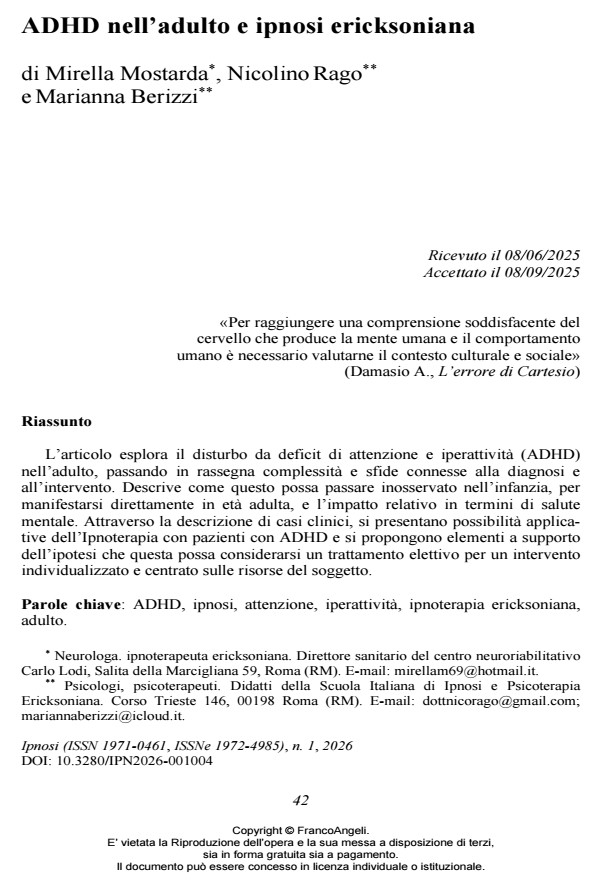
L’articolo esplora il disturbo da deficit di attenzione e iperattività (ADHD) nell’adulto, passando in rassegna complessità e sfide connesse alla diagnosi e all’intervento. Descrive come questo possa passare inosservato nell’infanzia, per manifestarsi direttamente in età adulta, e l’impatto relativo in termini di salute mentale. Attraverso la descrizione di casi clinici, si presentano possibilità applicative dell’Ipnoterapia con pazienti con ADHD e si propongono elementi a supporto dell’ipotesi che questa possa considerarsi un trattamento elettivo per un intervento individualizzato e centrato sulle risorse del soggetto.
Parole chiave:ADHD, ipnosi, attenzione, iperattività, ipnoterapia ericksoniana, adulto.
- Amir R. (2005). Attention and hypnosis: neural substrates and genetic associations of two converging processes. Journal of Clinical and Experimental Hypnosis, 53(3): 237-258. DOI: 10.1080/00207140590961295
- Anju S., Cora C.B. (2017). Clinical Hypnosis, an Effective Mind–Body Modality for Adolescents with Behavioral and Physical Complaints. Children, 4(4): 19.
- Anthony W.A. (1993). Recovery from mental illness: The guiding vision of the mental health service system in the 1990s. Psychosocial Rehabilitation Journal, 16: 11-23.
- Antshel K.M., Faraone S.V., Gordon M. (2014). Cognitive behavioural treatment outcomes in adolescent ADHD. Journal of Attention Disorders, 18(6). DOI: 10.1177/1087054712443155
- Barabasz A., Barabasz M. (1996a). Neurotherapy and alert hypnosis in the treatment of attention deficit hyperactivity disorder. In Lynn S., Kirsh I., Ruhe J., eds., Casebook of Clinical Hypnosis. Washington, DC: American Psychological Association.
- Barkley R.A. (1990). Attention deficit hyperactivity disorder: a handbook for diagnosis and treatment. New York: Guilford.
- Barkley R.A. (1995). Taking charge of ADHD. New York: Guilford.
- Burte J.M. (1994). Ericksonian Hypnosis, Pharmacotherapy and Cognitive-Behavioural Therapy in the Treatment of ADHD. The Australian journal of clinical hypnotherapy and hypnosis, 15:1.
- Bush G., Franzier J.A., Rauch S.L., Seidman L.J., Whalen P.J., Jenike M.A., Rosen B.R., Biederman L. (1999). Anterior cingulate cortex dysfunction in attention-deficit/hyperactivity disorder revealed by fMRI and the Counting Stroop. Biological Psyichiatry, 45:1542-1552.
- Caldara D., Cerveri G., Landi P., Midili G., Viganò V., a cura di Migliarese G., Venturi V., Levin Reibman Y. e Mencacci C. (2023). ADHD negli adulti, un programma per l’intervento psicoeducativo. Webinar trasmesso in streaming dalla Casa Editrice Erickson, sede di Roma.
- Castellanos F.X., Giedd J.N., Eckburg P., Marsh W.L., Vaituzis A.C., Kaisen D., Hamburger S.D., Rapaport J.L. (1994). Quantitative morphology of the caudate nucleus in attention deficit hyperactivity disorder. American Journal of Psichiatry, 151: 1791-1796.
- Del Castello E., Loriedo C. (1995). Tecniche dirette ed indirette in ipnosi e psicoterapia. Milano: FrancoAngeli.
- DSM-5-TR (2023). Diagnostic and statistical manual of mental disorders, Fifth Edition, Text Revision, American Psychiatric Association.
- Ducci G., (2021), Disturbi del neuro-sviluppo e determinanti psicopatologici ambientali. Ruolo terapeutico dell’ipnosi. In De Benedittis G., Loriedo C., Mammini C, Rago N, a cura di, Trattato di ipnosi. Dai fondamenti teorici alla pratica clinica. Milano: FrancoAngeli.
- Elkins G.R., Barabasz A.F., Council J.R., Spiegel D. (2015). Advancing research and practice: The revised APA division 30 definition of hypnosis. International Journal of Clinical and Experimental Hypnosis, 63: 1-9. DOI: 10.1080/00207144.2014.961870
- Elkins G. (2020). Contemplative practices and hypnosis: emerging perspectives and future directions. International Journal of Clinical and Experimental Hypnosis, 68(2): 139-143. DOI: 10.1080/00207144.2020.1727209
- Emilsson B., Gudjonsson G., Sigurdsson J.F., Baldursson G., Einarsson E. Olafsdottir H., Young S. (2011). Cognitive behaviour therapy in medication-treated adults with ADHD and persistent symptoms: a randomized controlled trial. BMC Psychiatry, 11(116). DOI: 10.1186/1471-244X-11-116
- Faraone S.V. (2015). Attention-deficit/hyperactivity disorder. Nature reviews disease primers, 1:15020. DOI: 10.1016/S0140-6736(05)66915-2
- French B., Daley D., Groom M., Cassidy S. (2023). Risks associated with undiagnosed ADHD and/or Autism: A mixed-method. Journal of Attention Disorders. 27(12): 1393-1410. DOI: 10.1177/10870547231176862
- Goldbeck L., Schmid K. (2003). Effectiveness of autogenic relaxation on children and adolescents with behavioural and emotional problems. Journal of the American Academy of Child & Adolescent Psychiatry, 42(9): 1046-1054. DOI: 10.1097/01.CHI.0000070244.24125.F
- Haley J. (1976). Terapie non comuni. Tecniche ipnotiche e terapia della famiglia. Roma: Astrolabio Ubaldini.
- Hartmann T. (2010). The Edison gene. ADHD and the gift of the hunter child. Rochester: Park Street Press.
- Kooij J. (2021). Adult ADHD. Diagnostic Assessment and Treatment. Switzerland: Springer Nature.
- Low C.B. (1999). Attention deficit hyperactivity disorder: dissociation and adaptation (a theoretical presentation and case study). American Journal of Clinical Hypnosis, 41(3): 253-261. DOI: 10.1080/00029157.1999.10404216
- Martindale C. (1990). Creative imagination and neural activity. In Kunzendorf R., Sheikh A., eds, The psychophysiology of mental imagery: theory, research and application. Amityville, NY: Baywood Publishing.
- Musullulu H. (2025). Evaluating attention deficit and hyperactivity disorder (ADHD): a review of current methods and issues. Frontiers in Psychology. 16:1466088.
- Olendzky N., Elkins G.R., Slonena E., Hung J., Rhodes J (2020). Mindful Hypnotherapy to Reduce Stress and increase mindfulness: a randomized controlled pilot study. International Journal of Clinical Experimental Hypnosis, 68(2): 151-166. DOI: 10.1080/00207144.2020.1722028
- Quay H.C (1998). Attention deficit disorder and the behavioural inhibition system: the relevance of the neuropsychological theory of Jeffrey A: Gray. In Bloomingdale L.M, Sergeant J.A, eds, Attention deficit disorder: criteria, cognition, intervention. New York: Pergamon Press.
- Rafalovich A. (2013), Attention Deficit-Hyperactivity Disorder as the Medicalization of Childhood: Challenges from and for Sociology. Sociology Compass, 7(5): 343-354.
- Ragazzone P. (2011). L’approccio ericksoniano nel trattamento del DDAI. Ipnosi, 2011(2): 39-53.
- Sawni A., Breuner C.C. (2017). Clinical Hypnosis, an effective mind-body modality for adolescents with behavioral and physical complaints. Children, 4(4):19.
- Sieg K., Gaffney G.R., Preston D.F., Helling J.A. (1995). SPECT brain imaging abnormalities in attention deficit hyperactivity disorder. Clinical Nuclear Medicine, 20: 55-60. DOI: 10.1097/00003072-199501000-00014
- Simpkins C.A and Simpkins A.M. (2001). Mindfulness and hypnosis: the power of suggestion to transform experience by M. Yapko. American Journal of Clinical Hypnosis, 55 (2): 199-200. DOI: 10.1080/00029157.2013.686417
- Swanepoel A. (2024). ADHD and ASD are normal biological variations as part of human evolution and are not “disorders”. Clinical Neuropsychiatry, 21(6): 451-454.
- Termine C., Uccello M., Ventriglia L. (2021). ADHD: dall’infanzia alla terza età. Diagnosi e metodi di intervento. Roma: Carocci.
- Watkins J.G. (1971). The affect-bridge: A hypnoanalytic technique. International Journal of Clinical and Experimental Hypnosis, 19(1). DOI: 10.1080/00207147108407148
- Yapko M. (2011). Mindfulness and hypnosis: the power of suggestion to transform experience. New York: Norton & Co.
- Young S. (2020). Females with ADHD: An expert consensus statement taking a lifespan approach providing guidance for the identification and treatment of attention-deficit/ hyperactivity disorder in girls and women. BMC Psychiatry, 20: 404.
Mirella Mostarda, Nicolino Rago, Marianna Berizzi, ADHD nell’adulto e ipnosi ericksoniana in "IPNOSI" 1/2026, pp 42-57, DOI: 10.3280/IPN2026-001004