Storia di un mercato. La commercializzazione nelle campagne medievali (Arona, secoli XI-XV)
Titolo Rivista IMPRESE E STORIA
Autori/Curatori Federico Del Tredici
Anno di pubblicazione 2026 Fascicolo 2024/49
Lingua Italiano Numero pagine 46 P. 39-84 Dimensione file 236 KB
DOI 10.3280/ISTO2024-049003
Il DOI è il codice a barre della proprietà intellettuale: per saperne di più
clicca qui
Qui sotto puoi vedere in anteprima la prima pagina di questo articolo.
Se questo articolo ti interessa, lo puoi acquistare (e scaricare in formato pdf) seguendo le facili indicazioni per acquistare il download credit. Acquista Download Credits per scaricare questo Articolo in formato PDF
FrancoAngeli è membro della Publishers International Linking Association, Inc (PILA), associazione indipendente e non profit per facilitare (attraverso i servizi tecnologici implementati da CrossRef.org) l’accesso degli studiosi ai contenuti digitali nelle pubblicazioni professionali e scientifiche.
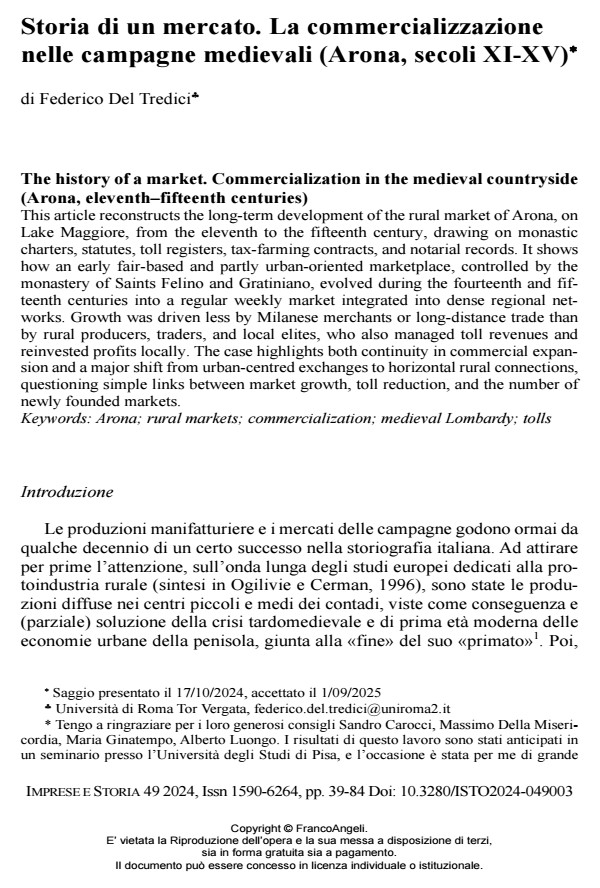
This article reconstructs the long-term development of the rural market of Arona, on Lake Maggiore, from the eleventh to the fifteenth century, drawing on monastic charters, statutes, toll registers, tax-farming contracts, and notarial records. It shows how an early fair-based and partly urban-oriented marketplace, controlled by the monastery of Saints Felino and Gratiniano, evolved during the fourteenth and fifteenth centuries into a regular weekly market integrated into dense regional networks. Growth was driven less by Milanese merchants or long-distance trade than by rural producers, traders, and local elites, who also managed toll revenues and reinvested profits locally. The case highlights both continuity in commercial expansion and a major shift from urban-centred exchanges to horizontal rural connections, questioning simple links between market growth, toll reduction, and the number of newly founded markets.
Parole chiave:Arona; rural markets; commercialization; medieval Lombardy; tolls
- Albini G. (1993). Contadini-artigiani in una comunità bergamasca: Gandino sulla base di un estimo della seconda metà del ’400. Studi di storia medioevale e di diplomatica, 14: 111-192.
- Albuzzi A. (2012). Meda 1252. Arbitrato tra monastero e comune. Milano: EduCatt.
- Andenna G. (1982). Andar per castelli. Da Novara tutto intorno. Torino: Milvia.
- Andenna G. (2023), Vivere per sei mesi in una città “contesa”. Novara nel 1495. In: in Blythe Alice Raviola, Rosso C. e De Franco D., a cura di (2023). Un territorio conteso. Novara e il Novarese tra fonti d'Archivio e storiografia (XVII-XVIII sec.). Roma: Ministero della Cultura. Direzione Generale Archivi.
- Arcangeli L. (2012). Ragioni di stato e ragioni di famiglia: strategie successorie dell’aristocrazia milanese tra Quattro e Cinquecento (Visconti, Trivulzio, Borromeo). Mélanges de l’École Française de Rome. Italie et Méditerranée modernes et contemporaines, 124/2: 447-469.
- Arcangeli L., Battioni G.L., Del Tredici F. e Gentile M., a cura di (2024). Rendite e spese dello Stato di Milano. Il “bilancio” del 1463. Milano: Ledizioni.
- Armocida G. (1988). La peste nera a Cannobio nel 1350. In: Fabularum patria. Angera e il suo territorio nel medioevo. Bologna: Cappelli.
- Arnold R. (2012), Sempione, passo del. In: Dizionario storico della Svizzera (DSS), versione del 19.12.2012 disponibile online: https://hls-dhs-dss.ch/it/articles/008806/2012-12-19/. Consultato il 04.10.2024.
- Beonio Brocchieri V. (2000). «Piazza universale di tutte le professioni del mondo». Famiglie e mestieri nel ducato di Milano in età spagnola. Milano: Unicopli.
- Bertoni L. (2016). Strade e mercati. Itinerari commerciali e normativa daziaria nella Lombardia viscontea. In Medioevo vissuto. Studi per Rinaldo Comba fra Piemonte e Lombardia. Roma: Viella
- Besozzi L. (1995). Il mercato, le fiere, le esenzioni, i dazi e le tasse, 1497-1796. In: La Città di Angera, feudo dei Borromeo, sec. XV-XVIII. Varese: Nicolini.
- Bourin, M., Menant, F. e To Figueras, L. (2014b). Les campagnes européennes avant la Peste : préliminaires historiographiques pour de nouvelles approches méditerranéennes. In: Bourin, M., Menant, F. e To Figueras, L., a cura di (2014a). Dynamiques du monde rural dans la conjoncture de 1300. Échanges, prélèvements et consommation en Méditerranée occidentale. Rome : École française de Rome.
- Bourin, M., Menant, F. e To Figueras, L., a cura di (2014a). Dynamiques du monde rural dans la conjoncture de 1300. Échanges, prélèvements et consommation en Méditerranée occidentale. Rome : École française de Rome.
- Braunstein P., a cura di (2001). La sidérurgie alpine en Italie (XIIe-XVIIe siècle). Roma: École française de Rome.
- Britnell R.H. (1993). The Commercialisation of English Society, 1000-1500. Cambridge: Cambridge University Press.
- Broadberry S., Campbell B.M.S, Klein A., Overton M. e van Leeuwen B. (2015). British Economic Growth, 1270–1870. Cambridge: Cambridge University Press.
- Carocci S. (2016). Il dibattito teorico sulla “congiuntura del Trecento”. Archeologia medievale, 43: 17-32.
- Cavallera M. (1995). Angera nella vita economica del Verbano. In: La Città di Angera, feudo dei Borromeo, sec. XV-XVIII. Varese: Nicolini.
- Cherubini G. (1996). Foires et marchés dans les campagnes italiennes au Moyen Âge. In: Desplat C., a cura di (1996). Foires et marchés dans les Campagnes de l’Europe médiévale et moderne. Toulouse: Presses universitaires du Midi.
- Chittolini G. (2007). Note sugli “spazi lacuali” nell'organizzazione territoriale lombarda alla fine del Medioevo. In: Chittolini G., Petti Balbi G. e Vitolo G., a cura di (2007). Città e territori nell’Italia del Medioevo. Studi in onore di Gabriella Rossetti. Napoli: Liguori
- Comba R. (1988). Contadini, signori e mercanti nel Piemonte medievale. Roma-Bari: Laterza.
- Corritore R.P. (1993). Il processo di 'ruralizzazione' in Italia nei secoli XVII-XVIII. Verso una regionalizzazione. Rivista di storia economica, n.s. 10: 353-386.
- d’Arcangelo P. (2024), La transumanza in area lombarda tra medioevo ed età moderna (secoli XV-XVI). In: Besana C., Corti M., e Mocarelli L., a cura di (2024). Transumanze. La mobilità dell’allevamento bovino in Lombardia e in altre regioni alpine (secc. XIV-XX). Milano: FrancoAngeli.
- De Maddalena A. (1983). Dalla città al borgo. Avvio di una metamorfosi economica e sociale nella Lombardia spagnola. Milano: FrancoAngeli.
- Del Tredici, F. (2012). Maestri per il contado. Istruzione primaria e società locale nelle campagne milanesi (secolo XV). In: Covini M.N., Della Misericordia M., Gamberini A. e Somaini F., a cura di (2012). Medioevo dei poteri. Studi di storia per Giorgio Chittolini. Roma: Viella.
- Del Tredici F. (2013). Comunità, nobili e gentiluomini nel contado di Milano del Quattrocento. Milano: Unicopli.
- Del Tredici F. (2015). Il partito dello stato. Crisi e ricostruzione del ducato visconteo nelle vicende di Milano e del suo contado (1402-1417). In: Cengarle F., Covini M.N., a cura di (2015). Il ducato di Filippo Maria Visconti, 1412-1447. Economia, politica, cultura. Firenze: Firenze University Press.
- Del Tredici F. (2017). Un’altra nobiltà. Storie di (in)distinzione a Milano. Secoli XIV-XV. Milano: FrancoAngeli.
- Del Tredici F. (2018). Separazione, subordinazione e altro. I borghi della montagna e dell’alta pianura lombarda nel tardo medioevo. In: Lattanzio F. e Varanini G. M., a cura di (2018). I centri minori italiani nel Tardo medioevo. Cambiamento sociale, crescita economica, processi di ristrutturazione (secoli XIII-XVI). Firenze: FUP.
- Del Tredici F. (2019a). Il profilo economico della signoria lombarda. Il caso dei Visconti e quello dei Borromeo (secoli XIV-XV). In: Gamberini A. e Pagnoni F., a cura di (2019). La signoria rurale nell'Italia del tardo medioevo. 1. Gli spazi economici. Milano: Bruno Mondadori.
- Del Tredici F. (2019b). Percorsi economici e forme politiche della Lombardia viscontea, prima e dopo la crisi di inizio Quattrocento. In Collavini S. e Petralia G., a cura di (2019). La mobilità sociale nel Medioevo italiano. 4. Cambiamento economico e dinamiche sociali (XI-XV secolo). Roma: Viella.
- Del Tredici F. (2020a). Alla ricerca del proprius sacerdos. Giuspatronati popolari e forza delle comunità (Milano e contado, secoli 14.-15.). In: Zuliani F., a cura di (2020). Una nuova frontiera al centro dell'Europa. Le Alpi e la dorsale cattolica (sec. XV-XVIII). Milano: FrancoAngeli.
- Del Tredici F. (2020b). Visconti, Gaspare. In Dizionario Biografico degli Italiani, XCIX. Roma: Istituto dell'Enciclopedia italiana.
- Del Tredici F. (2021). Borromeo. In Del Tredici F., a cura di (2021). La signoria rurale nell’Italia del tardo medioevo. Roma: Universitalia.
- Del Tredici F. (2024). Castelli, chiese, mutazione signorile e crescita economica. Milano e il suo territorio nei secoli XI-XII. Reti medievali rivista, 25 /1: 7-54.
- Della Misericordia M. (2006). Divenire comunità. Comuni rurali, poteri locali, identità sociali e territoriali in Valtellina e nella montagna lombarda nel tardo Medioevo. Milano: Unicopli.
- Della Misericordia M. (2013). I confini dei mercati. Territori, istituzioni locali e spazi economici nella montagna lombarda del tardo medioevo. Morbegno: Ad Fontes.
- Desplat C., a cura di (1996). Foires et marchés dans les Campagnes de l’Europe médiévale et moderne. Toulouse: Presses universitaires du Midi.
- Dijkman J. (2011). Shaping Medieval Markets. The Organisation of Commodity Markets in Holland, c. 1200-c. 1450. Leiden: Brill.
- Drendel J., a cura di (2015). Crisis in the Later Middle Ages. Beyond the Postan-Duby Paradigm. Turnhout: Brepols.
- Dyer C. (2005). An Age of Transition? Economy and Society in England in the Later Middle Ages. Oxford: Oxford University Press.
- Epstein S. (1993). Manifatture tessili e strutture politico-istituzionali nella Lombardia tardo-medievale. Ipotesi di ricerca. Studi di storia medioevale e di diplomatica, 14: 55-89.
- Epstein S.R. (2000). Freedom and Growth. The Rise of States and Markets in Europe, 1300-1750. London, New York: Routledge.
- Fantoni G. (1990), L'acqua a Milano. Uso e gestione nel Basso Medioevo, 1385-1535. Bologna: Cappelli.
- Fiore A. (2017). Il mutamento signorile. Assetti di potere e comunicazione politica nelle campagne dell'Italia centro-settentrionale (1080-1130 c.). Firenze: Firenze University Press.
- Fiore A. e Poloni A. (2024). L’economia medievale. Un profilo storico (secoli V-XV). Roma: Carocci.
- Franceschi F. et alii (2017). La crescita economica dell’Occidente medievale. Un tema storico non ancora esaurito. Roma: Viella.
- Frangioni L. (1983). Milano e le sue strade. Costi di trasporto e vie di commercio dei prodotti milanesi alla fine del Trecento. Bologna: Cappelli.
- Frigerio P., a cura di (1998). Arona porta da entrare in Lombardia… Tra medioevo ed età moderna. Verbani-Intra: Alberti.
- Ghosh S. (2020). Rural Commercialization in Southern Germany, c.1200–c.1500: Sources, Problems, and Potential. Medieval Studies, 82: 207–74.
- Ginatempo M.A. (2018). La popolazione dei centri minori dell’Italia centrosettentrionale nei secoli XIII-XV. Uno sguardo d’insieme. In: Lattanzio F. e Varanini G. M., a cura di (2018). I centri minori italiani nel Tardo medioevo. Cambiamento sociale, crescita economica, processi di ristrutturazione (secoli XIII-XVI). Firenze: FUP.
- Ginatempo, M.A. (2023). Oltre la frammentazione: spazi fiscali ed economici nell’Italia tardomedievale: Introduzione. I Quaderni Del m.æ.S. - Journal of Mediæ Ætatis Sodalicium, 21: 1-13.
- Grillo P. (1995). Le strutture di un borgo medievale. Torno, centro manifatturiero nella Lombardia viscontea. Firenze: La nuova Italia.
- Lattanzio F. e Varanini G.M., a cura di (2018). I centri minori italiani nel Tardo medioevo. Cambiamento sociale, crescita economica, processi di ristrutturazione (secoli XIII-XVI). Firenze: FUP.
- Leggero R. (1998). Arona. In Schedario storico-territoriale dei comuni piemontesi: https://www.archiviocasalis.it
- Lucioni A. (1994). Arona e gli esordi del monastero dei SS. Felino e Gratiniano (secoli X-XII). In: Frigerio P., a cura di (1994). Arona porta da entrare in Lombardia… tra Medioevo ed età moderna. Verbania-Intra: Alberti.
- Luongo A. (2022). La Peste Nera. Contagio, crisi e nuovi equilibri nell’Italia del Trecento. Roma: Carocci.
- Lusso E. (2020). Legno e mattone. Consistenza edilizia e immagine degli insediamenti subalpini nei secoli XIII-XV. In: Basso E., Bernardi P. e Pinto G., a cura di (2020). Le pietre delle città medievali. Materiali, uomini, tecniche (area mediterranea, secc. XIII-XV). Les pierres des villes médiévales. Matériaux, hommes, techni-ques (aire méditerranéenne, XIIIe-XVe siècles). Cherasco: Centro Internazionale di Studi sugli Insediamenti Medievali.
- Mainoni P. (1975). Un mercante milanese del primo Quattrocento: Marco Serranieri. Nuova rivista storica, 59: 331-377.
- Mainoni P. (1994). Economia e politica nella Lombardia medievale. Da Bergamo a Milano fra XIII e XV secolo. Cavallermaggiore: Gribaudo.
- Mainoni P. (2004). Attraverso i valichi svizzeri: merci oltremontane e mercati lombardi. In: Varanini G.M. (2004), a cura di. Le Alpi medievali nello sviluppo delle regioni contermini. Napoli: Liguori.
- Mainoni P. (2012). Per una storia di Lecco in età viscontea, In: Guzzi C., Mainoni P. e Zelioli Pini F., a cura di (2012). Lecco viscontea. Gli atti dei notai di Lecco e del suo territorio (1343-1409). Oggiono- Lecco: Cattaneo Editore.
- Mainoni P. (2019). Finanza e fiscalità nella prima metà del Trecento. In Grillo P. e Menant F., a cura di (2019). La congiuntura del primo Trecento in Lombardia (1290-1360). Roma: École française de Rome.
- Malanima P. (1998). La fine del primato. Crisi e riconversione nell'Italia del Seicento. Milano: Bruno Mondadori.
- Manni C., a cura di (2001). Arona nella storia. Novara: Interlinea.
- Masschaele J. (1997). Peasants, Merchants, and Markets. Inland Trade in Medieval England, 1150-1350. New York: Palgrave Macmillan.
- Medoni F. (1844). Memorie storiche di Arona e del suo castello. Novara: Tipografia Pietro Ibertis.
- Mira G. (1955). Le fiere lombarde nei secoli XIV-XVI. Prime indagini. Como: Centro lariano per gli studi economici.
- Moioli A. (1986), La deindustrializzazione della Lombardia nel secolo XVII. Archivio storico lombardo, 112: 167-203.
- Molinari A., a cura di (2010). Mondi rurali d’Italia: insediamenti, struttura sociale, economia. Secoli X-XIII. Sesto Fiorentino: All’Insegna del Gliglio [Archeologia medievale, 37, numero monografico].
- Molinari, A. e Orecchioni P. (2017). La dinamica dei consumi attraverso le fonti archeologiche. Secoli VIII-XV. In: Franceschi et alii (2017). La crescita economica dell’occidente medievale. Un tema storico non ancora esaurito.
- Montanari M. (2003). I borghi nuovi come fulcri dell’espansione commerciale urbana: il caso di Novara (secc. XII-XIII). In: Bordone R., a cura di (2003). Le villenove nell’Italia comunale. Progetti di governo territoriale nel riordino dell’insediamento rurale. Carmagnola: Musso.
- Morenzoni F. (2004). La via del Vallese e il commercio internazionale e regionale alla fine del Medioevo. In: Varanini G.M. (2004), a cura di. Le Alpi medievali nello sviluppo delle regioni contermini. Napoli: Liguori.
- Morra D. e Vidal T., a cura di, (2023). Oltre la frammentazione: spazi fiscali ed economici nell'Italia tardomedievale. Sezione monografica di I Quaderni Del m.æ.S. - Journal of Mediæ Ætatis Sodalicium, 21: 1-109.
- Noto A., a cura di (1950). Liber datii mercantie communis Mediolani. Registro del secolo XV. Milano: Università L. Bocconi.
- Ogilvie S. e Cerman M., a cura di (1996). European Proto-Industrialization. An Introductory Handbook. Cambridge: Cambridge University Press.
- Orecchioni P. (2022). Dopo la peste. Consumi ceramici e standard di vita in Toscana e in Inghilterra tra Due e Quattrocento. Sesto Fiorentino: All’Insegna del Giglio.
- Pensotti R. (1996). Uno sguardo all’economia del primo Quattrocento in Valsassina dagli atti del notaio Pastore della Chiesa. Archivi di Lecco, 19/2: 92-126.
- Perelli Cippo R. (1988). Note sul patrimonio dell'abbazia dei SS. Felino e Gratiniano di Arona nei secoli XI-XIII. In: Fabularum Patria. Angera e il suo territorio nel medioevo. Bologna: Cappelli.
- Petralia G. (2018). I centri minori italiani nel tardo medioevo: aspetti storiografici e problemi di metodo. In: Lattanzio F. e Varanini G.M., a cura di (2018). I centri minori italiani nel Tardo medioevo. Cambiamento sociale, crescita economica, processi di ristrutturazione (secoli XIII-XVI). Firenze: FUP.
- Pirovano F. (1994). La signoria del monastero di Arona nel XIV secolo. In: Frigerio P., a cura di (1994). Arona porta da entrare in Lombardia… tra Medioevo ed età moderna. Verbania-Intra: Alberti.
- Pisoni P.G. (1988). 1497-1499: «la cossa de Angera». In: Fabularum patria. Angera e il suo territorio nel medioevo. Bologna: Cappelli.
- Rao R. (2020). Lombard Alps. In: Smail D.L., Pizzorno G.H. e Morreale L., a cura di, The Documentary Archaeology of Late Medieval Europe. http://dalme.org/collections/lombard-alps/.
- Rao R. (2022). Fucine, ferrari e lavorazione del ferro nella Valtellina del basso medioevo. In: De Vingo P., a cura di, Le radici della terra. Le miniere orobiche valtellinesi da risorsa economica a patrimonio culturale delle comunità tra medioevo ed età contemporanea. Milano: FrancoAngeli.
- Sella D (1982). L’economia lombarda durante la dominazione spagnola. Bologna: il Mulino.
- Sergi G. (1978). Castello, da. In: Dizionario Biografico degli Italiani, XXI. Roma: Istituto della Enciclopedia Italiana.
- Settia A.A. (1993). «Per foros Italiae». Le aree extraurbane fra Alpi e Appennini. In Mercati e mercanti nell’alto medioevo. L’area euroasiatica e l’area mediterranea. Spoleto: Centro studi sull’alto medioevo.
- Soldi Rondinini G. (1978). Le vie transalpine del commercio milanese dal sec. XIII al XV. In: «Felix olim Lombardia». Studi di storia padana in onore di Giuseppe Martini. Alessandria: Tipografia Ferraris.
- Tallone A. e Borello L., a cura di (1927). Le carte dell'Archivio comunale di Biella fino al 1379. Voghera: Gabetta.
- Tamborini M. (1988), Castrum de Angleria de subtus: attorno ad un’altra fortificazione di Angera medievale. In: Fabularum patria. Angera e il suo territorio nel medioevo. Bologna: Cappelli.
- Tonelli G. (2008), La Lombardia spagnola nel XVII secolo. Studi di storia economica dopo Sella. Mediterranea. Ricerche storiche, 5: 401-416.
- Wickham C., How did the Feudal Economy Work? the Economic Logic of Medieval Societies. Past & Present, 251/1: 3-40.
- Wickham C. (2023). The Donkey and the Boat. Reinterpreting the Mediterranean economy, 950-1180. New York: Oxford University.
- Zanoboni M.P. (1996). Il commercio di legname e laterizi lungo il Naviglio Grande nella seconda metà del Quattrocento, Nuova Rivista Storica, 80: 75-118.
- Zapperi R. (1971). Botta, Leonardo. In Dizionario biografico degli italiani, XIII. Roma: Istituto della Enciclopedia Italiana.
Federico Del Tredici, Storia di un mercato. La commercializzazione nelle campagne medievali (Arona, secoli XI-XV) in "IMPRESE E STORIA" 49/2024, pp 39-84, DOI: 10.3280/ISTO2024-049003