Centro o periferia? Schio e la Pedemontana vicentina tra medioevo ed età moderna (XV-XVIII sec.)
Titolo Rivista IMPRESE E STORIA
Autori/Curatori Edoardo Demo, Giulio Ongaro
Anno di pubblicazione 2026 Fascicolo 2024/49
Lingua Italiano Numero pagine 50 P. 85-134 Dimensione file 619 KB
DOI 10.3280/ISTO2024-049004
Il DOI è il codice a barre della proprietà intellettuale: per saperne di più
clicca qui
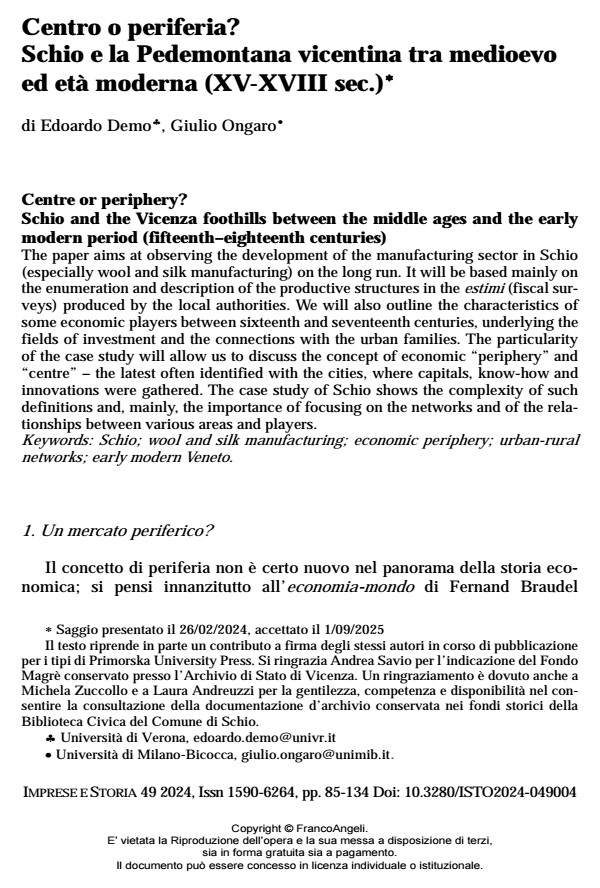
Qui sotto puoi vedere in anteprima la prima pagina di questo articolo.
Se questo articolo ti interessa, lo puoi acquistare (e scaricare in formato pdf) seguendo le facili indicazioni per acquistare il download credit. Acquista Download Credits per scaricare questo Articolo in formato PDF
FrancoAngeli è membro della Publishers International Linking Association, Inc (PILA), associazione indipendente e non profit per facilitare (attraverso i servizi tecnologici implementati da CrossRef.org) l’accesso degli studiosi ai contenuti digitali nelle pubblicazioni professionali e scientifiche.
The paper aims at observing the development of the manufacturing sector in Schio (especially wool and silk manufacturing) on the long run. It will be based mainly on the enumeration and description of the productive structures in the estimi (fiscal surveys) produced by the local authorities. We will also outline the characteristics of some economic players between sixteenth and seventeenth centuries, underlying the fields of investment and the connections with the urban families. The particularity of the case study will allow us to discuss the concept of economic “periphery” and “centre” – the latest often identified with the cities, where capitals, know-how and innovations were gathered. The case study of Schio shows the complexity of such definitions and, mainly, the importance of focusing on the networks and of the relationships between various areas and players.
Parole chiave:Schio; wool and silk manufacturing; economic periphery; urban-rural networks; early modern Veneto.
- Alfani, G. (2010). Il Grand Tour dei Cavalieri dell’Apocalisse. L’Italia del «lungo Cinquecento» (1494-1629). Venezia: Marsilio.
- Alfani, G., e Di Tullio, M. (2019). The Lion’s Share. Inequality and the Rise of the Fiscal State in Preindustrial Europe. Cambridge: Cambridge University Press.
- Bairoch, P., Batou, J. e Chèvre, P. (1988). La population des villes européennes de 800 à 1850. Ginevra: Librairie Droz.
- Belfanti, C. M. (2013). Des industries rurales aux districts industriels? In: Minovez, J., Verna, C. e Hilaire-Pérez, L., a cura di, Les industries rurales dans l’Europe médiévale et moderne. Tolouse: Presses Universitaires du Midi.
- Bertoli, P. e Ghiotto, E. (1985). La fabbrica di panni alti di Nicolò Tron a Schio. Note di storia e archeologia industriale. Pievebelvicino: Satigraf.
- Bianchi, F. e Demo, E. (2014). Economia, demografia, società. In: Gullino, G., a cura di, Storia di Vicenza dalla preistoria all’età contemporanea. Verona: Cierre, pp. 97-114.
- Bianchi, F. e Panciera, W., a cura di (2018). «Bellissimo per le doti della natura e per l’industria umana». Immagini e descrizioni del territorio vicentino tra medioevo ed età moderna. Roma: Viella.
- Braudel, F. (1977). La dinamica del capitalismo. Bologna: Il Mulino.
- Caizzi, B. (1965). Industria e commercio della Repubblica Veneta nel XVIII secolo. Milano: Banca Commerciale Italiana.
- Cazzola, F. (1996). Terre senza foreste: zone umide, pinete costiere e piantate di alberi nell’economia agraria nella bassa valle del Po (secoli XV-XVIII). In Cavaciocchi, S., a cura di, L’uomo e la foresta secc. XIII-XVIII. Firenze: Le Monnier, pp. 971-988.
- Chittolini, G. (1990). "Quasi-città". Borghi e terre in area lombarda nel tardo medioevo. Società e Storia, 47: 3-26.
- Ciriacono, S. (1983). Protoindustria, lavoro a domicilio e sviluppo economico nelle campagne venete in epoca moderna. Quaderni Storici, 52: 57-80.
- Ciriacono, S. (1997). L’industrializzazione vicentina nel contesto europeo (XVII-XIX secolo). In: Fontana, G. L., a cura di, Le vie dell'industrializzazione europea. Sistemi a confronto. Bologna: Il Mulino, pp. 77-97.
- Corazzol, G. (1979). Fitti e livelli a grano. Un aspetto del credito rurale nel Veneto del '500. Milano: Franco Angeli.
- Corritore, R. P. (1993). Il processo di “ruralizzazione” in Italia nei secoli XVII-XVIII. Verso una regionalizzazione. Rivista di Storia Economica, 10/3: 353-386.
- De Vries, J. (1984). European urbanization 1500-1800. Londra: Methuen.
- Delille, G. (1990). La famiglia contadina nell’Italia moderna. In: Bevilacqua, P., a cura di, Storia dell’agricoltura italiana in età contemporanea. Vol. 2, Uomini e classi. Venezia: Marsilio, pp. 507-534.
- Demo, E. (2001). L’«anima della città». L’industria tessile a Verona e Vicenza (1400-1550). Milano: Unicopli.
- Demo, E. (2001 b). Mercati e manifatture nel Veneto tardomedievale. Reti Medievali Rivista, II: 1-10.
- Demo, E. (2004). Le manifatture tra Medioevo ed Età Moderna. In: Fontana, G. L., a cura di, L’industria vicentina dal Medioevo a oggi. Padova: Cluep, pp. 21-126.
- Demo, E. (2012). Mercanti di terraferma. Uomini, merci e capitali nell’Europa del Cinquecento. Milano: Franco Angeli.
- Demo, E. (2013). Manifattura vs. agricoltura: la difficile gestione delle acque nella Pedemontana veneta della prima età moderna. In: Mocarelli, L., a cura di, Quando manca il pane. Origini e cause della scarsità delle risorse alimentari in età moderna e contemporanea. Bologna: Il Mulino, pp. 19-33.
- Demo, E. e Ongaro, G. (2023). Rural merchants in the Early Modern Republic of Venice. Business History (on-line).
- Demo, E. e Vianello, F. (2011). Manifatture e commerci nella Terraferma veneta in età moderna. Archivio Veneto, 142: 27-50.
- Di Tullio, M. e Ongaro, G. (2020). Gaining power. Rural élites in northern Italy during the early modern period. The Journal of European Economic History, 1: 75-109.
- Faggion, L. (2017). Il notaio di vicariato nel territorio vicentino nella prima età moderna. In: Demo, E. e Savio, A., a cura di, Uomini del contado e uomini di città nell’Italia settentrionale del XVI secolo. Atti del convegno internazionale di storia, arte e architettura. Palermo: New Digital Frontiers, pp. 39-60.
- Ferrarese, A. (2008). Il territorio vicentino nel Cinquecento: contesti agrari e assetti protoindustriali. In: Barbieri, F., a cura di, Palladio 1508-2008. Il simposio del Cinquecentenario. Venezia: Marsilio, pp. 288-291.
- Fontana, G. L. (1985). L’industria laniera scledense da Niccolò Tron ad Alessandro Rossi. In: Fontana, G. L., a cura di, Schio e Alessandro Rossi. Imprenditorialità, politica, cultura e paesaggi sociali del secondo Ottocento. Roma: Edizioni di Storia e Letteratura, pp. 71-256.
- Fontana, G. L. (a cura di) (1986). Schio e Alessandro Rossi. Imprenditorialità, politica, cultura e paesaggi sociali del secondo Ottocento (vol. 2). Roma: Edizioni di Storia e Letteratura.
- Fontana, G. L. (1993). Mercanti, pionieri e capitani d’industria. Imprenditori e imprese nel Vicentino tra ‘700 e ‘900. Vicenza: Neri Pozza.
- Glückler, J., Shearmur, R. e Martinus, K. (2023). Liability or opportunity? Reconceptualizing the periphery and its role in innovation. Journal of Economic Geography, 23: 231-249.
- Grubb, J. S. (1984). L’economia rurale e gli estimi del territorio di Vicenza (1519-1606). Annali Veneti, 1/1: 97-109.
- Knpaton, M. (2010). Le campagne trevigiane: i frutti di una ricerca. Società e Storia, 130: 771-800.
- Lanaro, P., a cura di (2006). At the Centre of the Old World. Trade and Manufacturing in Venice and in the Venetian Mainland, 1400-1800. Toronto: Centre for Reformation and Renaissance Studies.
- Ludwig, K. e Vergani R. (1994). Mobilität und Migrationem der Bergleute vom 13. bis zum 17. Zahrhundert/Mobilità e migrazioni dei minatori (XIII-XVII secolo). In: Cavaciocchi, S., a cura di, Le migrazioni in Europa (secc. XIII-XVIII): atti della venticinquesima Settimana di studi, 3-8 maggio 1993. Bagno a Ripoli: Le Monnier, pp. 611-622.
- Malanima, P. (1998). Italian Cities 1300-1800. A quantitative approach. Rivista di Storia Economica, XIV/2: 91-126.
- Mantese, G. (1969). Storia di Schio. Schio: Comune di Schio.
- Migliavacca, M. (2021). Il paesaggio minerario alto-vicentino: una riconsiderazione. In: Magnini, L., Bettineschi, C. e Burigana, L., a cura di, Traces of complexity. Studi in onore di Armando de Guio. Mantova: SAP – Società Archeologica, pp. 69-79.
- Minovez, J., Verna, C. e Hilaire-Pérez, L. (2013). L’industrie des campagnes: retrouver la longue durée. In: Minovez, J., Verna, C. e Hilaire-Pérez, L., a cura di, Les industries rurales dans l’Europe médiévale et moderne. Tolouse: Presses Universitaires du Midi.
- Mocarelli, L., Ongaro, G. e Tedeschi, P. (2021). The 19th century in the Lombard Alps: The unfulfilled promise of industrialization. Journal of Agrarian Change, 21/3: 545-561.
- Ongaro, G. (2008). Località minori, centri urbani e Venezia dagli albori del Dominium Veneciarum alla metà del XVI secolo: il caso di Schio nell’ambito del Vincentini districtus. Tesi di laurea, Università Ca’ Foscari di Venezia, Relatore Prof. Sergio Zamperetti.
- Ongaro, G. (2011). “Pro bono et utilitate Comunis Scledi” Equilibri familiari e magistrature Comunali a Schio tra il XV e il XVI secolo. Tesi di laurea, Università Ca’ Foscari di Venezia, Relatore Prof. Sergio Zamperetti.
- Ongaro, G. (2017). Storia economica delle campagne venete in etá moderna: nuove prospettive di ricerca. Archivio Veneto, 14: 67-87
- Ongaro, G. (2020). Famiglia, agricoltura e manifattura nel Vicentino di età moderna. In: Samoggia, A. e Scalone, F., a cura di, La famiglia tra mutamenti demografici e sociali. Udine: Forum, pp. 55-66.
- Ongaro, G. (2021). Maize diffusion in the Republic of Venice: the case of the Province of Vicenza (sixteenth-eighteenth century). In: Mocarelli, L. e Panjek, A., a cura di, Maize to the People! Cultivation, Consumption and Trade in the North-Eastern Mediterranean (Sixteenth-Nineteenth Century). Koper: University of Primorska Press, pp. 25-45.
- Panciera, W. (1985). Articolazione della produzione e livelli tecnologici delle manifatture laniere di Schio nella seconda metà del XVIII secolo. Quaderni Storici, 59: 403 – 426.
- Panciera, W. (1988). I lanifici dell’alto Vicentino nel XVIII secolo. Vicenza: Stocchiero.
- Panciera, W. (1996). L'Arte matrice. I lanifici della Repubblica di Venezia nei secoli XVII e XVIII. Treviso: Canova Editore.
- Panciera, W. (1997). Il distretto tessile vicentino (secc. XVII-XVIII). In: Fontana, G. L., a cura di, Le vie dell'industrializzazione europea. Sistemi a confronto. Bologna: Il Mulino, pp. 477 – 494.
- Panciera, W. (2004). La formazione delle specializzazioni economiche territoriali nel Sei e Settecento. In: Fontana, G. L., a cura di, L'industria vicentina dal Medioevo a oggi. Padova: CLEUP, pp. 231-346.
- Panciera, W. (2014). L’età moderna. In: Gullino, G., a cura di, Storia di Vicenza dalla preistoria all’età contemporanea. Verona: Cierre, pp. 121-170.
- Panciera, W. (2017). Le attività manifatturiere del Vicentino nel XVI secolo. In: Demo, E. e Savio, A., a cura di, Uomini del contado e uomini di città nell'Italia settentrionale del XVI secolo. Palermo: New Digital Frontiers, pp. 207-227
- Panjek, A., Larsson, J. e Mocarelli, L., a cura di (2017). Integrated Peasant Economy in a Comparative Perspective. Alps, Scandinavia, and Beyond. Koper: University of Primorska Press.
- Pezzolo, L. (2011). La storia agraria veneta: risultati, ipotesi, prospettive. Archivio Veneto, 1/a. CXLII: 79-110.
- Poni, C. (2009). La seta in Italia. Una grande industria prima della rivoluzione industriale. Bologna: Il Mulino.
- Pugh, R. e Dubois, A. (2021). Peripheries within economic geography: Four “problems” and the road ahead of us. Journal of Rural Studies, 87: 267-275.
- Ramella, F. (1997). Protoindustria e regole del gioco: l’area laniera di Biella in una prospettiva comparativa. In: Fontana, G. L., a cura di, Le vie dell'industrializzazione europea. Sistemi a confronto. Bologna: Il Mulino, pp. 923-935.
- Roverato, G. (1997). La crescita di una «periferia» industriale: il Vicentino nel caso veneto. In: Fontana, G. L., a cura di, Le vie dell'industrializzazione europea. Sistemi a confronto. Bologna: Il Mulino, pp. 539-558.
- Saccardo, A. (2002). L’utilizzo delle acque a Valli del Pasubio nell’epoca dell’Antico Regime. Acque e Acque della Valleogra. Sentieri culturali, 2: 215-232.
- Savio, A. (2017). Rogge di sangue in una “quasi città” del Cinquecento. I mercanti scledensi promotori del Corpo Territoriale vicentino. In: Demo, E. e Savio, A., a cura di, Uomini del contado e uomini di città nell’Italia settentrionale del XVI secolo. Atti del convegno internazionale di storia, arte e architettura. Palermo: New Digital Frontiers, pp. 305-328.
- Sereni, E. (1982). Storia del paesaggio agrario italiano. Roma-Bari: Laterza.
- Sheppard, E. (2002). The Space and Time of Globalization: Place, Scale, Networks, and Positionality. Economic Geography, 78/3, 307-330.
- Snichelotto, P. (2007). «Voglio che sii erretto un hospitale qui in Schio». L’ospedale Baratto dalle origini al primo ‘900. Vol. II de L’archivio svelato. Il convento di San Francesco e gli ospedali nella società scledense tra XV e XX secolo. Schio: Centrostampa.
- Snichelotto, P. e Mastrovita, F. (2002). Magli di ferro in Val Leogra: Santorso, San Vito di Leguzzano, Schio, Torrebelvicino, Valli del Pasubio. Il sistema-maglio. Tecnologia e appunti storici. Acque e Acque della Valleogra. Sentieri culturali, 2: 111-158.
- Valseriati, E. (2018). Descrizioni, cronache, diari di viaggio: le testimonianze scritte. In: Bianchi F. e Panciera, W., a cura di, «Bellissimo per le doti della natura e per l’industria umana». Immagini e descrizioni del territorio vicentino tra medioevo ed età moderna. Roma: Viella, pp. 51-106.
- Vergani, R. (1997). Industria rurale, protoindustria o industria ante litteram? L’argento alto-vicentino tra Quattro e Cinquecento. In: Fontana, G. L., a cura di, Le vie dell'industrializzazione europea. Sistemi a confronto. Bologna: Il Mulino, pp. 467-476.
- Vergani, R. (2003). Lavoro e lavoratori nelle miniere venete dei secoli XV e XVI. In: Vergani, R., a cura di, Miniere e società nella montagna del passato. Alpi venete, secoli XIII-XIX. Sommacampagna: Cierre, pp. 121-136.
- Vianello, F. (2004). Seta fine e panni grossi. Manifatture e commerci nel Vicentino 1570-1700. Milano: Franco Angeli.
- Vianello, F. (2004b). Mercanti, imprese e commerci nel Cinque e Seicento. In: Fontana, G. L., a cura di, L'industria vicentina dal Medioevo a oggi. Padova: CLEUP, pp. 188-225.
- Wallerstein, I. (1974). The modern world-system I. Capitalist agriculture and the origins of the European world-economy in the sixteenth century. New York: Academic Press.
- Wallerstein, I. (1980). The Modern World-System, vol. II: Mercantilism and the Consolidation of the European World-Economy, 1600-1750. New York: Academic Press.
- Zannini, A. (2010). Sempre più agricola, sempre più regionale. L’economia della Repubblica di Venezia da Agnadello al Lombardo-Veneto (1509-1817). Ateneo Veneto, 9/1: 137-172.
Edoardo Demo, Giulio Ongaro, Centro o periferia? Schio e la Pedemontana vicentina tra medioevo ed età moderna (XV-XVIII sec.) in "IMPRESE E STORIA" 49/2024, pp 85-134, DOI: 10.3280/ISTO2024-049004