I frame di contrasto al cambiamento climatico nella narrazione televisiva di un disastro naturale: il caso dell’alluvione in Emilia-Romagna
Titolo Rivista SOCIOLOGIA DELLA COMUNICAZIONE
Autori/Curatori Cecilia Biancalana, Riccardo Ladini , Daria Loreti, Guido Legnante
Anno di pubblicazione 2026 Fascicolo 2026/71
Lingua Italiano Numero pagine 21 P. 46-66 Dimensione file 160 KB
DOI 10.3280/SC2026-071003
Il DOI è il codice a barre della proprietà intellettuale: per saperne di più
clicca qui
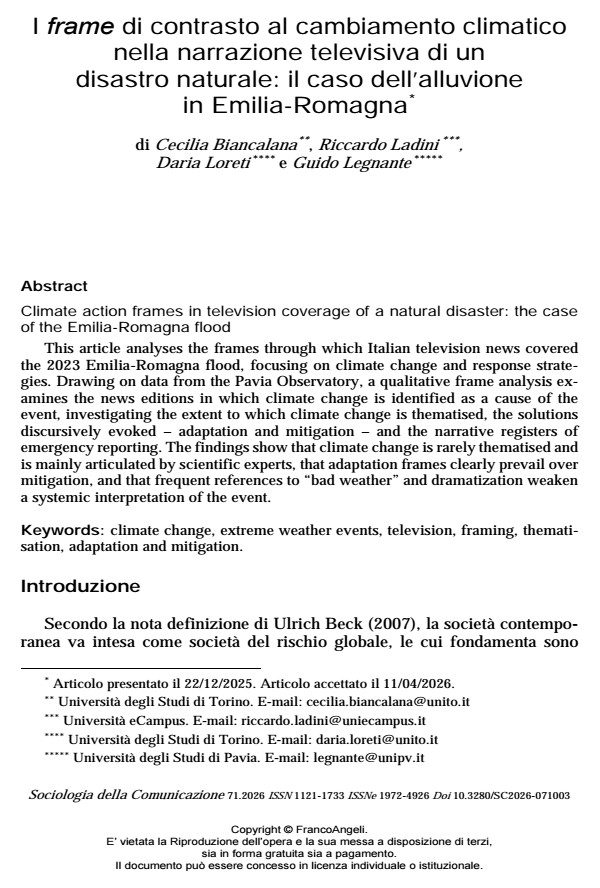
Qui sotto puoi vedere in anteprima la prima pagina di questo articolo.
Se questo articolo ti interessa, lo puoi acquistare (e scaricare in formato pdf) seguendo le facili indicazioni per acquistare il download credit. Acquista Download Credits per scaricare questo Articolo in formato PDF
FrancoAngeli è membro della Publishers International Linking Association, Inc (PILA), associazione indipendente e non profit per facilitare (attraverso i servizi tecnologici implementati da CrossRef.org) l’accesso degli studiosi ai contenuti digitali nelle pubblicazioni professionali e scientifiche.
Climate action frames in television coverage of a natural disaster: the case of the Emilia-Romagna flood This article analyses the frames through which Italian television news covered the 2023 Emilia-Romagna flood, focusing on climate change and response strategies. Drawing on data from the Pavia Observatory, a qualitative frame analysis examines the news editions in which climate change is identified as a cause of the event, investigating the extent to which climate change is thematised, the solutions discursively evoked – adaptation and mitigation – and the narrative registers of emergency reporting. The findings show that climate change is rarely thematised and is mainly articulated by scientific experts, that adaptation frames clearly prevail over mitigation, and that frequent references to “bad weather” and dramatization weaken a systemic interpretation of the event.
Parole chiave:climate change, extreme weather events, television, framing, thematisation, adaptation and mitigation.
- AGCOM (2024), Osservatorio sulle comunicazioni 1/2024, Autorità per le garanzie nelle comunicazioni, Roma.
- Altheide D., Snow R. (1979), Media Logic, Sage, Beverly Hills.
- Azzalini M., Marchese M. (a cura di) (2024), L’informazione sulla crisi climatica in Italia. Rapporto di ricerca 2023 Osservatorio di Pavia per Greenpeace Italia, [online] testo disponibile in: https://www.osservatorio.it/wp-content/uploads/2016/07/GP_2023_Report_Annuale_Definitivo.pdf.
- Beck U. (2007), Vivere nella società del rischio globale, in «Ars Interpretandi. Annuario di ermeneutica giuridica», 12, pp. 123-147.
- Beltrame L., Bucchi M., Loner E. (2017), Climate change communication in Italy, in Von Storch A. (ed.) Oxford Research Encyclopedia of Climate Science, Oxford University Press, Oxford, pp. 1-35.
- Biancalana C., Conte S., Ladini R., Legnante G., Loreti D. (2026), Climate change and attribution in Italian TV news coverage of the Emilia-Romagna flood: a missing story?, in «Contemporary Italian Politics», pp. 1-21. DOI: 10.1080/23248823.2026.267316
- Biancalana C., Ladini R. (2022), Climate change in Italian public opinion, media, and parties: State of the art and research agenda, in «Polis», 36(3), pp. 455-472. DOI: 10.1424/10549
- Biancalana C., Ladini R. (2024), Emergenza lenta: la questione climatica in Italia tra politica, media e società, Fondazione Giangiacomo Feltrinelli, Milano.
- Biancalana C., Ladini R., Visconti F. (2023), Climate change in Italy: Towards the politicization of an issue, in «Italian Political Science», 18(3), pp. 177-193. DOI: 10.69101/IPS.2023.18.3.
- Biancalana C., Loreti D. (2024), Obstacle or opportunity for the environment? Exploring attention to environmental issues and framing of the energy crisis in the first year of the Russo–Ukrainian war in an Italian newspaper, in «Comunicazione politica», 1, pp. 7-36. DOI: 10.3270/11328
- Bohensky E.L., Leitch A.M. (2014), Framing the flood: A media analysis of themes of resilience in the 2011 Brisbane flood, in «Regional Environmental Change», 14(2), pp. 475-488.
- Cabeza L., Ronchi S., Sallabera P. (2023), Public support for climate policies in a context of low politicisation: Evidence from Italy, in «Italian Political Science», 18(3), pp. 338-370. DOI: 10.69101/IPS.2023.18.3.
- Candela A. (2015), Storytelling e cambiamenti climatici nella rappresentazione mediatica delle previsioni meteorologiche, in «Studi culturali», 12(3), pp. 373-390. DOI: 10.1405/8191
- Carmichael J.T., Brulle R.J. (2017), Elite cues, media coverage, and public concern: An integrated path analysis of public opinion on climate change, 2001-2013, in «Environmental Politics», 26(2), pp. 232-252. DOI: 10.1080/09644016.2016.126343
- Deriu M., Arrobbio O., Bertuzzi N. (2025), Introduzione, in Deriu M., Arrobbio O., Bertuzzi N. (a cura di), Il clima d’informazione: la costruzione di uno spazio pubblico di discussione tra giornalismo ambientale ed ecologia della comunicazione, Castelvecchi, Roma, pp. 9-15.
- Fairbrother M. (2022), Public opinion about climate policies: A review and call for more studies of what people want, in «PLOS Climate», 1(5).
- Fairbrother M., Sevä I.J., Kulin J. (2025), How do Europeans want to fight climate change? Comparing and explaining public support for a wide variety of policies, in «Journal of Public Policy», pp. 1-25. DOI: 10.1017/S0143814X2510082
- Gavin N.T., Leonard-Milsom L., Montgomery J. (2011), Climate change, flooding and the media in Britain, in «Public Understanding of Science», 20(3), pp. 422-438. DOI: 10.1177/096366250935337
- Gerosa M. (2025), Focus: L’alluvione e le esondazioni in Emilia-Romagna, in Deriu M., Arrobbio O., Bertuzzi N. (a cura di), Il clima d’informazione: la costruzione di uno spazio pubblico di discussione tra giornalismo ambientale ed ecologia della comunicazione, Castelvecchi, Roma, pp. 71-79.
- Goffman E. (1974), Frame analysis: An essay on the organization of experience, Harper & Row, New York.
- Goldberg M.H., Gustafson A., Van der Linden S. (2020), Leveraging social science to generate lasting engagement with climate change solutions, in «One Earth», 3(3), pp. 314-324.
- Guenther L., Jörges S., Mahl D., Brüggemann M. (2024), Framing as a bridging concept for climate change communication: A systematic review based on 25 years of literature, in «Communication Research», 51(4), pp. 367-391. DOI: 10.1177/0093650222113716
- Hallin D. C., Mancini P. (2004), Comparing media systems: Three models of media and politics, Cambridge University Press, Cambridge.
- Imperatore P., Frazzetta F. (2023), Narratives of extreme weather events as a field of conflict: A media comparison between the Emilia-Romagna and Marche floods, in «Italian Political Science», 18(3), pp. 316-337. DOI: 10.69101/IPS.2023.18.3.
- Inglisa M. (2008), La rappresentazione dei cambiamenti climatici nei media italiani, Ibis, Como.
- Kudrnác A., Fairbrother M. (2025), Perceived costs and benefits and public support for climate policies, in «npj Climate Action», 4(1), p. 93.
- Lahsen M., Ribot J. (2022), Politics of attributing extreme events and disasters to climate change, in «Wiley Interdisciplinary Reviews: Climate Change», 13(1).
- Legnante G., Bordignon M., Baretto C., Conte S., Sassi S. (2023), A multifaceted issue: The coverage and politicization of the climate change issue on Italian television, in «Italian Political Science», 19(2), pp. 92-110. DOI: 10.69101/IPS.2024.19.2.
- Marletti C. (1988), Prima e dopo. Tematizzazione e comunicazione politica, ERI, Torino.
- Padovani C., Bobba G., Baroni A., Belluati M., Biancalana C., Bomba M., Fubini A., Marrazzo F., Rega R., Ruggiero C., Sallusti S., Splendore S., Valente M. (2021), Italy: A highly regulated system in search of equality, in Trappel J., Tomaz T. (eds.), The media for democracy monitor 2021, Nordicom, Göteborg, pp. 315-386.
- Pasquaré Mariotto F.A., Oppizzi P. (2012), How do the media affect public perception of climate change and geohazards? An Italian case study, in «Global and Planetary Change», 90, pp. 152-157.
- Pasquaré Mariotto F.A., Venturini C. (2017), The “year without a summer” in Italy: News media coverage and implications for the climate change debate, in «Environment, Development and Sustainability», 19, pp. 1367-1380.
- Thistlethwaite J., Henstra D., Minano A., Dordi T. (2019), Policy framing in the press: Analyzing media coverage of two flood disasters, in «Regional Environmental Change», 19(8), pp. 2597-2607.
- Tierney K. (2019), Disasters: A sociological approach, Wiley, Hoboken.
- Tuchman G. (1978), Making news. A study in the construction of reality, Free Press, New York.
- Van der Ven H., Sun Y. (2021), Varieties of crises: Comparing the politics of Covid-19 and climate change, in «Global Environmental Politics», 21(1), pp. 13-22.
- Wright K., Irwin S. (2025), Not talking about climate change: Everyday interactions, relational work and climate silences, in «Sociology», 59(3), pp. 406-423. DOI: 10.1177/0038038524128974
- AGCOM (2024), Osservatorio sulle comunicazioni 1/2024, Autorità per le garanzie nelle comunicazioni, Roma.
- Altheide D., Snow R. (1979), Media Logic, Sage, Beverly Hills.
- Azzalini M., Marchese M. (a cura di) (2024), L’informazione sulla crisi climatica in Italia. Rapporto di ricerca 2023 Osservatorio di Pavia per Greenpeace Italia, [online] testo disponibile in: https://www.osservatorio.it/wp-content/uploads/2016/07/GP_2023_Report_Annuale_Definitivo.pdf.
- Beck U. (2007), Vivere nella società del rischio globale, in «Ars Interpretandi. Annuario di ermeneutica giuridica», 12, pp. 123-147.
- Beltrame L., Bucchi M., Loner E. (2017), Climate change communication in Italy, in Von Storch A. (ed.) Oxford Research Encyclopedia of Climate Science, Oxford University Press, Oxford, pp. 1-35.
- Biancalana C., Conte S., Ladini R., Legnante G., Loreti D. (2026), Climate change and attribution in Italian TV news coverage of the Emilia-Romagna flood: a missing story?, in «Contemporary Italian Politics», pp. 1-21. DOI: 10.1080/23248823.2026.267316
- Biancalana C., Ladini R. (2022), Climate change in Italian public opinion, media, and parties: State of the art and research agenda, in «Polis», 36(3), pp. 455-472. DOI: 10.1424/10549
- Biancalana C., Ladini R. (2024), Emergenza lenta: la questione climatica in Italia tra politica, media e società, Fondazione Giangiacomo Feltrinelli, Milano.
- Biancalana C., Ladini R., Visconti F. (2023), Climate change in Italy: Towards the politicization of an issue, in «Italian Political Science», 18(3), pp. 177-193. DOI: 10.69101/IPS.2023.18.3.
- Biancalana C., Loreti D. (2024), Obstacle or opportunity for the environment? Exploring attention to environmental issues and framing of the energy crisis in the first year of the Russo–Ukrainian war in an Italian newspaper, in «Comunicazione politica», 1, pp. 7-36. DOI: 10.3270/11328
- Bohensky E.L., Leitch A.M. (2014), Framing the flood: A media analysis of themes of resilience in the 2011 Brisbane flood, in «Regional Environmental Change», 14(2), pp. 475-488.
- Cabeza L., Ronchi S., Sallabera P. (2023), Public support for climate policies in a context of low politicisation: Evidence from Italy, in «Italian Political Science», 18(3), pp. 338-370. DOI: 10.69101/IPS.2023.18.3.
- Candela A. (2015), Storytelling e cambiamenti climatici nella rappresentazione mediatica delle previsioni meteorologiche, in «Studi culturali», 12(3), pp. 373-390. DOI: 10.1405/8191
- Carmichael J.T., Brulle R.J. (2017), Elite cues, media coverage, and public concern: An integrated path analysis of public opinion on climate change, 2001-2013, in «Environmental Politics», 26(2), pp. 232-252. DOI: 10.1080/09644016.2016.126343
- Deriu M., Arrobbio O., Bertuzzi N. (2025), Introduzione, in Deriu M., Arrobbio O., Bertuzzi N. (a cura di), Il clima d’informazione: la costruzione di uno spazio pubblico di discussione tra giornalismo ambientale ed ecologia della comunicazione, Castelvecchi, Roma, pp. 9-15.
- Fairbrother M. (2022), Public opinion about climate policies: A review and call for more studies of what people want, in «PLOS Climate», 1(5).
- Fairbrother M., Sevä I.J., Kulin J. (2025), How do Europeans want to fight climate change? Comparing and explaining public support for a wide variety of policies, in «Journal of Public Policy», pp. 1-25. DOI: 10.1017/S0143814X2510082
- Gavin N.T., Leonard-Milsom L., Montgomery J. (2011), Climate change, flooding and the media in Britain, in «Public Understanding of Science», 20(3), pp. 422-438. DOI: 10.1177/096366250935337
- Gerosa M. (2025), Focus: L’alluvione e le esondazioni in Emilia-Romagna, in Deriu M., Arrobbio O., Bertuzzi N. (a cura di), Il clima d’informazione: la costruzione di uno spazio pubblico di discussione tra giornalismo ambientale ed ecologia della comunicazione, Castelvecchi, Roma, pp. 71-79.
- Goffman E. (1974), Frame analysis: An essay on the organization of experience, Harper & Row, New York.
- Goldberg M.H., Gustafson A., Van der Linden S. (2020), Leveraging social science to generate lasting engagement with climate change solutions, in «One Earth», 3(3), pp. 314-324.
- Guenther L., Jörges S., Mahl D., Brüggemann M. (2024), Framing as a bridging concept for climate change communication: A systematic review based on 25 years of literature, in «Communication Research», 51(4), pp. 367-391. DOI: 10.1177/0093650222113716
- Hallin D. C., Mancini P. (2004), Comparing media systems: Three models of media and politics, Cambridge University Press, Cambridge.
- Imperatore P., Frazzetta F. (2023), Narratives of extreme weather events as a field of conflict: A media comparison between the Emilia-Romagna and Marche floods, in «Italian Political Science», 18(3), pp. 316-337. DOI: 10.69101/IPS.2023.18.3.
- Inglisa M. (2008), La rappresentazione dei cambiamenti climatici nei media italiani, Ibis, Como.
- Kudrnác A., Fairbrother M. (2025), Perceived costs and benefits and public support for climate policies, in «npj Climate Action», 4(1), p. 93.
- Lahsen M., Ribot J. (2022), Politics of attributing extreme events and disasters to climate change, in «Wiley Interdisciplinary Reviews: Climate Change», 13(1).
- Legnante G., Bordignon M., Baretto C., Conte S., Sassi S. (2023), A multifaceted issue: The coverage and politicization of the climate change issue on Italian television, in «Italian Political Science», 19(2), pp. 92-110. DOI: 10.69101/IPS.2024.19.2.
- Marletti C. (1988), Prima e dopo. Tematizzazione e comunicazione politica, ERI, Torino.
- Padovani C., Bobba G., Baroni A., Belluati M., Biancalana C., Bomba M., Fubini A., Marrazzo F., Rega R., Ruggiero C., Sallusti S., Splendore S., Valente M. (2021), Italy: A highly regulated system in search of equality, in Trappel J., Tomaz T. (eds.), The media for democracy monitor 2021, Nordicom, Göteborg, pp. 315-386.
- Pasquaré Mariotto F.A., Oppizzi P. (2012), How do the media affect public perception of climate change and geohazards? An Italian case study, in «Global and Planetary Change», 90, pp. 152-157.
- Pasquaré Mariotto F.A., Venturini C. (2017), The “year without a summer” in Italy: News media coverage and implications for the climate change debate, in «Environment, Development and Sustainability», 19, pp. 1367-1380.
- Thistlethwaite J., Henstra D., Minano A., Dordi T. (2019), Policy framing in the press: Analyzing media coverage of two flood disasters, in «Regional Environmental Change», 19(8), pp. 2597-2607.
- Tierney K. (2019), Disasters: A sociological approach, Wiley, Hoboken.
- Tuchman G. (1978), Making news. A study in the construction of reality, Free Press, New York.
- Van der Ven H., Sun Y. (2021), Varieties of crises: Comparing the politics of Covid-19 and climate change, in «Global Environmental Politics», 21(1), pp. 13-22.
- Wright K., Irwin S. (2025), Not talking about climate change: Everyday interactions, relational work and climate silences, in «Sociology», 59(3), pp. 406-423. DOI: 10.1177/0038038524128974
Cecilia Biancalana, Riccardo Ladini , Daria Loreti, Guido Legnante, I frame di contrasto al cambiamento climatico nella narrazione televisiva di un disastro naturale: il caso dell’alluvione in Emilia-Romagna in "SOCIOLOGIA DELLA COMUNICAZIONE " 71/2026, pp 46-66, DOI: 10.3280/SC2026-071003