Climi di opinione. Cornici di verità del cambiamento climatico su Facebook in Italia
Titolo Rivista SOCIOLOGIA DELLA COMUNICAZIONE
Autori/Curatori Giovanni Boccia Artieri, Stefano Brilli, Francesco Maria Parente, Luca Serafini
Anno di pubblicazione 2026 Fascicolo 2026/71
Lingua Italiano Numero pagine 23 P. 67-89 Dimensione file 374 KB
DOI 10.3280/SC2026-071004
Il DOI è il codice a barre della proprietà intellettuale: per saperne di più
clicca qui
Qui sotto puoi vedere in anteprima la prima pagina di questo articolo.
Se questo articolo ti interessa, lo puoi acquistare (e scaricare in formato pdf) seguendo le facili indicazioni per acquistare il download credit. Acquista Download Credits per scaricare questo Articolo in formato PDF
FrancoAngeli è membro della Publishers International Linking Association, Inc (PILA), associazione indipendente e non profit per facilitare (attraverso i servizi tecnologici implementati da CrossRef.org) l’accesso degli studiosi ai contenuti digitali nelle pubblicazioni professionali e scientifiche.
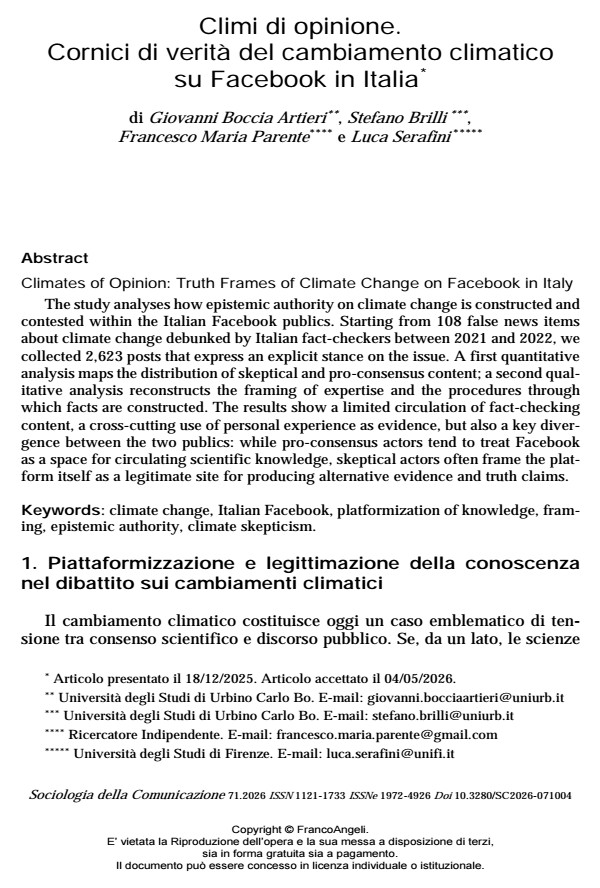
The study analyses how epistemic authority on climate change is constructed and contested within the Italian Facebook publics. Starting from 108 false news items about climate change debunked by Italian fact-checkers between 2021 and 2022, we collected 2,623 posts that express an explicit stance on the issue. A first quantitative analysis maps the distribution of skeptical and pro-consensus content; a second qualitative analysis reconstructs the framing of expertise and the procedures through which facts are constructed. The results show a limited circulation of fact-checking content, a cross-cutting use of personal experience as evidence, but also a key divergence between the two publics: while pro-consensus actors tend to treat Facebook as a space for circulating scientific knowledge, skeptical actors often frame the platform itself as a legitimate site for producing alternative evidence and truth claims.
Parole chiave:climate change, Italian Facebook, platformization of knowledge, framing, epistemic authority, climate skepticism.
- Barkun M. (2006), A Culture of Conspiracy: Apocalyptic Visions in Contemporary America, University of California Press, Berkeley.
- Bentivegna S., Boccia Artieri G. (2021), Voci della democrazia. Il futuro del dibattito pubblico, il Mulino, Bologna.
- Bloomfield E.F., Tillery D. (2019), The circulation of climate change denial online: Rhetorical and networking strategies on Facebook, in «Environmental Communication», 13(1), pp. 23-34. DOI: 10.1080/17524032.2018.1527378
- Boccia Artieri G. (2025), Sfiduciati. Democrazia e disordine comunicativo nella società esposta, Fondazione Giangiacomo Feltrinelli, Milano.
- Boccia Artieri G., Gemini L. (2019), Mass media and the web in the light of Luhmann’s media system, in «Current Sociology», 67(4), pp. 563-578. DOI: 10.1177/0011392119837542
- Byford J. (2011), Conspiracy Theories: A Critical Introduction, Palgrave Macmillan, London.
- Cloud D.L. (2018), Reality Bites: Rhetoric and the Circulation of Truth Claims in US Political Culture, The Ohio State University Press, Columbus.
- Coen S., Meredith J., Woods R., Fernandez A. (2021), Talk like an expert: The construction of expertise in news comments concerning climate change, in «Public Understanding of Science», 30(4), pp. 400-416. DOI: 10.1177/0963662520981729
- Cook J., Nuccitelli D., Green S.A., Richardson M., Winkler B., Painting R., Way R., Jacobs P., Skuce A. (2013), Quantifying the consensus on anthropogenic global warming in the scientific literature, in «Environmental Research Letters», 8(2). DOI: 10.1088/1748-9326/8/2/024024
- Druckman J.N. (2001), On the limits of framing effects: Who can frame?, in «The Journal of Politics», 63(4), pp. 1041-1066. DOI: 10.1111/0022-3816.00100
- Entman R.M. (1993), Framing: Toward clarification of a fractured paradigm, in «Journal of Communication», 43(4), pp. 51-58.
- Falkenberg M., Galeazzi A., Torricelli M., Di Marco N., Larosa F., Sas M., Mekacher A., Pearce W., Zollo F., Quattrociocchi W., Baronchelli A. (2022), Growing polarization around climate change on social media, in «Nature Climate Change», 12, pp. 1114-1121.
- Fischer F. (2019), Knowledge politics and post-truth in climate denial: On the social construction of alternative facts, in «Critical Policy Studies», 13(2), pp. 133-152. DOI: 10.1080/19460171.2019.1602067
- Fuller M., Weizman E. (2021), Investigative Aesthetics: Conflicts and Commons in the Politics of Truth, Verso, London-New York.
- Gemini L., Boccia Artieri G., Giglietto F., Farci M., Brilli S., Zurovac E. (2021), Ciarlatani: post-verità, contropubblici online e nuove articolazioni della fiducia nel sistema della medicina, in «Salute e Società», 2, pp. 201-222.
- Guenther L., Jörges S., Mahl D., Brüggemann M. (2023), Framing as a bridging concept for climate change communication: A systematic review based on 25 years of literature, in «Communication Research», 51(4), pp. 367-391. DOI: 10.1177/00936502221137165
- Moser S.C. (2010), Communicating climate change: History, challenges, process and future directions, in «Wiley Interdisciplinary Reviews: Climate Change», 1(1), pp. 31-53.
- Naab T.K., Ruess H.S., Küchler C. (2025), The influence of the deliberative quality of user comments on the number and quality of their reply comments, in «New Media & Society», 27(1), pp. 62-83. DOI: 10.1177/14614448231172168
- Neresini F., Agodi M.C., Crabu S., Tosoni S. (2024), Manufacturing Refused Knowledge in the Age of Epistemic Pluralism: Discourses, Imaginaries, and Practices on the Border of Science, Palgrave Macmillan, Cham.
- Nisbet M.C. (2009), Communicating climate change: Why frames matter for public engagement, in «Environment: Science and Policy for Sustainable Development», 51(2), pp. 12-23.
- Picardi I. (2019), Nebulose di pseudoscienza. Incertezza, pseudofatti e tensioni nella governance tecnoscientifica, in «Cambio. Rivista sulle trasformazioni sociali», 9(18), pp. 19-31.
- Picardi I., Serafini L., Serino M. (2024), Disentangling Discursive Spaces of Knowledge Refused by Science: An Analysis of the Epistemic Structures in the Narratives Repertoires on Health During the Covid-19 Pandemic, in Neresini F., Agodi M.C., Crabu S., Tosoni S. (a cura di), Manufacturing Refused Knowledge in the Age of Epistemic Pluralism: Discourses, Imaginaries, and Practices on the Border of Science, Palgrave Macmillan, Cham, pp. 139-168.
- Scheufele D.A. (1999), Framing as a theory of media effects, in «Journal of Communication», 49(1), pp. 103-122.
- Schmid-Petri H. (2017), Politicization of science: How climate change skeptics use experts and scientific evidence in their online communication, in «Climatic Change», 145(3), pp. 523-537.
- Treen K.M.D.I., Williams H.T., O’Neill S.J. (2020), Online misinformation about climate change, in «WIREs Climate Change», 11(5).
- Van Dijck J., Poell T., de Waal M. (2018), The Platform Society: Public Values in a Connective World, Oxford University Press, Oxford.
- van Eck C.W., Mulder B.C., van der Linden S. (2021), Echo chamber effects in the climate change blogosphere, in «Environmental Communication», 15(2), pp. 145-152. DOI: 10.1080/17524032.2020.1861048
- van Zoonen L. (2012), I-pistemology: Changing truth claims in popular and political culture, in «European Journal of Communication», 27(1), pp. 56-67. DOI: 10.1177/0267323112438808
- Vliegenthart R., van Zoonen L. (2011), Power to the frame: Bringing sociology back to frame analysis, in «European Journal of Communication», 26(2), pp. 101-115. DOI: 10.1177/0267323111404838
- Vosoughi S., Roy D., Aral S. (2018), The spread of true and false news online, in «Science», 359(6380), pp. 1146-1151.
- Westlund O., Bélair-Gagnon V., Graves L., Larsen R., Steensen S. (2024), What is the problem with misinformation? Fact-checking as a sociotechnical and problem-solving practice, in «Journalism Studies», 25(8), pp. 898-918.
- Il clima mediato. Attori, arene e frame del racconto pubblico della crisi climatica Valentina Cappi, Paola Parmiggiani, in SOCIOLOGIA DELLA COMUNICAZIONE 71/2026 pp.5
DOI: 10.3280/SIL2026-001011
Giovanni Boccia Artieri, Stefano Brilli, Francesco Maria Parente, Luca Serafini, Climi di opinione. Cornici di verità del cambiamento climatico su Facebook in Italia in "SOCIOLOGIA DELLA COMUNICAZIONE " 71/2026, pp 67-89, DOI: 10.3280/SC2026-071004