«Ma la vernice non inquina?»: #UltimaGenerazione e i frame dell’attivismo climatico su TikTok
Titolo Rivista SOCIOLOGIA DELLA COMUNICAZIONE
Autori/Curatori Claudio Riva, Martina Ceccato
Anno di pubblicazione 2026 Fascicolo 2026/71
Lingua Italiano Numero pagine 19 P. 108-126 Dimensione file 162 KB
DOI 10.3280/SC2026-071006
Il DOI è il codice a barre della proprietà intellettuale: per saperne di più
clicca qui
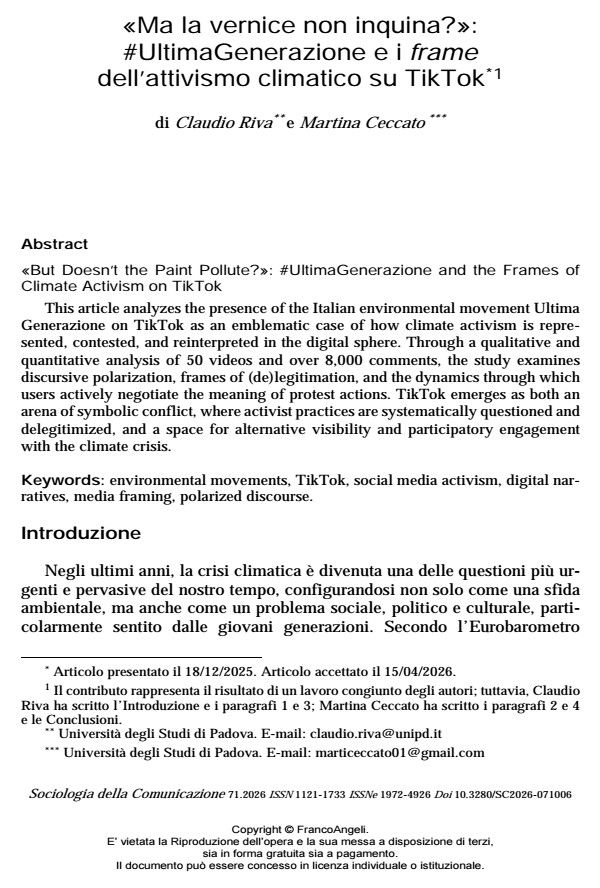
Qui sotto puoi vedere in anteprima la prima pagina di questo articolo.
Se questo articolo ti interessa, lo puoi acquistare (e scaricare in formato pdf) seguendo le facili indicazioni per acquistare il download credit. Acquista Download Credits per scaricare questo Articolo in formato PDF
FrancoAngeli è membro della Publishers International Linking Association, Inc (PILA), associazione indipendente e non profit per facilitare (attraverso i servizi tecnologici implementati da CrossRef.org) l’accesso degli studiosi ai contenuti digitali nelle pubblicazioni professionali e scientifiche.
This article analyzes the presence of the Italian environmental movement Ultima Generazione on TikTok as an emblematic case of how climate activism is represented, contested, and reinterpreted in the digital sphere. Through a qualitative and quantitative analysis of 50 videos and over 8,000 comments, the study examines discursive polarization, frames of (de)legitimation, and the dynamics through which users actively negotiate the meaning of protest actions. TikTok emerges as both an arena of symbolic conflict, where activist practices are systematically questioned and delegitimized, and a space for alternative visibility and participatory engagement with the climate crisis.
Parole chiave:environmental movements, TikTok, social media activism, digital narratives, media framing, polarized discourse.
- Albrecht G. (2019), Earth Emotions: New Words for a New World, Cornell University Press, Ithaca.
- Anderson K.E. (2020), Getting acquainted with social networks and apps: it is time to talk about TikTok, in «Library Hi Tech News», 37(4), pp. 7-12. DOI: 10.1108/LHTN-01-2020-000
- Bennett W.L., Segerberg A. (2012), The logic of connective action. Digital media and the personalization of contentious politics, in «Information, Communication & Society», 15(5), pp.739-768. DOI: 10.1080/1369118X.2012.67066
- Bladow K.A., Ladino J. (2018), Affective Ecocriticism: Emotion, Embodiment, Environment, University of Nebraska Press, Lincoln.
- Boccia Artieri G. (2021), Networked Participation: Selfie Protest and Ephemeral Public Spheres, in Della Ratta D., Lovink G., Numerico T., Sarram P. (eds.), The Aesthetics and Politics of the Online Self: A Savage Journey into the Heart of Digital Cultures, Palgrave Macmillan, Cham, pp. 331-356.
- Boccia Artieri G., Zurovac E., Donato V. (2022), Visibility and Networked. Participation in TikTok. The Breonna Taylor Trend, in «Comunicazione politica», 23(3), pp. 403-422. DOI: 10.3270/10543
- Boulianne S., Lalancette M., Ilkiw D. (2020), “School Strike 4 Climate”: Social Media and the International Youth Protest on Climate Change, in «Media and Communication», 8(2), pp. 208-218.
- Cammaerts B., Mattoni A., McCurdy P. (eds.) (2013), Mediation and Protest Movements, Intellect Books, Bristol.
- Castells M. (1997), The Power of Identity, Blackwell, Oxford.
- Ceccarini L., Diamanti I. (2018), Tra politica e società. Fondamenti, trasformazioni e prospettive, il Mulino, Bologna.
- Cervi L., Divon T. (2023), Playful Activism: Memetic Performances of Palestinian Resistance in TikTok #Challenges, in «Social Media + Society», 9(1), pp. 1-13. DOI: 10.1177/2056305123115760
- Cervi L., Marín-Lladó C. (2022), Freepalestine on TikTok: from performative activism to (meaningful) playful activism, in «Journal of international and intercultural communication», 15(4), pp.414-434. DOI: 10.1080/17513057.2022.213188
- Dahlgren P. (2009), Media and Political Engagement: Citizens, Communication, and Democracy, Cambridge University Press, Cambridge.
- de Moor J., De Vydt M., Uba K., Wahlström M. (2021), New kids on the block: taking stock of the recent cycle of climate activism, in «Social Movement Studies», 20(5), pp. 619-625. DOI: 10.1080/14742837.2020.183661
- de Nardis F., Galiano A. (2024), Contentious interation in Ultima Generazione (Last Generation). A preliminary analysis on radicalization and spin-off movements, in «SocietàMutamentoPolitica», 15, pp. 199-212. DOI 10.36253/smp-15508
- della Porta D., Diani M. (2015), The Oxford Handbook of Social Movements, Oxford University Press, Oxford.
- Denicolai L. (2023), Attivismo e valori green su TikTok. Se il social mi attiva, in Marino G., Surace B. (a cura di), TikTok. Capire le dinamiche della comunicazione ipersocial. Hoepli, Milano, pp. 125-147.
- Dennis J. (2019). Beyond Slacktivism. Political Participation on Social Media, in «Interest Groups, Advocacy and Democracy Series». DOI: 10.1007/978-3-030-00844-
- Earl J., Maher T.V., Elliott T. (2017), Youth, activism, and social movements, in «Sociology Compass», 11(4), pp. 1-14.
- Eriksson Krutrök M., Åkerlund M. (2022), Through a white lens: Black victimhood, visibility, and whiteness in the Black Lives Matter movement on TikTok, in «Information, Communication & Society», 26(10), pp. 1996-2014. DOI: 10.1080/1369118X.2022.206521
- Eurobarometro (2024), European Parliament Youth Survey, [online] testo disponibile in: https://webgate.ec.europa.eu/ebsm/api/public/deliverable/download?doc=true&deliverableId=96862, ultimo accesso: 21/11/2025.
- Galiano A. (2025), Le proteste dilemmatiche di Ultima Generazione, in «Rivista Trimestrale di Scienza dell’Amministrazione», 2, pp. 1-32. DOI: 10.32049/RTSA.2025.2.0
- Gamson W.A., Modigliani A. (1989), Media discourse and public opinion on nuclear power: A constructionist approach, in «American Journal of Sociology», 95(1), pp.1-37. DOI: 10.1086/22921
- Gerodimos R., Ward J. (2007), Rethinking online youth civic engagement: reflections on web content analysis, in Loader B.D., Young citizens in the digital age, Routledge, Londra, pp. 128-140.
- Granovetter M.S. (1973), The Strength of Weak Ties, in «American Journal of Sociology», 78(6), pp.1360-1380.
- Greijdanus H., de Matos Fernandes C.A., Turner-Zwinkels F., Honari A., Roos C.A., Rosenbusch H., Postmes T. (2020), The psychology of online activism and social movements: relations between online and offline collective action, in «Current Opinion in Psychology», 35, pp. 49-54.
- Hautea S., Parks P., Takahashi B., Zeng J. (2021), Showing They Care (Or Don’t): Affective Publics and Ambivalent Climate Activism on TikTok, in «Social Media + Society», 7(2), pp. 1-14. DOI: 10.1177/2056305121101234
- Highfield T. (2016), Social Media and Everyday Politics, Polity Press, Cambridge.
- Inglehart R. (1977), The Silent Revolution: Changing Values and Political Styles among Western Publics, Princeton University Press, Princeton.
- Knupfer H., Neureiter A., Matthes J. (2023), From social media diet to public riot? Engagement with “greenfluencers” and young social media users’ environmental activism, in «Computers in Human Behavior», 139.
- Ksiazek T.B., Peer L., Zivic A. (2014), Discussing the news. Civility and hostility in user comments, in «Digital Journalism», 3(6), pp. 850-870. DOI: 10.1080/21670811.2014.97207
- Literat I., Kligler-Vilenchik N. (2019), Youth collective political expression on social media: The role of affordances and memetic dimensions for voicing political views, in «New Media & Society», 21(9), pp. 1988-2009. DOI: 10.1177/146144481983757
- Loader B.D., Vromen A., Xenos M.A. (2014), The networked young citizen: social media, political participation and civic engagement, in «Information, Communication & Society», 17(2), pp. 143-150. DOI: 10.1080/1369118X.2013.87157
- Malm A. (2021), How to Blow Up a Pipeline, Verso, London-New York.
- Medina Serrano J.C., Papakyriakopoulos O., Hegelich S. (2020), Dancing to the Partisan Beat: A First Analysis of Political Communication on TikTok, in «Proceedings of the 12th ACM Conference on Web Science» pp. 257-266. DOI: 10.1145/3394231.339791
- Norgaard K.M. (2011), Living in Denial. Climate Change, Emotions, and Everyday Life, The MIT Press, Cambridge-London.
- Pariser E. (2011), The Filter Bubble: What the Internet Is Hiding from You, Penguin, Londra.
- Pellizzoni L., Osti G. (2008), Sociologia dell’ambiente, il Mulino, Bologna.
- Raynauld V., Lalancette M., Tourigny-Koné S. (2016), Political protest 2.0: social media and the 2012 student strike in the province of Quebec, Canada, in «French Politics», 14, pp. 1-29.
- Riva C. (a cura di) (2021), Social media e politica, UTET, Torino.
- Rootes C. (2004), Environmental Movements, in Snow D.A., Soule S.A., Kriesi H. (a cura di), The Blackwell Companion to Social Movements, Blackwell, Oxford, pp. 608-640.
- Statista (2025), Distribution of TikTok e users worldwide as of October 2025, by age and gender, [online] testo disponibile in: https://www.statista.com/statistics/1299771/tiktok-global-user-age-distribution/, ultimo accesso: 21/11/2025.
- Treré E., Kaun A. (2021), Digital media activism, in Balbi G, Ribeiro N., Schafer V., Schwarzenegger C. (eds) Digital Roots: Historicizing Media and Communication Concepts of the Digital Age, De Gruyter, Berlin, pp. 193-208.
- van Eck, C. W., Mulder, B.C., Dewulf, A. (2020), Online climate change polarization: Interactional framing analysis of climate change blog comments, in «Science Communication», n. 42(4), pp. 454–480. DOI: 10.1177/10755470209422
- Wahlström M., Kocyba P., De Vydt M., de Moor J. (2019), Protest for a future: Composition, mobilization and motives of the participants in Fridays For Future climate protests on 15 March, 2019 in 13 European cities, [online] testo disponibile in: https://www.diva-portal.org/smash/record.jsf?pid=diva2%3A1397070&dswid=-9110, ultimo accesso: 25/10/2023.
Claudio Riva, Martina Ceccato, «Ma la vernice non inquina?»: #UltimaGenerazione e i frame dell’attivismo climatico su TikTok in "SOCIOLOGIA DELLA COMUNICAZIONE " 71/2026, pp 108-126, DOI: 10.3280/SC2026-071006