Una rivoluzione (neo) liberale? La Premier League tra mito e realtà
Titolo Rivista IMPRESE E STORIA
Autori/Curatori Giuseppe Telesca
Anno di pubblicazione 2026 Fascicolo 2024/50
Lingua Italiano Numero pagine 19 P. 106-124 Dimensione file 160 KB
DOI 10.3280/ISTO2024-050005
Il DOI è il codice a barre della proprietà intellettuale: per saperne di più
clicca qui
Qui sotto puoi vedere in anteprima la prima pagina di questo articolo.
Se questo articolo ti interessa, lo puoi acquistare (e scaricare in formato pdf) seguendo le facili indicazioni per acquistare il download credit. Acquista Download Credits per scaricare questo Articolo in formato PDF
FrancoAngeli è membro della Publishers International Linking Association, Inc (PILA), associazione indipendente e non profit per facilitare (attraverso i servizi tecnologici implementati da CrossRef.org) l’accesso degli studiosi ai contenuti digitali nelle pubblicazioni professionali e scientifiche.
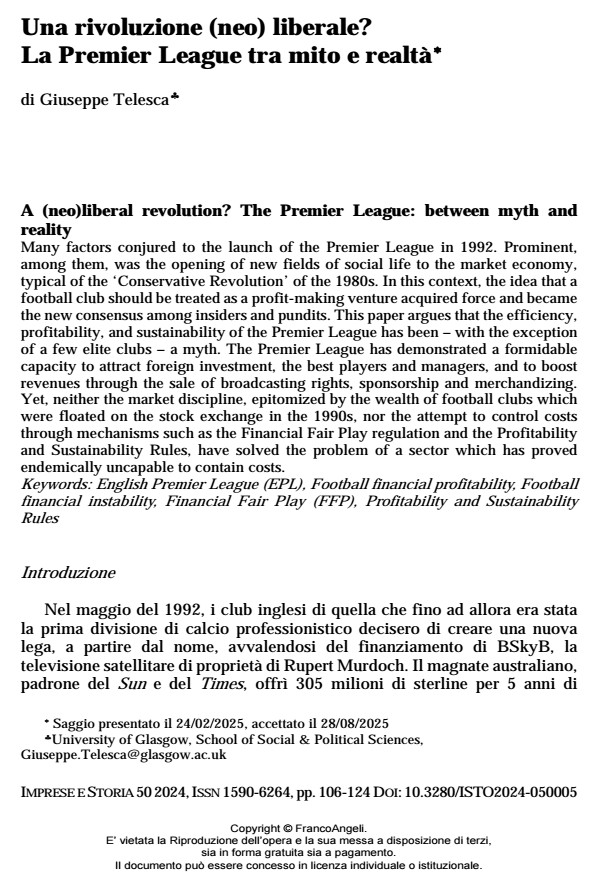
Many factors conjured to the launch of the Premier League in 1992. Prominent, among them, was the opening of new fields of social life to the market economy, typical of the ‘Conservative Revolution’ of the 1980s. In this context, the idea that a football club should be treated as a profit-making venture acquired force and became the new consensus among insiders and pundits. This paper argues that the efficiency, profitability, and sustainability of the Premier League has been – with the exception of a few elite clubs – a myth. The Premier League has demonstrated a formidable capacity to attract foreign investment, the best players and managers, and to boost revenues through the sale of broadcasting rights, sponsorship and merchandizing. Yet, neither the market discipline, epitomized by the wealth of football clubs which were floated on the stock exchange in the 1990s, nor the attempt to control costs through mechanisms such as the Financial Fair Play regulation and the Profitability and Sustainability Rules, have solved the problem of a sector which has proved endemically uncapable to contain costs.
Parole chiave:English Premier League (EPL), Football financial profitability, Football financial instability, Financial Fair Play (FFP), Profitability and Sustainability Rules
- Andreff, W., Staudohar, P.D. (2000). The evolving European model of professional sports finance, Journal of Sports Economics, 13:257–276.
- Augar, P. (2018). The Bank that Lived a Little. Barclays in the Age of the Very Free Market, London: Penguin.
- Bertheussen, B.A., Solberg, H.A. (2022). Soft budget constraints and institutional logics in European football, In: Professional Team Sports and the Soft Budget Constraint, Storm, R.K., Nielsen, Havran Z., a cura di, Northampton: Edward Elgar Publishing, 19–21.
- Brannagan, P.M. Scelles, N., Valenti, M., Inoue, Y., Grix, J., Perkin, S.J (2022). The 2021 European Super League attempt: motivation, outcome, and the future of football, International Journal of Sport Policy and Politics, 14: 169–176.
- Brown, A. (2007). Not for sale? The destruction and reformation of football communities in the Glazer takeover of Manchester United, Soccer and Society, 8: 614–635.
- Collins, T. (2013). Sport in Capitalist Society: A Short History, New York: Routledge.
- Conn, D. (2005). The Beautiful Game? Searching for the Soul of Football, London: Yellow Jersey Press.
- Dabscheck, B. (2006). The globe at their feet: FIFA’s new employment rules – II, Sport in Society, 9: 1–18.
- Deloitte (2006). Annual Review of Football Finance, Manchester: Deloitte.
- Frank, E. (2014). Financial Fair Play in European clubs: what is it all about?, International Journal of Sport Finance, 9:193–217.
- Gamble, A. (2012). The United Kingdom: the triumph of fiscal realism, In: The Consequences of the Global Financial Crisis: The Rhetoric of Reform and Regulation, ed. by W. Grant e G.K. Wilson, Oxford: Oxford University Press, 34–49.
- Gieve, J. (2007). London, Money and the UK Economy, Bank of England Quarterly Bulletin, 47: 428–436.
- Hamil, S., Walters, G. (2010). Financial performance in English professional football: an inconvenient truth, Soccer and Society, 11: 354–372.
- Hamil, S., Chadwick, S. (2010). Managing Football: An International Perspective, Oxford: Elsevier.
- Hobsbawm, E. (1978). The forward march of Labour halted?, Marxsism Today, settembre 1978, 279–286.
- King, A. (1997). New directors, customers and fans: the transformation of English football in the 1990s, Sociology of Sport Journal, 14: 224–240.
- Jennett, N., Sloane, P. (1995). Football in decline: an economic analysis of the report of the Chester Committee of Inquiry, Leisure Studies, 4: 39–56.
- Leach S., Szymanski S. (2015). Making money out of football, Scottish Journal of Political Economy, 62: 25–50.
- Maguire, K., Philippou, C. (2023), Still ill? Assessing the financial sustainability of football, Policy Paper, Department for Culture, Media & Sport, 7 settembre 2023 – https://www.gov.uk/government/publications/reforming-club-football-governance-consultation-response/research-report-still-ill-assessing-the-financial-sustainability-of-football-2023, ultimo accesso 7 agosto 2025.
- Millward, P. (2013). New football directors in the twenty–first century: profit and revenue in the English Premier League’s transnational age, Leisure Studies, 32:399–414.
- Morrow, S. (2016). Football, economics and finance, in Routledge Handbook of Football Studies, Hughson, J., Maguire, J., Moore, K., Spaaij, R., London: Routledge, 163–175.
- Naurigh J., Ramfjord J. (2010). Who owns England's game? American professional sporting influences and foreign ownership in the Premier League, Soccer and Society, 11: 428–441.
- T. Peeters, T., S. Szymanski, S., C. Fumagalli, C., e C. Thomas, C. (2015) Financial Fair Play in European Football, Economic Policy, 29:345–390.
- Pieper, J. (2018). Financial fair play in European football, In: Wagner, U., Storm, Nielsen, K., a cura di, When Sport Meets Business: Capabilities, Challenges, Critiques, Los Angeles: Sage, 167–185.
- Platts C., Smith, A. (2010). Money, money, money? The development of financial inequalities in English professional football, Soccer and Society, 11: 643–658.
- Sloane, P. (1971), The economics of professional football: the football club as a utility maximiser, Scottish Journal of Political Economy, 18:121–146.
- Sloane P. (1983). The economic crisis in professional football, Economic Affairs, luglio 1983, 273–275.
- Storm, R.K., Nielsen, K., (2012). Soft budget constraints in professional football, European Sports Management Quarterly, 12: 183–201.
- Szymanski, S. (2012). Insolvency in English professional football: irrational exuberance or negative shocks?, North American Association of Sports Economists, Working Paper no. 12–02.
- Szymanski, S. (2014). Insolvency in English football, In: Goddard, J., Sloane P. (a cura di), Handbook on the Economics of Professional Football, Cheltenham: Edward Elgar, 100–116.
- Szymanski, S. (2015). Money and Football, A Soccernomics Guide, New York, Nation Books, 2015.
- Telesca, G. (2022). The English Premier League and the City of London (1980—2010): A tale of two ‘revolutions’, Soccer and Society. 23: 500–512.
- Walters, G., Hamil, S. (2013). The contests for power and influence over the regulatory space within the English professional football industry, 1980–2012, Business History, 55: 740–767.
- Williams, J., Hopkins, S., (2011). Over here: Americanization and the new politics of football club ownership – the case of Liverpool FC, Sport in Society, 14: 160–174.
- Taylor, M. (2008). The Association Game: A History of British Football, Harlow: Pearson Longman.
- Thani, S., Heenan, T., The ball may be round but football is becoming increasingly Arabic: oil money and the rise of the new football order, Soccer and Society, 18: 1012–1026.
- Triesman, D. (1981). Football in decline, Marxism Today, marzo 1981, pp. 12–16.
Giuseppe Telesca, Una rivoluzione (neo) liberale? La Premier League tra mito e realtà in "IMPRESE E STORIA" 50/2024, pp 106-124, DOI: 10.3280/ISTO2024-050005