Comitati aziendali europei: un nuovo tagliando alla direttiva a trent’anni dalla istituzione
Titolo Rivista GIORNALE DI DIRITTO DEL LAVORO E DI RELAZIONI INDUSTRIALI
Autori/Curatori Salvo Leonardi
Anno di pubblicazione 2026 Fascicolo 2026/191
Lingua Italiano Numero pagine 26 P. 361-386 Dimensione file 233 KB
DOI 10.3280/GDL2026-191002
Il DOI è il codice a barre della proprietà intellettuale: per saperne di più
clicca qui
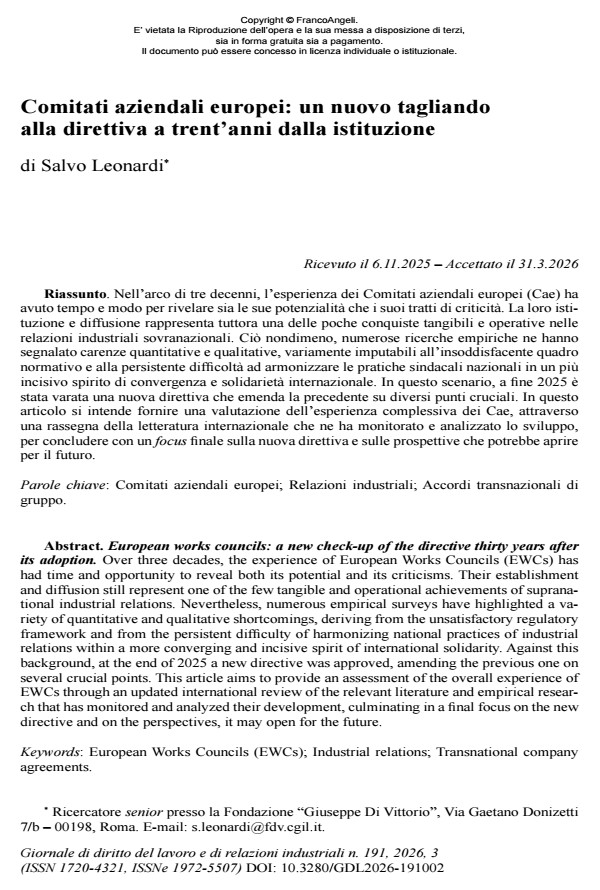
Qui sotto puoi vedere in anteprima la prima pagina di questo articolo.
Se questo articolo ti interessa, lo puoi acquistare (e scaricare in formato pdf) seguendo le facili indicazioni per acquistare il download credit. Acquista Download Credits per scaricare questo Articolo in formato PDF
FrancoAngeli è membro della Publishers International Linking Association, Inc (PILA), associazione indipendente e non profit per facilitare (attraverso i servizi tecnologici implementati da CrossRef.org) l’accesso degli studiosi ai contenuti digitali nelle pubblicazioni professionali e scientifiche.
Nell’arco di tre decenni, l’esperienza dei Comitati aziendali europei (Cae) ha avuto tempo e modo per rivelare sia le sue potenzialità che i suoi tratti di criticità. La loro istituzione e diffusione rappresenta tuttora una delle poche conquiste tangibili e operative nelle relazioni industriali sovranazionali. Ciò nondimeno, numerose ricerche empiriche ne hanno segnalato carenze quantitative e qualitative, variamente imputabili all’insoddisfacente quadro normativo e alla persistente difficoltà ad armonizzare le pratiche sindacali nazionali in un più incisivo spirito di convergenza e solidarietà internazionale. In questo scenario, a fine 2025 è stata varata una nuova direttiva che emenda la precedente su diversi punti cruciali. In questo articolo si intende fornire una valutazione dell’esperienza complessiva dei Cae, attraverso una rassegna della letteratura internazionale che ne ha monitorato e analizzato lo sviluppo, per concludere con un focus finale sulla nuova direttiva e sulle prospettive che potrebbe aprire per il futuro.
Parole chiave:Comitati aziendali europei; Relazioni industriali; Accordi transnazionali di gruppo.
- Alaimo A. (2026). Prime osservazioni sulla Direttiva (Ue) 2025/2450: il terzo tempo della disciplina dei Comitati Aziendali Europei e il tempismo dei Seminari di Bertinoro (in corso di stampa).
- Allamprese A., Borelli S., Orlandini G. (a cura di) (2025). Delocalizzazioni. Un vecchio problema alla ricerca di nuove risposte. Roma: Futura Editrice.
- Arrigo G., Barbucci G. (a cura di) (2012). Il nuovo quadro normativo dei Comitati aziendali europei. La Direttiva n. 2009/38 alla prova delle legislazioni nazionali. Roma: Ediesse.
- Baccaro L., Howell C. (2017). Trajectories of Neoliberal Transformation European Industrial Relations Since the 1970s. Cambridge: Cambridge University Press.
- Biasi M. (a cura di) (2024). Diritto del lavoro e intelligenza artificiale. Milano: Giuffré. Brancaccio E. (2022). Democrazia sotto assedio. La politica economica del nuovo capitali
- smo oligarchico. 50 brevi lezioni. Milano: Piemme.
- Brancaccio E., Giammetti R., Lopreite M., Puliga M. (2018). Centralization of capital and financial crisis: A global network analysis of corporate control. SCED: 94 ss.
- Carrieri M., Nerozzi P., Treu T. (a cura di) (2015). La partecipazione incisiva. Idee e proposte per rilanciare la democrazia nelle imprese. Bologna: il Mulino.
- Casale C., Treu T. (eds.) (2019). Transformations of work: challenges for the institutions and social actors. Milano: Kluwer Law International.
- Commissione europea (2016). Evaluation study on the implementation of Directive 2009/38/ EC on the establishment of a European Works Council: final report. Publications Office. Commissione europea (2018). Report on the implementation by Member States of Directive 2009/38/EC on the establishment of a European Works Council or a Brussels, 14.5.2018 COM(2018) 292 final. procedure in Communityscale undertakings for the purposes of informing and consulting employees.
- Conchon A., Waddington J. (2015). Boardlevel employee representation in Europe: challenging commonplace prejudice. In: Vitols S., Kluge N. (eds.), The Sustainable Company: a new approach to corporate governance. Brussels: ETUI.
- Copeland P. (2025). A social assessment of the first von der Leyen Commission (20192024). In: Sabato S. et al. (eds.), Social policy in the European Union: state of play 2024. Brussels: ETUI.
- Corti M. (2012). La partecipazione dei lavoratori. La cornice europea e l’esperienza comparata. Milano: Vita e Pensiero.
- Crouch C. (2012). Il potere dei giganti. Perché la crisi non ha sconfitto il neoliberismo. RomaBar: Laterza.
- Czarzasty J. (2024). 20 years after. Changing perspectives on industrial relations in Central and Eastern Europe two decades after EU enlargement: from transition to transformation. Transfer: 15 ss.
- Dalos G., Kowalczuk I.S., Potel J.Y. (2023). On a long way to democracy: from Berlin to Gdansk via Budapest and Prague. Brussels: ETUI.
- De Spiegelare S. (2016). Too little, too late? Evaluating the EWC Recast Directive. Brussles: ETUI.
- De Spiegelaere S., Jagodzinski R., Waddington J. (2018). European Works Council: contested and still in the making. Brussels: ETUI.
- Dukes R., Streeck W. (2023). Democracy at Work. Cambridge: Polity Press.
- Erne R., Stan S., Golden D., Szabò I., Maccarrone V. (2024). Politicising Commodification: European Governance and Labour Politics from the Financial Crisis to the Covid Emergency. Cambridge: UP.
- ETUC, ETUI (2015). Benchmarking Working Europe 2015. Brussels: ETUI.
- ETUI (2018). Can anybody hear us. An overview of the 2018 survey of EWC and SEWC representatives. Testo disponibile su: www.etui.org/publications/guides/cananybodyhearus (consultato il: 15.3.2026)
- ETUI (2021). How to deal with confidential information, 1 Manual for European Workers’ Representatives. Brussels: ETUI.
- EWCDB (2025). Banca dati dei comitati aziendali europei. Testo disponibile su: ewcdb.eu/ statistics (consultato il: 15.3.2026)
- Ferrera M. (2025). Ideas and institutional change. Insights from the analysis of political ideologies. SM: 71 ss.
- Ferreras I., Battilana J., Méda D. (2022). Il manifesto del lavoro. Democratizzare. Demercificare. Disinquinare. Roma: Castelvecchi.
- Ficari L. (a cura di) (2006). Società europea, diritti di informazione e partecipazione dei lavoratori. Milano: Giuffrè.
- Fraser N. (2023). Capitalismo cannibale. Come il sistema sta divorando la democrazia, il nostro senso di comunità e il pianeta. RomaBari: Laterza.
- Gallino L. (2005). L’impresa irresponsabile. RomaBari: Laterza.
- Gallino L. (2013). La lotta di classe dopo la lotta di classe. RomaBari: Laterza.
- Gold M., Rees C. (2013). What makes an effective EWC? Consideration based on three case studies. Transfer: 539 ss.
- Gorges M. (1996). EuroCorporatism? Interest Intermediation in the European Community. London: Bloomsbury Academics.
- Gouzoulis G., Galanis G., Iliopoulos P. (2024). Financialisation, shareholder value orientation, and the decline of trade union membership in the EU. Transfer, 3: 161 ss.
- Guarriello F. (2013). I diritti di informazione e partecipazione. In: Cinelli M., Ferraro G., Mazzotta O. (a cura di), Il nuovo mercato del lavoro. Torino: Giappichelli.
- Guarriello F. (2019). Transnational collective agreements. In: Casale C., Treu T. (eds.), Transformations of Work. Challanges for the Institutions and Social Actors. Milano: Kluwer Law International.
- Guarriello F., Stanzani C. (a cura di) (2018). Sindacato e contrattazione nelle multinazionali. Milano: FrancoAngeli.
- Hall P.A., Soskice D. (eds.) (2001). Varieties of Capitalism. The Institutional Foundations of Comparative Advantage. Oxford: Oxford University Press.
- Hoffmann A., Jagodzinki R. (2017). One step forward, two steps back? Taking stock of social dialogue and workers’ participation. In: Benchmarking Working Europe 2017. Brussels: ETUI.
- Hyman R., GumbrellMcCormick (2024). Towards a European system of industrial relations? The ETUC in the twentyfirst century. Brussels: ETUI.
- IettoGillies G. (2015). Transnational Corporations and International Production. Cheltenham: Edward Elgar.
- Jagodzinski R. (2011). EWC after 15 Years – Success or Failure? Transfer: 203 ss. Jagodzinski R. (ed.) (2015). Variations on a theme: the implementation of the EWC Recast Directive. Brussles: ETUI.
- Keune M., Pochet P. (2023). The revival of Social Europe: is this time different? Transfer: 173 ss.
- Kilpatrick C. (2023). The Roaring 20s for Social Europe. Transfer: 203 ss.
- Kilpatrick C., Steiert M. (2025). A little learning is a dangerous thing: AG Emilou on the Adequate Minimum Wage Directive. DLRI: 437 ss.
- Kyriazi A., Miró J., Natili M., Ronchi S. (2024). Social Policy and EU Politybuilding Through Crises and Beyond. London: Routledge.
- Kotthoff H., Whittall M. (2014). Paths to Transnational Solidarity IdentityBuilding Processes in European Works Councils. Losanna: Peter Lang.
- Lafuente S., De Spiegelaere S., Jagodzinski R. (2022). Friends in high places: relations between European works councils and boardlevel representatives. ETUI, Policy Brief.
- Lehndorff S. (ed.) (2015). Divisive integration. The triumph of failed idea – revisited. Bruxelles: ETUI.
- Leonardi S. (2013). Globalizzazione, sindacati e contrattazione transnazionale. QRS: 149 ss.
- Leonardi S. (a cura di) (2014). La lezione dei Comitati Aziendali Europei a vent’anni dalla loro nascita. Roma: Ediesse.
- Leonardi S. (2015). Transnational company agreements: the empirical findings of the EURACTA 2 Project. In: Leonardi S. (eds.), EURACTA 2 Project. Testo disponibile su: www.etui.org/aboutetui/news/transnationalcompanyagreementsexperiencesandprospects (consultato il: 15.3.2026)
- Leonardi S. (2024). La direttiva europea sul salario minimo adeguato e le sue ripercussioni nel quadro italiano. DLRI: 79 ss.
- Leonardi S., Pedersini R. (eds.) (2018). Multiemployer bargaining under pressure. Bruxelles: ETUI.
- Lo Faro A. (2012). Bargaining in the Shadow of “Optional Frameworks”? The Rising of Transnational Collective Agreements and EU Law. EJIR: 153 ss.
- Lo Faro A. (2025). Autorità salariale, legge e contrattazione collettiva. Spigolature comparate. RGL, I: 475 ss.
- Lynch E., Vanhercke B. (2024). Forward, in Pisana A. and Theodoropolos S. (eds.). Benchmarking Working Europe, Bruxelles: ETUI.
- Marginsson P. (2014). Coordinated bargaining in Europe: From incremental corrosion to frontal assault? EJIR: 97 ss.
- Meylemans L., De Spiegelaere S. (2020). La confidenzialità nei Comitati Aziendali Europei e come i rappresentanti la gestiscono: caso studio di e intuizioni di indagine. ETUI, Working paper 02.
- Muller T. (2025). Collective bargaining and minimum wage regimes in the European Union. Bruxelles: ETUI.
- Muller T. (2013). Transnational company agreements and the role of European Works Councils in negotiations. A quantitative analysis in the metalworking sector. Bruxelles: ETUI.
- Muller T., Hoffman A. (2001). EWC Research: A Review of the Literature. University of Warwick: Warwick Papers in Industrial Relation.
- Muller T., Schulten T. (2024). The European Minimum Wage Directive: a milestone for EU social policymaking. In: Vanhercke B. et al. (eds.), Social policy in the European Union: state of play 2023. ETUI and OSE: 75 ss.
- Niksova D. (2023). Transnational Company Agreements and EU Law. IJCLLIR: 265 ss. OECD (2025). OECD Corporate Governance Factbook 2025. Testo disponibile su: www.
- oecd.org/en/publications/oecdcorporategovernancefactbook2025_f4f43735en.html (consultato il: 15.3.2026)
- Papadakis K. (ed.) (2011). Shaping Global Industrial Relations: The Impact of International Framework Agreements. Ginevra: ILO/Palgrave Macmillan.
- Pennacchi L. (2020). Democrazia economica. Dalla pandemia a un nuovo umanesimo. Roma: Castelvecchi.
- Peruzzi M. (2023). Intelligenza artificiale e lavoro. Uno studio sui poteri datoriali e tecniche di tutela. Torino: Giappichelli.
- Pisarczyk L., Boguska A. (2023). European Framework Agreements in Multinational Companies. What Role for European Labour Law? IJCLLIR: 247 ss.
- Pulignano V., Waddington J. (2020). Management, European Works Councils and institutional malleability. EJIR: 5 ss.
- Ratti L. (2025). La misurazione delle soglie di adeguatezza del salario minimo nell’ordinamento multilivello. DLRI: 63 ss.
- Rehfeldt U. (2025). La Codetermination, une dimension oubliée du projet européen. In: Favereau O. (ed.), Traité de codétermination. Québec: PUL, 499 ss.
- Roccella M., Treu T. (2012). Diritto del lavoro dell’Unione Europea. Padova: Cedam. Rosenbohm S., Kuebart J. (2022). Can access to company boards improve transnational employee representation? Insight from employee representation in European Companies. Transfer: 423 ss.
- Scarponi S. (2011). Gli accordi transnazionali a livello di impresa: uno strumento per contrastare il social dumping? LD: 119 ss.
- Sciarra S. (2011). Automotive e altro: cosa sta cambiando nella contrattazione collettiva nazionale e transnazionale. DLRI: 130 ss.
- Sciarra S. (2013). L’Europa e il lavoro. Solidarietà e conflitto in tempo di crisi. RomaBari: Laterza.
- Schömann I., Jagodzinski R., Boni G., Clauwaert S., Glassner V., Jaspers T. (2012). Transnational collective bargaining at company level. A new component of European industrial relations? Brussels: ETUI.
- Schulten T., Muller T. (2023). A paradigm shift towards Social Europe? The proposed Directive on adequate minimum wages in the EU. ILLeJ: 1 ss.
- Streeck W. (1997). Neither European nor works councils: a reply to Paul Knutsen. IED: 325 ss.
- Streeck W. (2024). Globalismo e democrazia. L’economia politica del tardo neoliberismo. Milano: Feltrinelli.
- Tros F. (2023). Pathways in Decentralised Collective Bargaining in Europe. Amsterdam: Amsterdam University Press.
- Van Gyes G., Schulten T. (eds.) (2015). Wage bargaining under the new European Economic Governance. Alternative strategies for inclusive growth. Brussles: ETUI.
- Waddington J. (2010). European Works Council and Industrial Relations. A Transnational Industrial Relations Institution in the making. London: Routledge.
- Waddington J., Pulignano V., Turk J., Swert T. (2016). Managers, BusinessEurope and the development of EWC. ETUI Working Paper.
- Zito M. (2025). L’evoluzione della contrattazione collettiva transnazionale nel settore tessi leabbigliamento: sfide e opportunità. DLRI: 15 ss.
Salvo Leonardi, Comitati aziendali europei: un nuovo tagliando alla direttiva a trent’anni dalla istituzione in "GIORNALE DI DIRITTO DEL LAVORO E DI RELAZIONI INDUSTRIALI " 191/2026, pp 361-386, DOI: 10.3280/GDL2026-191002