Mindfulness e auto-compassione in pazienti dermatologici: uno studio quali-quantitativo su intervento di gruppo
Titolo Rivista PSICOLOGIA DELLA SALUTE
Autori/Curatori Oriana Mosca, Giulia Zucca, Giulia Ulivi, Annamaria Tupputi, Antonella Silletti, Mattia Mocenni, Marco Guicciardi, Paola Mamone
Anno di pubblicazione 2026 Fascicolo 2026/3
Lingua Italiano Numero pagine 23 P. 69-91 Dimensione file 299 KB
DOI 10.3280/PDS2026-003007
Il DOI è il codice a barre della proprietà intellettuale: per saperne di più
clicca qui
Qui sotto puoi vedere in anteprima la prima pagina di questo articolo.
Se questo articolo ti interessa, lo puoi acquistare (e scaricare in formato pdf) seguendo le facili indicazioni per acquistare il download credit. Acquista Download Credits per scaricare questo Articolo in formato PDF
FrancoAngeli è membro della Publishers International Linking Association, Inc (PILA), associazione indipendente e non profit per facilitare (attraverso i servizi tecnologici implementati da CrossRef.org) l’accesso degli studiosi ai contenuti digitali nelle pubblicazioni professionali e scientifiche.
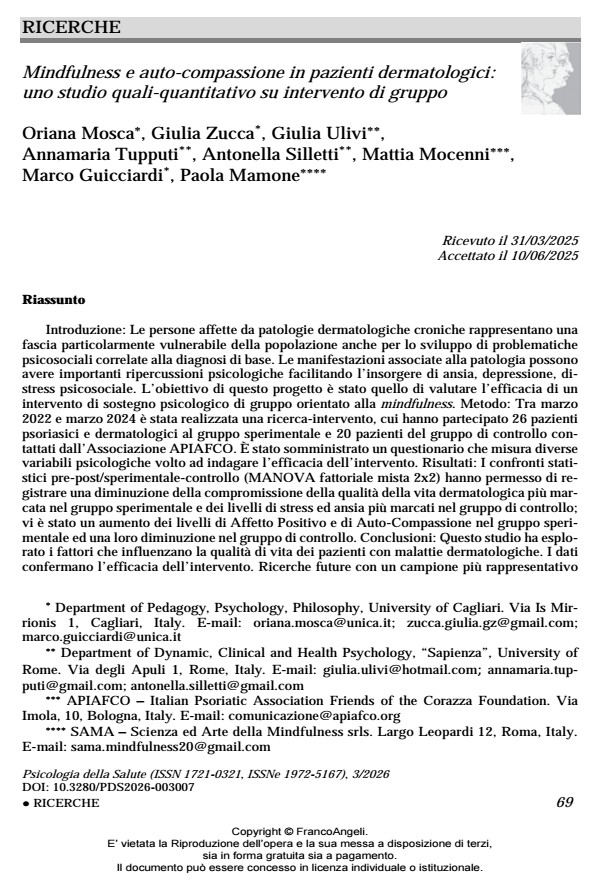
Introduzione: Le persone affette da patologie dermatologiche croniche rappresentano una fascia particolarmente vulnerabile della popolazione anche per lo sviluppo di problematiche psicosociali correlate alla diagnosi di base. Le manifestazioni associate alla patologia possono avere importanti ripercussioni psicologiche facilitando l’insorgere di ansia, depressione, distress psicosociale. L’obiettivo di questo progetto è stato quello di valutare l’efficacia di un intervento di sostegno psicologico di gruppo orientato alla mindfulness. Metodo: Tra marzo 2022 e marzo 2024 è stata realizzata una ricerca-intervento, cui hanno partecipato 26 pazienti psoriasici e dermatologici al gruppo sperimentale e 20 pazienti del gruppo di controllo contattati dall’Associazione APIAFCO. È stato somministrato un questionario che misura diverse variabili psicologiche volto ad indagare l’efficacia dell’intervento. Risultati: I confronti statistici pre-post/sperimentale-controllo (MANOVA fattoriale mista 2x2) hanno permesso di registrare una diminuzione della compromissione della qualità della vita dermatologica più marcata nel gruppo sperimentale e dei livelli di stress ed ansia più marcati nel gruppo di controllo; vi è stato un aumento dei livelli di Affetto Positivo e di Auto-Compassione nel gruppo sperimentale ed una loro diminuzione nel gruppo di controllo. Conclusioni: Questo studio ha esplorato i fattori che influenzano la qualità di vita dei pazienti con malattie dermatologiche. I dati confermano l’efficacia dell’intervento. Ricerche future con un campione più rappresentativo ed un follow-up potrebbero fornire ulteriori informazioni preziose sull’efficacia degli interventi di gruppo orientati alla mindfulness.
Parole chiave:psoriasi, dermatite atopica, artrite psoriasica, mindfulness, psicologia della salute, intervento di gruppo.
- Baer R. (2019). Assessment of mindfulness by self-report. Current Opinion in Psychology, 28: 42-48.
- Blanca M.J., Arnau J., García-Castro F.J., Alarcón R., & Bono R. (2023). Repeated measures ANOVA and adjusted F-tests when sphericity is violated: which procedure is best?. Frontiers in Psychology, 14: 1192453.
- Blome C., Radtke M.A., Eissing L., & Augustin M. (2016). Quality of life in patients with atopic dermatitis: disease burden, measurement, and treatment benefit. American journal of clinical dermatology, 17: 163-169.
- Bottesi G., Ghisi M., Altoè G., Conforti E., Melli G., & Sica C. (2015). The Italian version of the Depression Anxiety Stress Scales-21: Factor structure and psychometric properties on community and clinical samples. Comprehensive Psychiatry, 60: 170-181.
- Carleton R.N., McCreary D.R., Norton P.J., & Asmundson G.J. (2006). Brief Fear of Negative Evaluation Scale- revised. Depression and Anxiety, 23(5): 297-303.
- Carli R., & Paniccia R.M. (2012). Analisi della domanda: Teoria e tecnica dell’intervento in psicologia clinica. Bologna: Il Mulino.
- Chen S.Y., & Wu J.T. (2017). Global productivity of dermatological research: a bibliometric analysis from 1985 to 2014. British Journal of Dermatology, 176(1): 234-236.
- Chida Y., & Steptoe A. (2010). Greater cardiovascular responses to laboratory mental stress are associated with poor subsequent cardiovascular risk status. Hypertension, 55(4): 1026-1032. DOI: 10.1161/HYPERTENSIONAHA.109.14662
- D’Alton P., Kinsella L., Walsh O., Sweeney C., Timoney I., Lynch M., O’Connor M., & Kirby B. (2019). Mindfulness-Based Interventions for Psoriasis: a Randomized Controlled Trial. Mindfulness, 10: 288-300.
- Dalgard F.J., Gieler U., Tomas-Aragones L., Lien L., Poot F., Jemec G.B., Misery L., Szabo C., Linder D., Sampogna F., Evers A.W.M., Halvorsen J.A., Balieva F., Szepietowski J., Romanov D., Marron S.E., Altunay I.K., Finlay A.Y., Salek S.S., & Kupfer J. (2015). The psychological burden of skin diseases: A cross-sectional multicenter study among dermatological out-patients in 13 European countries. Journal of Investigative Dermatology, 135(4): 984-991.
- Dharmawardene M., Givens J., Wachholtz A., Makowski S., & Tjia J. (2016). A systematic review and meta-analysis of meditative interventions for informal caregivers and health professionals. BMJ supportive & palliative care, 6(2): 160-169.
- Di Fabio A., & Busoni L. (2009). Proprietà psicometriche della versione italiana della Satisfaction With Life Scale (SWLS) con studenti universitari. Counseling. Giornale Italiano di Ricerca e Applicazioni, 2: 201-212.
- Diener E.D., Emmons R.A., Larsen R.J., & Griffin S. (1985). The satisfaction with life scale. Journal of Personality Assessment, 49: 71-75.
- Dowling V.L. (2014). The psychological impact of psoriasis: A review of short-term psychotherapy group participation for psoriasis patients. Journal of the Dermatology Nurses’ Association, 6(5s): S2-S6. DOI: 10.1097/JDN.000000000000007
- Driscoll M.A., Edwards R.R., Becker W.C., Kaptchuk T.J., & Kerns R.D. (2021). Psychological interventions for the treatment of chronic pain in adults. Psychological Science in the Public Interest, 22(2): 52-95. DOI: 10.1177/1529100621100815
- Ewert C., Vater A., & Schröder-Abé M. (2021). Self-compassion and coping: A meta-analysis. Mindfulness, 12: 1063-1077.
- Ferreira B.I.R.C., Abreu J.L.P.D.C., Dos Reis J.P.G., & Figueiredo A.M.D.C. (2016). Psoriasis and associated psychiatric disorders: a systematic review on etiopathogenesis and clinical correlation. The Journal of clinical and aesthetic dermatology, 9(6): 36.
- Finlay A.Y., Chernyshov P.V., Tomas Aragone, L., Bewley A., Svensson A., Manolache L., Marron S., Suru A., Sampogna F. & Poot F. (2021). Methods to improve quality of life, beyond medicines. Position statement of the European Academy of Dermatology and Venereology Task Force on Quality of Life and Patient Oriented Outcomes. Journal of the European Academy of Dermatology and Venereology, 35(2): 318-328.
- Finlay A.Y., & Khan G. (1994). Dermatology Life Quality Index (DLQI)- a simple practical measure for routine clinical use. Clinical and Experimental Dermatology, 19(3): 210-216.
- Fordham B., Griffiths C.E.M., & Bundy C. (2015a). A pilot study examining mindfulness-based cognitive therapy in psoriasis. Psychology, health & medicine, 20(1): 121-127. DOI: 10.1080/13548506.2014.90248
- Fordham B.A., Nelson P., Griffiths C.E.M., & Bundy C. (2015b). The acceptability and usefulness of mindfulness-based cognitive therapy for people living with psoriasis: A qualitative study. The British Journal of Dermatology, 172: 823-825.
- Goldin P.R., & Gross J.J. (2010). Effects of mindfulness-based stress reduction (MBSR) on emotion regulation in social anxiety disorder. Emotion, 10(1): 83.
- Goldman-Mellor S.J., Saxton K.B., & Catalano R.C. (2010). Economic contraction and mental health: A review of the evidence, 1990-2009. International Journal of Mental Health, 39(2): 6-31 DOI: 10.2753/IMH0020-741139020
- Janowski K., Steuden S., Pietrzak A., Krasowska D., Kaczmarek L., Gradus I., & Chodorowska G. (2012). Social support and adaptation to the disease in men and women with psoriasis. Archives of Dermatological Research, 304(6): 421-432.
- Kabat-Zinn J. (2003). Mindfulness-based interventions in context: Past, present, and future. Clinical Psychology: Science and Practice, 10(2): 144-156.
- Kabat-Zinn J. (2016). Vivere momento per momento: Edizione riveduta e aggiornata. Corbaccio.
- Katugampola R.P., Lewis V.J., & Finlay A.Y. (2007). The Dermatology Life Quality Index: assessing the efficacy of biological therapies for psoriasis. British Journal of Dermatology, 156(5): 945-950.
- Kubo A., Altschuler A., Kurtovich E., Hendlish S., Laurent C.A., Kolevska T., Li Y. & Avins A. (2018). A pilot mobile-based mindfulness intervention for cancer patients and their informal caregivers. Mindfulness, 9: 1885-1894.
- Lahousen T., Kupfer J., Gieler U., Hofer A., Linder M.D., & Schut C. (2016). Differences between psoriasis patients and skin-healthy controls concerning appraisal of touching, shame, and disgust. Acta Dermato-Venereologica, 96(1): 78-82. DOI: 10.2340/00015555-237
- Lakuta P., Marcinkiewicz K., Bergler-Czop B., Brzezinska-Wcislo L., & Slomian A. (2018). Associations between site of skin lesions and depression, social anxiety, body-related emotions, and feelings of stigmatization in psoriasis patients. Advances in Dermatology and Allergology/Postepy Dermatologii i Alergologii, 35(1): 60-66.
- Lewin K. (1946). Action research and minority problems. In: Lewin G.W. (Ed.). Resolving Social Conflicts. New York: Harper & Row (1948).
- Lovibond P.F., & Lovibond S.H. (1995). The structure of negative emotional states: Comparison of the Depression Anxiety Stress Scales (DASS) with the Beck Depression and Anxiety Inventories. Behaviour Research and Therapy, 33(3): 335-343. DOI: 10.1016/0005-7967(94)00075-
- Lu Y., Duller P., Van Der Valk P.G.M., & Evers A.W.M. (2003). Helplessness as predictor of perceived stigmatization in patients with psoriasis and atopic dermatitis. Dermatology and Psychosomatics/Dermatologie und Psychosomatik, 4(3): 146-150. DOI: 10.1159/00007399
- Maddock A., Hevey D., D’Alton P., & Kirby B. (2020). Examining individual differences in wellbeing, anxiety and depression in psoriasis using a clinically modified Buddhist psychological model. Journal of Clinical Psychology in Medical Settings, 27(4): 842-858.
- Mazzotti E., Barbaranelli C., Picardi A., Abeni D., & Pasquini P. (2005). Psychometric properties of the Dermatology Life Quality Index (DLQI) in 900 Italian patients with psoriasis. Acta dermato-venereologica, 85(5). DOI: 10.1080/00015550510032832
- Meneo D., Martoni M., Giannandrea A., Tengattini V., & Baglioni C. (2024). Mindfulness and self-compassion in dermatological conditions: a systematic narrative review. Psychology & Health, 39(2): 268-300. DOI: 10.1080/08870446.2022.207061
- Montgomery K., & Thompson A.R. (2018). The potential role of mindfulness in psychosocial support for dermatology patients. Clinics in Dermatology, 36(6): 743-747.
- Muftin Z., Gilbert P., & Thompson A.R. (2022). A randomized controlled feasibility trial of online compassion-focused self-help for psoriasis. British Journal of Dermatology, 186(6), 955-962.
- National Institutes of Health (2023). Psoriasis. National Institutes of Health, Retrieved from https://www.niams.nih.gov/health-topics/psoriasis
- Neff K. (2003). Self-compassion: An alternative conceptualization of a healthy attitude toward oneself. Self and Identity, 2: 85-101. DOI: 10.1080/1529886030903
- Parisi R., Symmons D.P., Griffiths C.E., & Ashcroft D.M. (2013). Global epidemiology of psoriasis: A systematic review of incidence and prevalence. Journal of Investigative Dermatology, 133(2): 377-385.
- Poli A., & Miccoli M. (2023). The Italian version of the Self-Compassion Scale-Short Form (SCS-SF): validation and psychometric properties. Authorea Preprints.
- Peters E.M. (2016). Stressed skin?–a molecular psychosomatic update on stress-causes and effects in dermatologic diseases. JDDG: Journal der deutschen dermatologischen gesellschaft, 14(3): 233-252. DOI 10.1111/ddg.12957
- Qureshi A.A., Awosika O., Baruffi F., Rengifo-Pardo M., & Ehrlich A. (2019). Psychological therapies in management of psoriatic skin disease: A systematic review. American Journal of Clinical Dermatology, 20: 607-624.
- Raes F., Pommier E., Neff K.D., & Van Gucht D. (2011). Construction and factorial validation of a short form of the Self-Compassion Scale. Clinical Psychology & Psychotherapy, 18(3): 250-255. DOI 10.1002/cpp.702
- Sengupta A., & Wagani R. (2024). Mindful self-compassion for psychological distress associated with skin conditions: An online intervention study. Indian Journal of Dermatology, Venereology and Leprology, 1-5. DOI: 10.25259/IJDVL_451_202
- Stadtmüller, L., Eckardt, M., Zick, C., Kupfer, J., & Schut, C. (2020). Investigation of predictors of interest in a brief mindfulness-based intervention and its effects in patients with psoriasis at a rehabilitation clinic (SkinMind): an observational study and randomised controlled trial. BMJ open, 10(9): e033952.
- Terraciano A., McCrae R.R., & Costa Jr P.T. (2003). Factorial and construct validity of the Italian Positive and Negative Affect Schedule (PANAS). European journal of psychological assessment, 19(2): 131. DOI: 10.1027//1015-5759.19.2.13
- Thompson E.R. (2007). Development and validation of an internationally reliable short-form of the Positive and Negative Affect Schedule (PANAS). Journal of Cross-Cultural Psychology, 38(2): 227-242. DOI: 10.1177/00220221062973
- Toledano E., Pérez-Sancristóbal I., & Montilla C. (2024). Ab0411 effect of a mindfulness-based intervention on the health and well-being of patients with psoriatic arthritis (the oniros study). Annals of the Rheumatic Diseases, 83: 1455.
- World Health Organization (2016). Global report on psoriasis. World Health Organization. Retrieved from https://apps.who.int/iris/handle/10665/204417
- Xiao Y., Zhang X., Luo D., Kuang Y., Zhu W., Chen X., & Shen M. (2019). The efficacy of psychological interventions on psoriasis treatment: A systematic review and meta-analysis of randomized controlled trials. Psychology Research and Behavior Management, 12: 97-106. DOI: 10.2147/PRBM.S19518
- Zangi H.A., Mowinckel P., Finset A., Eriksson L.R., Høystad T.Ø., Lunde A.K., & Hagen K.B. (2012). A mindfulness-based group intervention to reduce psychological distress and fatigue in patients with inflammatory rheumatic joint diseases: a randomised controlled trial. Annals of the rheumatic diseases, 71(6): 911-917.
- Zautra A.J., Davis M.C., Reich J.W., Nicassario P., Tennen H., Finan P., Kratz A., Parrish B. & Irwin M.R. (2008). Comparison of cognitive behavioral and mindfulness meditation interventions on adaptation to rheumatoid arthritis for patients with and without history of recurrent depression. Journal of consulting and clinical psychology, 76(3): 408. DOI: 10.1037/0022-006X.76.3.40
- Zill J.M., Christalle E., Tillenburg N., Mrowietz U., Augustin M., Härter M., & Dirmaier J. (2019). Effects of psychosocial interventions on patient-reported outcomes in patients with psoriasis: A systematic review and meta-analysis. British Journal of Dermatology, 181(5): 939-945.
Oriana Mosca, Giulia Zucca, Giulia Ulivi, Annamaria Tupputi, Antonella Silletti, Mattia Mocenni, Marco Guicciardi, Paola Mamone, Mindfulness e auto-compassione in pazienti dermatologici: uno studio quali-quantitativo su intervento di gruppo in "PSICOLOGIA DELLA SALUTE" 3/2026, pp 69-91, DOI: 10.3280/PDS2026-003007