Quali con ni per quali emergenze? L’uso dei con ni amministrativi nella gestione delle emergenze di rilevanza nazionale in Italia
Titolo Rivista ARCHIVIO DI STUDI URBANI E REGIONALI
Autori/Curatori Francesco Curci, Anita De Franco, Carolina Pacchi
Anno di pubblicazione 2026 Fascicolo 2026/146
Lingua Italiano Numero pagine 20 P. 25-44 Dimensione file 150 KB
DOI 10.3280/ASUR2026-146002
Il DOI è il codice a barre della proprietà intellettuale: per saperne di più
clicca qui
Qui sotto puoi vedere in anteprima la prima pagina di questo articolo.
Se questo articolo ti interessa, lo puoi acquistare (e scaricare in formato pdf) seguendo le facili indicazioni per acquistare il download credit. Acquista Download Credits per scaricare questo Articolo in formato PDF
FrancoAngeli è membro della Publishers International Linking Association, Inc (PILA), associazione indipendente e non profit per facilitare (attraverso i servizi tecnologici implementati da CrossRef.org) l’accesso degli studiosi ai contenuti digitali nelle pubblicazioni professionali e scientifiche.
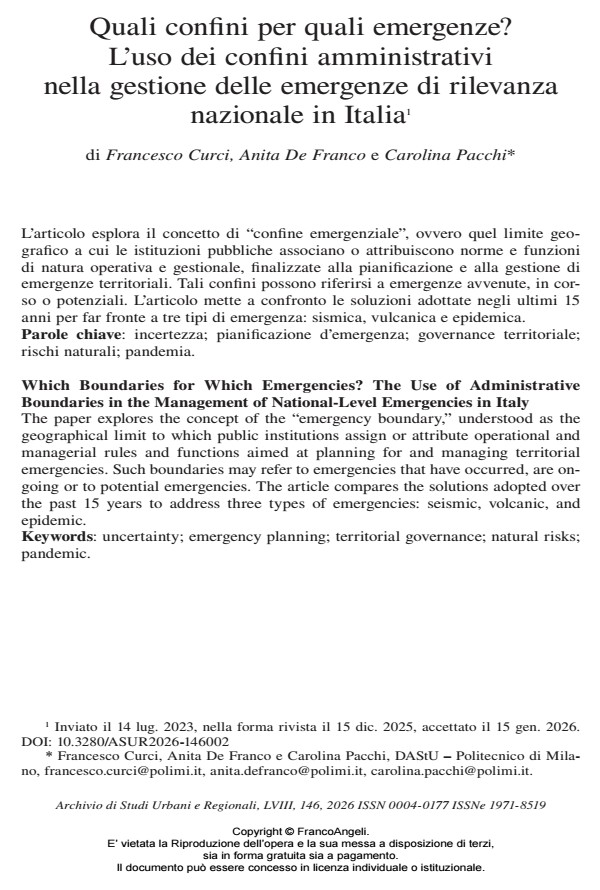
L’articolo esplora il concetto di “confine emergenziale”, ovvero quel limite geografico a cui le istituzioni pubbliche associano o attribuiscono norme e funzioni di natura operativa e gestionale, finalizzate alla pianificazione e alla gestione di emergenze territoriali. Tali confini possono riferirsi a emergenze avvenute, in corso o potenziali. L’articolo mette a confronto le soluzioni adottate negli ultimi 15 anni per far fronte a tre tipi di emergenza: sismica, vulcanica e epidemica.
Parole chiave:incertezza; pianificazione d’emergenza; governance territoriale; rischi naturali; pandemia.
- Alexander D.E. (2002). Principles of emergency planning and management. Harpenden: Terra Publishing.
- An B.Y. and Tang S.Y. (2020). Lessons from COVID19 responses in East Asia: Institutional infrastructure and enduring policy instruments. The American Review of Public Administration, 50(67): 790800. DOI: 10.1177/027507402094370
- Benton J.E., Rissler G.E. and Wagner S. (2020). City and county governments in the time of COVID19 and the recession: The long and winding road. State and Local Government Review, 52(1): 2852. DOI: 10.1177/0160323X2097547
- Boin A., Lodge M. and Luesink M. (2020). Learning from the COVID19 crisis: an initial analysis of national responses. Policy Design and Practice, 3(3): 189204. DOI: 10.1080/25741292.2020.182367
- Brambilla C. (2015). Exploring the critical potential of the borderscapes concept. Geopolitics, 20(1): 1434. DOI: 10.1080/14650045.2014.88456
- Brambilla C. and Jones R. (2020). Rethinking borders, violence, and conflict: From sovereign power to borderscapes as sites of struggles. Environment and Planning D: Society and Space, 38(2): 287305. DOI: 10.1177/026377581985635
- 21 Seguendo Searle (1969), sembra possibile affermare che la dichiarazione dello “stato di emergenza” viene messo in essere per mezzo di regole costitutive. Stabilire cosa sia concesso o meno fare all’interno di quella situazione (e di quel territorio) dipende da altre regole (regolative), conseguenti a ulteriori interventi normativi.
- Capano G. (2020). Policy design and state capacity in the COVID19 emergency in Italy: if you are not prepared for the (un) expected, you can be only what you already are. Policy and Society, 39(3): 326344. DOI: 10.1080/14494035.2020.178379
- Casati R., Smith B. and Varzi A.C. (1998). Ontological tools for geographic representation. In: Guarino N., ed., Formal Ontology in Information Systems. Amsterdam: IOS Press, 7785.
- Chiffi D. and Curci. F. (2020). Fragility: Concepts and related notions. Territorio, 44: 3943.
- Curci F. (2020). Natural Risks Exposure and Hazard Avoidance Strategies: Learning from Vesuvius. In: Balducci A., Chiffi D. and Curci F., eds., Risk and Resilience: SocioSpatial and Environmental Challenges. Cham: PoliMI SpringerBriefs, 95111.
- De Franco A. (2022). Dimensioni istituzionali dei fenomeni urbani e della pianificazione. Un’applicazione dell’ontologia sociale di John Searle. Territorio, 103: 120126. DOI: 10.3280/TR202310302
- De Franco A. (2023). Revisiting the distinction between the natural and the artificial. Towards a properly urban ontology. Planning Theory, 2(22): 224229. DOI: 10.1177/1473095223116218
- De Franco A. and Pacchi C. (2024). The space of rules and rules of space: reflecting on local ordinances during the Covid19 pandemic. City, Territory and Architecture, 11(1): 16.
- Deopa N. and Fortunato P. (2021). Cultural Markers of the COVID19 Pandemic. SSRN, Oct. 26th. Testo disponibile al sito: https://papers.ssrn.com/sol3/papers. cfm?abstract_id=3950327.
- Di Fiore L. (2017). The production of borders in nineteenthcentury Europe: between institutional boundaries and transnational practices of space. European Review of History: Revue européenne d’histoire, 24(1): 3657. DOI: 10.1080/13507486.2016.118359
- Español A. and Marsico G. (2021). Psychology of borders: An integral proposal to understand border phenomena in human life. Theory and Psychology, 31(5): 665674. DOI: 10.1177/0959354321102675
- Español A., Marsico G. and Tateo L. (2019). Maintaining borders: From border guards to diplomats. Human Affairs, 29(1): 108126.
- Fontana I. (2022). The human (in)security trap: how European border (ing) practices condemn migrants to vulnerability. International Politics, 59(3): 465484.
- Frosini T.E. (2021). Le regioni colorate e differenziate: come combattere la pandemia nei territori?. Diritti regionali. Rivista di diritto delle autonomie territoriali, 2: 281285.
- Gaeta L. (2018). La civiltà dei confini. Pratiche quotidiane e forme di cittadinanza. Roma: Carocci Editore.
- Gaeta L. (2021). Paradigm shifts in boundary and border studies: disclosing geopolitical assumptions. Space and Polity, 25(3): 306324. DOI: 10.1080/13562576.2021.199178
- Gaeta L. (2023). Orizzonti quotidiani: Introduzione alla conoscenza dei confini. MilanoUdine: Mimesis Edizioni.
- Galderisi A., di Venosa M., Fera G. e Menoni S., a cura di (2020). Geografie del rischio. Nuovi paradigmi per il governo del territorio. Roma: Donzelli.
- Galindo Caldés R., Tort Donada J. and Santasusagna Riu A. (2022). Administrative Boundaries and Covid19: The Case of Catalonia, Spain. In: Nunes Silva C., ed., Local Government and the COVID19 Pandemic: A Global Perspective. Cham: Springer International Publishing, 247275. DOI: 10.1007/9783030911126_1
- Gargiulo E. (2023). Registration as a border: Shaping the population at the local level in Italy. Geopolitics, 28(1): 439463. DOI: 10.1080/14650045.2021.191202
- Gibson E.L. (2013). Boundary control: Subnational authoritarianism in federal democracies. Cambridge: Cambridge University Press.
- Goolsbee A. and Syverson C. (2021). Fear, lockdown, and diversion: Comparing drivers of pandemic economic decline 2020. Journal of public economics, 193, 104311.
- Istituto Superiore di Sanità (ISS) (2020). Prevenzione e risposta a COVID19: evoluzione della strategia e pianificazione nella fase di transizione per il periodo autunnoinvernale. Roma: Ministero della Salute. Testo disponibile al sito: www.iss.it/monografie (ultimo accesso: 11 dicembre 2025).
- Kapucu N. (2006). Interagency communication networks during emergencies: Boundary spanners in multiagency coordination. The American review of public administration, 36(2): 207225.
- Koopmans R. (2020). A virus that knows no borders? Exposure to and restrictions of international travel and the global diffusion of COVID19. No. SP VI 2020103, WZB Discussion Paper.
- Lami I.M., De Franco A. and Moroni S. (2023). Values, indicators and policies. A reflection starting from sustainability issues and the Covid19 pandemic. Valori e Valutazioni, 32: 516 DOI: 10.48264/VVSIEV2023320
- Long J.A., Malekzadeh M., Klar B., and Martin G. (2021). Do regionally targeted lockdowns alter movement to nonlockdown regions? Evidence from Ontario, Canada. Health and Place, 102668.
- Malvasi M. (2020). Dai confini aperti al loro sigillo. La Lombardia blindata in tempo di Covid19. Documenti geografici, 1: 725738. DOI: 10.19246/DOCUGEO22817549/202001_4
- Mazzoleni O. (2023). Introduction: national populism and the politicisation of borders in a changing Europe. In: Biancalana C., Pilotti A., Bernhard L., Yerly G. and Launaner L., eds., National Populism and Borders. Cheltenham: Edward Elgar Publishing, 115.
- Minca C., Rijke A., PallisterWilkins P., Tazzioli M., Vigneswaran D., van Houtum H. and van Uden A. (2022). Rethinking the biopolitical: Borders, refugees, mobilities… Environment and Planning C: Politics and Space, 40(1): 330. DOI: 10.1177/239965442098138
- Montello D.R. (2008). Geographic regions as brute facts, social facts, and institutional facts. In: Smith B., Mark D.M. and Ehrlich I., eds., The Mystery of Capital and the Construction of Social Reality. Chicago: Open Court Publishing, 305330.
- Morin E. and Kern A.B. (1999). Homeland Earth: A Manifesto for the New Millennium. Cresskill (NJ): Hampton Press.
- Moroni S. (2024). Institutional fragility and institutional malleability in nonordinary situations. A reflection starting from the Covid19 pandemic. In: Chiffi D. and Curci F., eds., Fragility and Antifragility in Cities and Regions: Space, Uncertainty, and Inequality. Cheltenham: Edward Elgar Publisher, 91107. DOI: 10.4337/9781035312559.0001
- Moroni S. and Chiffi D. (2021). Complexity and uncertainty: implications for urban planning. In: Portugali J., ed., Handbook on cities and complexity. Cheltenham: Edward Elgar Publishing, 319330. DOI: 10.4337/9781789900125.0002
- Moroni S. and Chiffi D. (2022). Uncertainty and planning: cities, technologies and public decisionmaking. Perspectives on Science, 30(2): 237259.
- Moroni S., De Franco A., Pacchi C., Chiffi D. and Curci F. (2023). Planning and metaplanning to cope with disruptive events: what can be learnt from the institutional response to the Covid19 pandemic in Italy. City, Territory and Architecture, 10(1): 29.
- Moroni S. and Lorini G. (2017). Graphic rules in planning: A critical exploration of normative drawings starting from zoning maps and formbased codes. Planning Theory, 16(3): 318338. DOI: 10.1177/147309521665638
- Moroni S. and Lorini G. (2021). Multiple functions of drawings. Journal of Urban Design, 26(3): 374394. DOI: 10.1080/13574809.2020.180134
- Newman D. and Paasi A. (1998). Fences and neighbours in the postmodern world: boundary narratives in political geography. Progress in human geography, 22(2): 186207. DOI: 10.1191/03091329866603911
- Paasi A., Ferdoush M.A., Jones R., Murphy A.B., Agnew J., Espejo P.O., Fall J.J., and Peterle G. (2022). Locating the territoriality of territory in border studies. Political Geography, 95.
- Parker N. (2009). From borders to margins: a Deleuzian ontology for identities in the Postinternational Environment. Alternatives: Global, Local, Political, 34(1): 1739. DOI: 10.1177/03043754090340010
- Piccoli L., Dzankic J., Ruedin D. and JacobOwens T. (2023). Restricting human movement during the COVID19 pandemic: new research avenues in the study of mobility, migration, and citizenship. International Migration Review, 57(2): 505520. DOI: 10.1177/0197918322111890
- Ricci A. (2020). Verso un’era glaciale della globalizzazione? Il COVID19 e la vendetta dei confini. Documenti geografici, 1: 261278. DOI: 10.19246/DOCUGEO22817549/202001_1
- Sack R.D. (1986). Human territoriality: its theory and history. Cambridge: Cambridge University Press.
- Searle J.R. (1969). Speech acts. An essay in the philosophy of language. Cambridge: Cambridge University Press.
- Searle J.R. (1995). The Construction of Social Reality. New York: The Free Press. Searle J.R. (2010). Making the social world: The structure of human civilization. Oxford: Oxford University Press.
- Smith B. (1995). On drawing lines on a map. In: Frank A.U., Kuhn W. and Mark D.M., eds., Spatial Information Theory. Cham: Springer, 475484. DOI: 10.1007/3540603921_3
- Smith B. (2003). John Searle: From speech acts to social reality. In: Smith B., ed., John Searle. Cambridge: Cambridge University Press, 133.
- Smith B. and Mark D.M. (1998). Ontology and Geographic Kinds. In: Proceedings of the 8th International Symposium on Spatial Data Handling. Vancouver: International Geographical Union, 308320.
- Smith B. and Mark D.M. (2003). Do mountains exist? Towards an ontology of landforms. Environment and Planning B: Planning and Design, 30(3): 411427.
- Smith B. and Varzi A.C. (1997). Fiat and bona fide boundaries: Towards an ontology of spatially extended objects. In: Spatial Information Theory A Theoretical Basis for GIS: International Conference COSIT ’97 Laurel Highlands, Pennsylvania, USA, October 15–18, 1997 Proceedings 3. Cham: Springer, 103119.
- Smith C.H. and Hill C.R. (1920). Rising Above the Ruins in France: An Account of the Progress Made Since the Armistice in the Devastated Regions in Reestablishing Industrial Activities and the Normal Life of the People. New York: GP Putnam’s Sons.
- Steytler N. (2022). Comparative federalism and Covid19: Combating the pandemic. Abingdon: Taylor and Francis. 454 DOI: 10.4324/978100316677
- Struttura di Missione Casa Italia (2017). Rapporto sulla Promozione della sicurezza dai Rischi naturali del Patrimonio abitativo, Presidenza del Consiglio dei Ministri. Testo disponibile al sito: www.governo.it/sites/governo. it/files/Casa_Italia_RAPPORTO.pdf (ultimo accesso: 11 dicembre 2025).
- Tazzioli M. (2020). Governing migrant mobility through mobility: Containment and dispersal at the internal frontiers of Europe. Environment and Planning C, 38(1): 319. DOI: 10.1177/239965441983906
- Tooze A. (2022). Welcome to the world of the polycrisis. Financial Times, Oct 28th.
- Valentini F. (2017). Necessità e urgenza: i poteri dell’amministrazione per fronteggiare le emergenze. Altalex, 18 apr. Testo disponibile al sito: www. altalex.com/documents/news/2017/03/31/poteriamministrazioneperfronteggiareleemergenze (ultimo accesso: 11 dicembre 2025).
Francesco Curci, Anita De Franco, Carolina Pacchi, Quali con ni per quali emergenze? L’uso dei con ni amministrativi nella gestione delle emergenze di rilevanza nazionale in Italia in "ARCHIVIO DI STUDI URBANI E REGIONALI" 146/2026, pp 25-44, DOI: 10.3280/ASUR2026-146002