Terapeuta e paziente di fronte alla malattia grave del terapeuta. Interventi
Titolo Rivista PSICOTERAPIA E SCIENZE UMANE
Autori/Curatori Roberto Carnevali, Paolo Chiappero, Giorgio Meneguz, Fabrizio Rizzi, Francesca Tondi, Daniela Cantone
Anno di pubblicazione 2026 Fascicolo 2026/4
Lingua Italiano Numero pagine 6 P. 789-794 Dimensione file 248 KB
DOI 10.3280/PU2026-004009
Il DOI è il codice a barre della proprietà intellettuale: per saperne di più
clicca qui
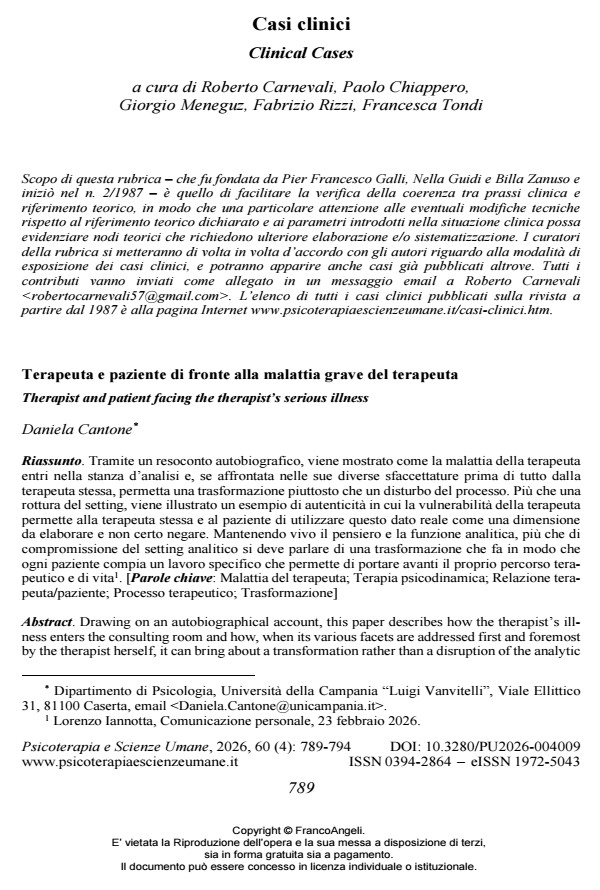
Qui sotto puoi vedere in anteprima la prima pagina di questo articolo.
Se questo articolo ti interessa, lo puoi acquistare (e scaricare in formato pdf) seguendo le facili indicazioni per acquistare il download credit. Acquista Download Credits per scaricare questo Articolo in formato PDF
FrancoAngeli è membro della Publishers International Linking Association, Inc (PILA), associazione indipendente e non profit per facilitare (attraverso i servizi tecnologici implementati da CrossRef.org) l’accesso degli studiosi ai contenuti digitali nelle pubblicazioni professionali e scientifiche.
Tramite un resoconto autobiografico, viene mostrato come la malattia della terapeuta entri nella stanza d’analisi e, se affrontata nelle sue diverse sfaccettature prima di tutto dalla terapeuta stessa, permetta una trasformazione piuttosto che un disturbo del processo. Più che una rottura del setting, viene illustrato un esempio di autenticità in cui la vulnerabilità della terapeuta permette alla terapeuta stessa e al paziente di utilizzare questo dato reale come una dimensione da elaborare e non certo negare. Mantenendo vivo il pensiero e la funzione analitica, più che di compromissione del setting analitico si deve parlare di una trasformazione che fa in modo che ogni paziente compia un lavoro specifico che permette di portare avanti il proprio percorso terapeutico e di vita .
Parole chiave:Malattia del terapeuta; Terapia psicodinamica; Relazione terapeuta/paziente; Processo terapeutico; Trasformazione
- Abend S.M. (1982). Serious illness in the analyst: Countertransference considerations. Journal of the American Psychoanalytic Association, 30, 2: 365-379.
- Dewald P.A. (1982). Serious illness in the analyst: Transference, countertransference, and reality responses. Journal of the American Psychoanalytic Association, 30, 2: 347-363.
- Dewald P.A. & Schwartz H.J. (1993). The life cycle of the analyst: Pregnancy, illness, and disability. Journal of the American Psychoanalytic Association, 41, 1: 191-207.
- Baudrillard J. (1976). L’échange symbolique et la mort. Paris: Gallimard (trad. it.: Lo scambio simbolico e la morte. Milano: Feltrinelli, 1979).
- Bollas C. (1989). Forces of Destiny: Psychoanalysis and Human Idiom. London: Free Association Books (trad. it.: Forze del destino: psicoanalisi e idioma umano. Roma: Borla, 1991; Milano: Raffaello Cortina, 2021).
- Corsa R. (2008). L’identità violata: quando l’analista perde la salute. Segreti e confessioni nella malattia dell’analista. Rivista di Psicoanalisi, 54, 2: 315-335.
- Corsa R. (2011). Se la cura si ammala. La caducità dell’analista. Seriate (BG): Kolbe.
- Corsa R. (2014). La malattia dell’analista: www.spiweb.it/la-ricerca/ricerca-psicoanalisi/malattia-dellanalista.
- Freud S. (1915 [1916]). Caducità. Opere, 8: 173-176. Torino: Boringhieri, 1976.
- Goisis P.R. (2020). Nella stanza dei sogni. Un analista e i suoi pazienti. Bologna: Damiani.
- Nelson M. (2024). Facing the unthinkable: Life-threatening illness in the analyst and its impact on the analytic couple. International Journal of Psychoanalysis, 105, 2: 142-152. DOI 10.1080/00207578.2023.2237128.
- Sherman S. (2024). Illness, aging, dying, and the psychoanalytic process: Bibliography. Psychoanalytic Review, 111, 1: 95-101.
- Fajardo B. (2001). Life-threatening illness in the analyst. Journal of the American Psychoanalytic Association, 49, 2: 569-586.
- Gerson S. (2024). Life-threatening illness in the analyst and its impact on the analytic couple. International Journal of Psychoanalysis, 105, 1: 45-61.
- Gervais L. (1994). Serious illness in the analyst: A time for analysis and a time for self-analysis. Canadian Journal of Psychoanalysis, 2, 2: 191-202.
- Lasky R. (1990). Catastrophic illness in the analyst and the analyst’s emotional reaction to it. International Journal of Psychoanalysis, 71, 3: 455-473.
- Lazar S.G. (1982). Serious illness in the analyst. Journal of the American Psychoanalytic Association, 30, 1: 189-215.
- Morrison A.L. (1997). Ten years of doing psychotherapy while living with a life-threatening illness. Psychoanalytic Dialogues, 7, 2: 255-281.
- Pizer B. (1997). When the analyst is ill: Dimensions of self-disclosure. Psychoanalytic Quarterly, 66, 3: 450-469.
- Schwartz H.J., & Silver A.-L., editors (1990). Illness in the Analyst: Implications for the Treatment Relationship. Madison, CT: International Universities Press.
- Silver A.-L. (1982). Resuming the work with a life-threatening illness. Contemporary Psychoanalysis, 18, 3: 314-326.
- Van Dam H. (1987). Countertransference during an analyst’s brief illness. Journal of the American Psychoanalytic Association, 35, 3: 647-655.
- Vassallo Torrigiani M.G. & Marzi A. (2005). When the analyst is physically ill: Vicissitudes in the analytical relationship. International Journal of Psychoanalysis, 86, 5: 1373-1389.
- Weinberg H. (1988). Illness and the working analyst. Contemporary Psychoanalysis, 24, 3: 451-461.
Roberto Carnevali, Paolo Chiappero, Giorgio Meneguz, Fabrizio Rizzi, Francesca Tondi, Daniela Cantone, Terapeuta e paziente di fronte alla malattia grave del terapeuta. Interventi in "PSICOTERAPIA E SCIENZE UMANE" 4/2026, pp 789-794, DOI: 10.3280/PU2026-004009