Accounting for market innovation: The pioneering Cruto’s lamp and the entrepreneurial logic of stakeholder engagement
Titolo Rivista CONTABILITÀ E CULTURA AZIENDALE
Autori/Curatori Laura Corazza, Giuseppe Modarelli, Francesco Marengo, Christian Rainero
Anno di pubblicazione 2026 Fascicolo 2026/1
Lingua Inglese Numero pagine 32 P. 9-40 Dimensione file 227 KB
DOI 10.3280/CCA2026-001002
Il DOI è il codice a barre della proprietà intellettuale: per saperne di più
clicca qui
Qui sotto puoi vedere in anteprima la prima pagina di questo articolo.
Se questo articolo ti interessa, lo puoi acquistare (e scaricare in formato pdf) seguendo le facili indicazioni per acquistare il download credit. Acquista Download Credits per scaricare questo Articolo in formato PDF
FrancoAngeli è membro della Publishers International Linking Association, Inc (PILA), associazione indipendente e non profit per facilitare (attraverso i servizi tecnologici implementati da CrossRef.org) l’accesso degli studiosi ai contenuti digitali nelle pubblicazioni professionali e scientifiche.
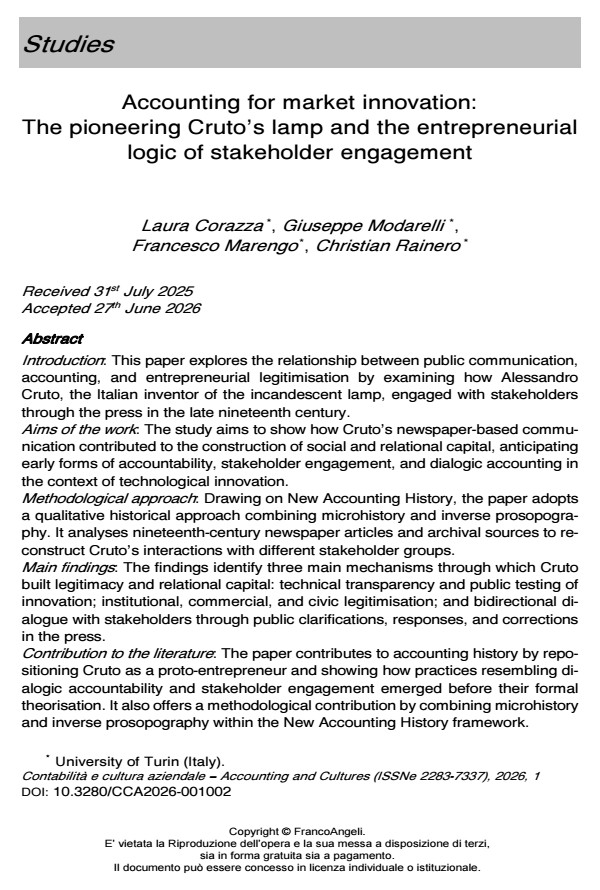
Introduction: This paper explores the relationship between public communication, accounting, and entrepreneurial legitimisation by examining how Alessandro Cruto, the Italian inventor of the incandescent lamp, engaged with stakeholders through the press in the late nineteenth century. Aims of the work: The study aims to show how Cruto’s newspaper-based communication contributed to the construction of social and relational capital, anticipating early forms of accountability, stakeholder engagement, and dialogic accounting in the context of technological innovation. Methodological approach: Drawing on New Accounting History, the paper adopts a qualitative historical approach combining microhistory and inverse prosopography. It analyses nineteenth-century newspaper articles and archival sources to reconstruct Cruto’s interactions with different stakeholder groups. Main findings: The findings identify three main mechanisms through which Cruto built legitimacy and relational capital: technical transparency and public testing of innovation; institutional, commercial, and civic legitimisation; and bidirectional dialogue with stakeholders through public clarifications, responses, and corrections in the press. Contribution to the literature: The paper contributes to accounting history by repositioning Cruto as a proto-entrepreneur and showing how practices resembling dialogic accountability and stakeholder engagement emerged before their formal theorisation. It also offers a methodological contribution by combining microhistory and inverse prosopography within the New Accounting History framework.
Parole chiave:accounting history, electricity innovation, dialogism, social capital, relational capital, bridging.
- Adomako S., Tran M.D. (2025). Stakeholder Integration, Inclusive Innovation, and Social Value Creation: Moderating Effect of Social Capital from Community Leaders. Corporate Social Responsibility and Environmental Management, 32(6): 8082-8093.
- Alexander A., Pilonato S., Redigolo G. (2023). Do institutional donors value social media activity and engagement? Empirical evidence on Italian non-profit grantees. The British Accounting Review, 55(5), 101169.
- Allen R.B., Sieczkiewicz R. (2010). How Historians Use Historical Newspapers. Proceedings of the American Society for Information Science and Technology, 47(1): 1-4.
- Baker M., Free C., Gao F. (2026). Battlelines of Accountability: The Discursive Production of Digital Responsibility. Journal of Business Ethics, ahead-of-print, 1-23.
- Baudraz M., Palmucci L. (1998). Alessandro Cruto Ad Alpignano, Nasce Una Fabbrica Si Illumina Un Paese. Alpignano: Biblioteca comunale “Caduti per la Libertà”.
- Bebbington J., Brown J., Frame B., Thomson I. (2007). Theorizing engagement: the potential of a critical dialogic approach. Accounting, Auditing & Accountability Journal, 20(3): 356-381. DOI: 10.1108/09513570710748544
- Bellucci M., Simoni L., Acuti D., Manetti G. (2019). Stakeholder engagement and dialogic accounting: Empirical evidence in sustainability reporting. Accounting, Auditing & Accountability Journal, 32(5): 1467-1499. DOI: 10.1108/AAAJ-09-2017-3158
- Bisman J.E. (2012). Surveying the Landscape: The First 15 Years of Accounting History as an International Journal. Accounting History, 17(1): 5-34. DOI: 10.1177/1032373211424883
- Bonollo E. (2025). The Supreme Audit Institution in a Country with a Napoleonic Administrative Tradition: Evolution or Cosmetic Change? Evidence from Italy. Accounting History, 30(2): 265-291. DOI: 10.1177/10323732251323290
- Bourdieu P. (1986). The Forms of Capital. In: Richardson J.G. (ed.). Handbook of Theory and Research for the Sociology of Education. New York: Greenwood Press: 241-258.
- Brown J. (2009). Democracy, sustainability and dialogic accounting technologies: Taking pluralism seriously. Critical Perspectives on Accounting, 20(3): 313-342.
- Capello R. (2001). Urban Innovation and Collective Learning: Theory and Evidence from Five Metropolitan Cities in Europe. In: Fischer M.M., Fröhlich J. (eds.). Knowledge, Complexity and Innovation Systems. Advances in Spatial Science. Berlin: Springer: 181-208. DOI: 10.1007/978-3-662-04546-6_10
- Carnegie G. (2014). The Present and Future of Accounting History. Accounting, Auditing & Accountability Journal, 27(8): 1241-1249. DOI: 10.1108/AAAJ-05-2014-1715
- Carnegie G., McBride K.M. (2023). Prosopography and Microhistory: Illuminating Historical Actors. In: Decker S., Foster W.M., Giovannoni E. (eds.). Handbook of Historical Methods for Management. Cheltenham: Edward Elgar Publishing: 245-263. DOI: 10.4337/9781800883741.00026
- Claridge T. (2018). Criticisms of Social Capital Theory: And Lessons for Improving Practice. Social Capital Research: 1-8.
- Coleman J.S. (1990). Foundations of Social Theory. Cambridge: Harvard University Press.
- Contrafatto M. (2014). The Institutionalization of Social and Environmental Reporting: An Italian Narrative. Accounting, Organizations and Society, 39(6): 414-432.
- Costa E., Pesci C. (2016). Social Impact Measurement: Why Do Stakeholders Matter? Sustainability Accounting, Management and Policy Journal, 7(1): 99-124. DOI: 10.1108/SAMPJ-12-2014-0092
- Cruto A. (1876). La Misura Logaritmica Universale Delle Temperature: Scoperta Fisico-Matematica. Firenze: Tipografia cooperativa.
- Cruto M. (1993). Un Muratore Scienziato. Alessandro Cruto e La Lampadina Elettrica a Filamento Carbonico. Torino: La Rosa Crescentino.
- De Saussure F. (1959). Course in General Linguistics. Bally C., Sechehaye A. (eds.). New York: Philosophical Library.
- Dillard J., Vinnari E. (2019). Critical dialogical accountability: From accounting-based accountability to accountability-based accounting. Critical Perspectives on Accounting, 62: 16-38.
- Elfenbein D.W., Zenger T.R. (2014). What Is a Relationship Worth? Repeated Exchange and the Development and Deployment of Relational Capital. Organization Science, 25(1): 222-244.
- Evan W.M., Freeman R.E. (1988). A Stakeholder Theory of the Modern Corporation: Kantian Capitalism. In: Beauchamp T., Bowie N. (eds.). Ethical Theory and Business (3rd ed.). New Jersey, 97-106.
- Fleischman R.K., Radcliffe V.S. (2005). The Roaring Nineties: Accounting History Comes of Age. The Accounting Historians Journal, 32(1): 61-109. DOI: 10.2308/0148-4184.32.1.61
- Ford R.C., Yoho K.D. (2020). The Government’s Role in Creating an Innovation Ecosystem: The Springfield Armory as Hub in the Connecticut River Valley. Journal of Management History, 26(4): 557-579. DOI: 10.1108/JMH-02-2020-0016
- Franzosi R. (1987). The Press as a Source of Socio-Historical Data: Issues in the Methodology of Data Collection from Newspapers. Historical Methods: A Journal of Quantitative and Interdisciplinary History, 20(1): 5-16. DOI: 10.1080/01615440.1987.10594173
- Freeman R.E. (1984). Strategic Management: A Stakeholder Approach. Boston: Pitman.
- Freeman R.E., Harrison J.S., Wicks A.C., Parmar B.L., de Colle S. (2010). Stakeholder Theory. Cambridge: Cambridge University Press. DOI: 10.1017/CBO9780511815768
- Fujita M., Jinnai Y. (2004). What Is the Object of Accounting? A Dialogue. In: The Real Life Guide to Accounting Research. Elsevier: 281-293. DOI: 10.1016/B978-008043972-3/50018-9
- Gaffikin M. (2011). What Is (Accounting) History? Accounting History, 16(3): 235-251. DOI: 10.1177/1032373211405019
- Gibson K. (2000). The Moral Basis of Stakeholder Theory. Journal of Business Ethics, 26(3): 245-257. DOI: 10.1023/A:1006110106408
- Hämäläinen J. (2014). Comparative Research in Social Work: Methodological Considerations Using the ‘Diachronic-Synchronic’ Distinction in Linguistics. European Journal of Social Work, 17(2): 192-205. 13691457.2013.777333.
- Hargadon A.B., Wadhwani R.D. (2023). Theorizing with Microhistory. Academy of Management Review, 48(4): 681-696.
- Haziel V. (2008). Il Signore Della Luce. Alessandro Cruto e La Storia Dimenticata Della Lampadina Italiana. Torino: Aragno.
- Hopwood A.G. (1983). On Trying to Study Accounting in the Contexts in Which It Operates. Accounting, Organizations and Society, 8(2-3): 287-305. DOI: 10.1016/0361-3682(83)90035-1
- Horvat R., Korošec B. (2015). The Role of Accounting in a Society: Only a Techn(Olog)Ical Solution for the Problem of Economic Measurement or Also a Tool of Social Ideology?. Naše Gospodarstvo/Our Economy, 61(4): 32-40.
- Jones I.G., Wilson J.F., Tilba A. and Larson M.J. (2025). Board composition in the ‘Big Four’ British clearing banks, 1970-2005: A prosopographic and theoretical analysis. Business History: 1-27. 13691457.2013.777333. DOI: 10.1080/00076791
- Kujala J., Sachs S., Leinonen H., Heikkinen A., Laude D. (2022). Stakeholder Engagement: Past, Present, and Future. Business & Society, 61(5): 1136-1196. DOI: 10.1177/00076503211066595
- Larsen L., Harlan S.L., Bolin B., Hackett E.J., Hope D., Kirby A., Nelson A., Rex T.R., Wolf S. (2004). Bonding and Bridging. Journal of Planning Education and Research, 24(1): 64-77. DOI: 10.1177/0739456X04267181
- Littleton A.C. (1933). Accounting Evolution To 1900. Richardson A.P. (ed.). New York: American Institute Publishing Co.
- MacLeod C., Nuvolari A. (2006). Inventive Activities, Patents and Early Industrialization. A Synthesis of Research Issues. Copenhagen: DRUID, Copenhagen Business School, Department of Industrial Economics and Strategy/Aalborg University, Department of Business Studies.
- Magnússon S.G., Szijártó I.M. (2013). What Is Microhistory? Theory and Practice. Routledge, Taylor & Francis Group.
- Manetti G., Bellucci M., Oliva S. (2021). Unpacking Dialogic Accounting: A Systematic Literature Review and Research Agenda. Accounting, Auditing & Accountability Journal, 34(9): 250-283. DOI: 10.1108/AAAJ-08-2020-4736
- Manning P.C. (2015). The Human Factor in Social Capital Management: The Owner-Manager Perspective, Vol. 9. Bingley: Emerald Group Publishing Limited. DOI: 10.1108/S2043-905920159
- Marchis V. (2009). Dal Laboratorio All’impresa: Alessandro Cruto Nella Business Community Torinese. Torino: Celid.
- Marengo F., Torchia D., Corazza L. (2026). Dialogic accounting and accountability for the New European Bauhaus: an autoethnographic study. Sustainability Accounting, Management and Policy Journal, ahead-of-print: 1-35. DOI: 10.1108/SAMPJ-12-2024-1404
- Marshall P.D., Moore C., Barbour K. (2015). Persona as Method: Exploring Celebrity and the Public Self through Persona Studies. Celebrity Studies, 6(3): 288-305. DOI: 10.1080/19392397.2015.1062649
- Masiero E. (2020). Accountability by the Accountable Self: The Case of Leone Wollemborg. Accounting History, 25(1): 109-133. 1032373218816494.
- Mazlish B. (2001). Civilization in a Historical and Global Perspective. International Sociology, 16(3): 293-300. DOI: 10.1177/026858001016003003
- Miller P., Hopper T., Laughlin R. (1991). The new accounting history: An introduction. Accounting, Organizations and Society, 16(5-6): 395-403. DOI: 10.1016/0361-3682(91)90036-E
- Mokyr J. (2004). Accounting for the Industrial Revolution. In: The Cambridge Economic History of Modern Britain. Cambridge: Cambridge University Press: 1-27. DOI: 10.1017/CHOL9780521820363.002
- Murray B., Domina T., Petts A., Renzulli L., Boylan R. (2020). ‘We’re in This Together’: Bridging and Bonding Social Capital in Elementary School PTOs. American Educational Research Journal, 57(5): 2210-2244. DOI: 10.3102/0002831220908848
- Narayan D., Pritchett L. (1999). Cents and Sociability: Household Income and Social Capital in Rural Tanzania. Economic Development and Cultural Change, 47(4): 871-897. DOI: 10.1086/452436
- Newell S., Tansley C., Huang J. (2004). Social Capital and Knowledge Integration in an ERP Project Team: The Importance of Bridging AND Bonding. British Journal of Management, 15(S1): 43-57.
- O’Dwyer B., Unerman J. (2007). From functional to social accountability: Transforming the accountability relationship between funders and non-governmental development organisations. Accounting, Auditing & Accountability Journal, 20(3): 446-471. DOI: 10.1108/09513570710748580
- Parker L.D. (1997). Informing Historical Research in Accounting and Management: Traditions, Philosophies, and Opportunities. Accounting Historians Journal, 24(2): 111-149. DOI: 10.2308/0148-4184.24.2.111
- Poortinga W. (2012). Community Resilience and Health: The Role of Bonding, Bridging, and Linking Aspects of Social Capital. Health & Place, 18(2): 286-295.
- Putnam R.D. (1994). Social Capital and Public Affairs. Bulletin of the American Academy of Arts and Sciences, 47(8): 5. DOI: 10.2307/3824796
- Rached D.H. (2016). The concept(s) of accountability: form in search of substance. Leiden Journal of International Law, 29(2): 317-342.
- Redshaw S., Ingham V. (2018). ‘Neighbourhood Is If They Come out and Talk to You’: Neighbourly Connections and Bonding Social Capital. Journal of Sociology, 54(4): 557-573. DOI: 10.1177/1440783317729762
- Rondi E., Debellis F., De Massis A., Garzoni A. (2020). Bonding and Bridging Social Capital in Family Firm Internationalization. Sinergie Italian Journal of Management, 38(2): 113-131.
- Rowley T.J. (2017). The Power of and in Stakeholder Networks. In: Wasieleski D.M., Weber J. (eds.). Stakeholder Management. Bingley: Emerald Publishing Limited: 101-122. DOI: 10.1108/S2514-175920170000005
- Rusconi G. (2014). La Teoria Degli Stakeholder Come Legame Tra Etica e Business. Impresa Progetto – Electronic Journal of Management, 3.
- Russell M.G., Huhtamäki J., Still K., Rubens N., Basole R.C. (2015). Relational capital for shared vision in innovation ecosystems. Triple Helix, 2(1): 1-36.
- Serono C. (1927). Alessandro Cruto e La Lampada Ad Incandescenza. Milano: Società anon. coop. Il Rotary.
- Svorencík A. (2018). The Missing Link. History of Political Economy, 50(3): 605-613. DOI: 10.1215/00182702-7023554
- Szijártó I. (2002). Four Arguments for Microhistory. Rethinking History, 6(2): 209-215. DOI: 10.1080/13642520210145644
- Ullah I., Ali A. (2022). Government Accounting in Pakistan: Transition from a Legacy System to the New Accounting Model. Accounting History Review, 32(2-3): 173-199. DOI: 10.1080/21552851.2022.2137536
- Vannini I.E., Sibilio B. (2024). La Verna Convent’s Accounting and Non-Accounting Systems: Identifying the Convent’s Stakeholders, Their Mutual Relations, and Their Engagement in Value Creation. Contabilità e Cultura Aziendale, 24(2): 59-118. DOI: 10.3280/CCA2024-002004
- Vázquez Oteo O., Garcia-Torea N., de la Cuesta-González M. (2025). Corporate corruption management: A proposal for an accountability framework. Revista de Contabilidad – Spanish Accounting Review, 28(1): 96-114.
- Wright C.E., Wilkie B. (2025). Small worlds: Institutional isomorphism and Australia’s corporate elite, 1910-2018. Business History, 67(5): 1270-1293. DOI: 10.1080/00076791.2024.2325608
Laura Corazza, Giuseppe Modarelli, Francesco Marengo, Christian Rainero, Accounting for market innovation: The pioneering Cruto’s lamp and the entrepreneurial logic of stakeholder engagement in "CONTABILITÀ E CULTURA AZIENDALE" 1/2026, pp 9-40, DOI: 10.3280/CCA2026-001002