Administrative and accounting practices as the unifying factor of the British business community in Sicily in the nineteenth century
Titolo Rivista CONTABILITÀ E CULTURA AZIENDALE
Autori/Curatori Pierluigi Catalfo, Alex Cooper
Anno di pubblicazione 2026 Fascicolo 2026/1
Lingua Inglese Numero pagine 25 P. 41-65 Dimensione file 315 KB
DOI 10.3280/CCA2026-001003
Il DOI è il codice a barre della proprietà intellettuale: per saperne di più
clicca qui
Qui sotto puoi vedere in anteprima la prima pagina di questo articolo.
Se questo articolo ti interessa, lo puoi acquistare (e scaricare in formato pdf) seguendo le facili indicazioni per acquistare il download credit. Acquista Download Credits per scaricare questo Articolo in formato PDF
FrancoAngeli è membro della Publishers International Linking Association, Inc (PILA), associazione indipendente e non profit per facilitare (attraverso i servizi tecnologici implementati da CrossRef.org) l’accesso degli studiosi ai contenuti digitali nelle pubblicazioni professionali e scientifiche.
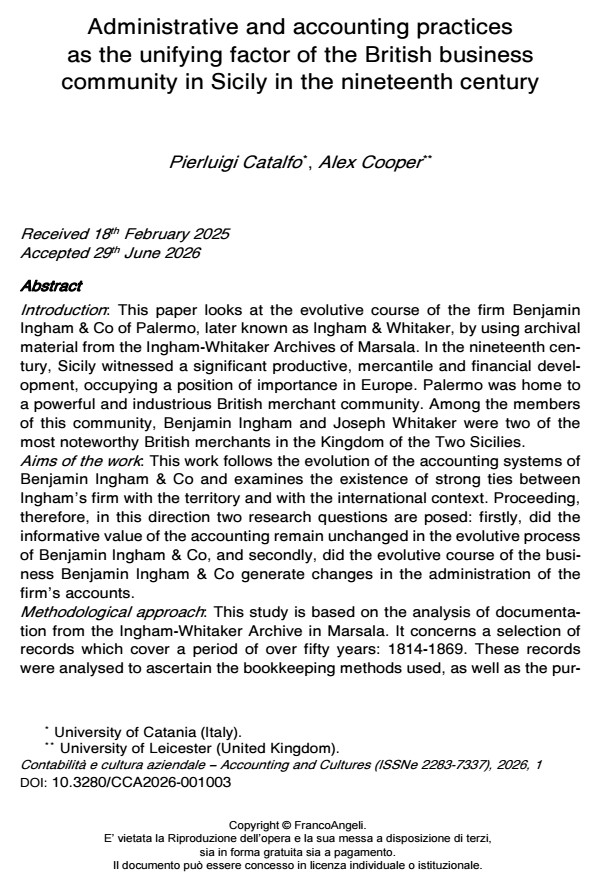
Introduction: This paper looks at the evolutive course of the firm Benjamin Ingham & Co of Palermo, later known as Ingham & Whitaker, by using archival material from the Ingham-Whitaker Archives of Marsala. In the nineteenth century, Sicily witnessed a significant productive, mercantile and financial development, occupying a position of importance in Europe. Palermo was home to a powerful and industrious British merchant community. Among the members of this community, Benjamin Ingham and Joseph Whitaker were two of the most noteworthy British merchants in the Kingdom of the Two Sicilies. Aims of the work: This work follows the evolution of the accounting systems of Benjamin Ingham & Co and examines the existence of strong ties between Ingham’s firm with the territory and with the international context. Proceeding, therefore, in this direction two research questions are posed: firstly, did the informative value of the accounting remain unchanged in the evolutive process of Benjamin Ingham & Co, and secondly, did the evolutive course of the business Benjamin Ingham & Co generate changes in the administration of the firm’s accounts. Methodological approach: This study is based on the analysis of documentation from the Ingham-Whitaker Archive in Marsala. It concerns a selection of records which cover a period of over fifty years: 1814-1869. These records were analysed to ascertain the bookkeeping methods used, as well as the purpose and content of the information they contain. By examining these records within the given timeframe, a comparison of the selected sources was made. The theoretical framework of this paper reflects the idea that accounting is a social tool, a social institutional practice, embedded in the social fabric and environment where it is practised. Bookkeeping has an ethnographical importance and, in the case studied here, the changes in bookkeeping techniques also occur in response to a changing environment. Main findings: From an analysis of the archival material over the period concerned, we have found the relevance of information systems in managing complex, even global business development. The main findings show that the firm used double-entry bookkeeping. In the early daybooks taken from 1814 and 1819, there was a dense concentration of information in the records, which in response to the research questions, demonstrates a deep, but compressed amount of information. In contrast, later records selected from 1866-1869, illustrate a change in the firm’s bookkeeping. This marks a change in the firm’s business in general, reflected by an evolutive development of the firm’s accounting methods. Contribution to the literature: This paper, from the records examined, demonstrates the existence of a deeply integrated British business community which had a common code in its accounting and administrative practices for managing its internal relations. Although there is a gap in the archival material from 1819 until 1866 in the daybooks, this void highlights the transition the firm Benjamin Ingham & Co made from a prevalently mercantile concern, to a more financial one which invested its patrimony globally, despite being based in Palermo. From the registers chosen a network of individuals can be traced which demonstrate a web of social and economic contacts within the business community of Sicily. These businessmen interacted with Ingham’s firm conducting significant business both on a commercial as well as a financial level. This paper fills a gap in the previous literature, to show how the firm’s bookkeeping and administrative methods were increasingly tied to the management of the firm’s growing patrimony on an international level.
Parole chiave:The Kingdom of the Two Sicilies, administrative and accounting methods, the British merchant community, the British Decade, double entry bookkeeping, global patrimony
- Battaglia R (2003). L’Ultimo Splendore: Messina tra rilancio e decadenza (1815-1920). Catanzaro: Rubbettino Editore.
- Becker G. S. (2008). Human capital. The Concise Encyclopaedia of Economics, 24850.
- Bottari S. (2018). Consoli inglesi nella Sicilia del Settecento: funzioni istituzionali e attività informali: in Ecole Francaise de Rome, Collection de la Casa de Velazquez, 160 Torrossa. Pp. 211-222.
- Bourdieu P. (2005). The Social Structures of the Economy. Cambridge: Polity Press.
- Boyns R. et al. (2000). Historical Accounting Records: A Guide for Archivists and Researchers. Somerset: Society of Archivists.
- Calaresu M. (2020). Thomas Jones’ Neapolitan kitchen: the material cultures of food on the Grand Tour. Journal of Early Modern History, 24(1): 84-102. DOI: 10.1163/15700658-12342664
- Cain P.J., A. G. Hopkins (1986). Gentlemanly capitalism and British expansion overseas I. The old colonial system, 1688-1850. Economic History Review, 501-525. DOI: 10.2307/2596293
- Cancila O. (2020). I Florio: Storia di una Dinastia Imprenditoriale. Catanzaro: Rubbettino Editore.
- Candela S. (1986). I Florio. Palermo: Sellerio Editore.
- Carnegie G.D., Brendan T. O’Connell (2012). Accounting scandals in Australia since the late 1980s. Creative accounting, fraud and international accounting scandals, pp. 135-161.
- Carnegie G.D. (2014). The Present and Future of Accounting History. Accounting, Auditing and Accountability Journal, 27: 1241-1249.
- Carnegie G.D., Napier C.J. (2017). Historiography in accounting research. The Routledge companion to qualitative accounting research methods. London: Routledge, 71-90. DOI: 10.4324/9781003509295-10
- Catalfo P., Cooper A. (2023). The Bankruptcy of Abraham Gibbs & Co. and the Crises of British Merchant Banking in the Kingdom of the Two Sicilies and in Britain. Contabilità e cultura aziendale: rivista della Società Italiana di Storia della Ragioneria, XXIII(2): 63-85.
- D'Andrea D. (2012). Gould Francis Leckie e la Sicilia, 1801-1818. Napoli: Edizioni Scientifiche Italiane.
- D'Angelo M. (1978). Alle origini dei Florio. Commercio Marittimo tra Bagnara e la Sicilia Occidentale alla fine del Settecento. Nuovi Quaderni del Meridione, 64: 381-394.
- D'Angelo M. (1988). Mercanti inglesi in Sicilia, 1806-1815: Rapporti Commerciali tra Sicilia e Gran Bretagna nel Periodo del Blocco Continentale. Milano: Giuffrè.
- D'Angelo M. (1992). Una Famiglia di Mercanto Imprenditori tra Malta e la Sicilia. I Sanderson. In: (ed.) I Whitaker e il Capitale Inglese in Sicilia Tra l’Ottocento e il Novecento. Trapani: Libera Università pp. 109-130.
- D’Angelo M, Lentini R., Saija M. (2020). Il ‘Decennio Inglese ‘ 1806-1815 in Sicilia. Bilancio storiografico e prospettive di Ricerca. Catanzaro: Rubbettino Università.
- Davis J. (1975). Oligarchia Capitalistica e Immobilismo Economico a Napoli (1815-1860). Studi Storici, 16(2): 378-426.
- DiMaggio P. J., and Powell W. W. (2000). The Iron Cage Revisited: Institutional Isomorphism and Collective Rationality in Organizational Fields. The New Economic Sociology. DOI: 10.1515/9780691122970-005
- Del Pozzo A. (1993). La contabilità di J. Whitaker: Modalità di Funzionamento dei Conti e Contenuto Informativo. In: Atti Del Convegno Nazionale di Storia della Ragioneria. Pisa: Pacini Editore.
- Di Pietro R. (2016). Exporting Marsal Wine and Importing Accounting Practices. In Sargiacomo M., L. D'Amico, and R. Di Pietra, eds. Accounting and food: some Italian experiences. London: Routledge. 9781315624259-16.
- Edwards J.R. (2011). Accounting education in Britain during the early modern period. Accounting History Review, 21(1): 37-67 DOI: 10.1080/21552851.2011.548544
- Epstein S.R. (1945). An Island for Itself. Economic Development and Social Change in Late Medieval Sicily. Cambridge University Press.
- Fazio I. (2001). Temporanee Confusioni. Matrimoni e modelli di successo nelle comunità estere a Messina nell’Ottocento. Quaderni Storici, 36(2): 475-516.
- Granovetter M. (1973). Strength of Weak Ties American. Journal of Sociology, 78(6): 1360-1380. DOI: 10.1086/225469
- Granovetter M. (1985). Economic Action and Social Structure: The Problem of Embeddedness. American Journal of Sociology, 91(3): 481-510. -- www.jstor.org/stable/2780199. doi.org/10.17323/1726-3247-2002-3-44-58.
- Håkansson H., Snehota I. (1989). No Business is an Island: The Network Concept of Business Strategy. Scandinavian Journal of Management, 5(3): 187-200. DOI: 10.1016/0956-5221(89)90026-2
- Hopwood A.G., Miller P. (1994). Accounting as Social and Institutional Practice. Cambridge: Cambridge University Press. DOI: 10.2307/2076997
- Hudson P. (1981). The Role of Banks in the Finance of the West Yorkshire Wool Textile Industry, c. 1780-1850. Business History Review, 55(3): 379-402. DOI: 10.2307/3114130
- Lentini R. (1976). Note su un Operatore Commerciale in Sicilia 1799-1802. Nuovi Quaderni del Meridione, 56: 386-394.
- Lentini R. (1990). Alle Origine del Capitalismo Finanziario: La Nascita della Prima Compagnia di Assicurazioni di Palermo. In: C. D’Aleo, S. Girgenti (Eds). I Whitaker e il Capitale Inglese tra l'Ottocento e il Novecento in Sicilia. Trapani: Libera Università, pp. 83-107.
- Lentini R. (2004). Dal Commercio alla Finanza: I Negozianti Banchieri Inglesi nella Sicilia Occidentale tra XVIII e XIX secolo. Mediterranea Ricerche Storiche.
- Lentini R. (2019). Sicilie del Vino nell’800: i Woodhouse, gli Ingham-Whitaker, il Duca d’Aumale e i Duchi di Salaparuta. Palermo: Palermo University Press.
- Lipset Seymour M., M. Trow, and J. S. Coleman. (2017). Organizational analysis. Sociological Methods. Routledge, 127-136. DOI: 10.4324/9781315129945-12
- Mandják T., Szántó Z. (2010). How can Economic Sociology Help Business Relationship Management?. Journal of Business & Industrial Marketing 25(3): 202-208. DOI: 10.1108/08858621011027795
- Manera C., Morey A., Seguì A. (2024). Merchant Networks and Profits on Merchant Capital in the Mediterranean (Majorca, 18th Century). Business History, 66(5). DOI: 10.1080/00076791.2022.2087632
- McKendrick N. (1960). Josiah Wedgwood: an eighteenth-century entrepreneur in salesmanship and marketing techniques. The Economic History Review, 12(3): 408-433. DOI: 10.2307/2590885
- Mennicken A., Miller P., Samiolo R. (2008). Accounting for Economic Sociology. Economic Sociology the European Electronic Newsletter, 10(1): 3-7.
- Mennicken A. (2002). Bringing calculation back. In: Sociological studies in accounting. Economic Sociology: European Electronic Newsletter, 3(3): 17-27. Hdl.handle.net/10419/155809.
- Misa T.J. (1996). Toward an Historical Sociology of Business Culture. Business and Economic History, 25(1): 55-64.
- Neal L. (2024). Lessons Learned, Applied, and Ignored. The Forgotten Financiers of the Louisiana Purchase: European Bankers, the US, and the Rise of International Finance. Cham: Springer Nature Switzerland, 203-211. DOI: 10.1007/978-3-031-5677-8_11
- Neill E. (2008). Fragile Fortunes: The Origins of a Great British Merchant Family. Somerset: Ryelands.
- Nobes C., Parker R.H. (2008). Comparative international accounting. Pearson Education, DOI: 10.1177/1032373216661363
- Pizzoni G. (2022). British Power in the Mediterranean: Sea Protests and Notarial Practice in Nineteenth-century Malta. The Journal of Imperial and Commonwealth History, 50(5): 829-859. DOI: 10.1080/03086534.2022.2086206
- Recca C. (2025). The Bourbons in Sicily and the British Protectorate. An Account of Events During an Awkward Coexistence, Royal Studies Journal.
- Riccobono F. (2006). Il Circolo della Borsa Messina 1805-2005: Due Secoli di Vita Sociale. Messina: EDAS, Ed. Sfameni.
- Schisani M. C., et al. (2021). Crowding out the change: business networks and persisting economic elites in the South of Italy over Unification (1840-1880). Cliometrica 15: 89-131.
- Scott-Warren J. (2016). Early Modern Bookkeeping and Life-Writing Revisited: Accounting for Richard Stonley. Past & Present 230(suppl.11): 151-170.
- Silvestri P (1985). Una Scelta di Lettere Commerciali dell’Archivio Ingham. Nuovi Quaderni del Meridione, XXIII(90): 181-188.
- Smelser N.J. and Swedberg R. (2005). Introducing economic sociology. The Handbook of Economic Sociology, 2: 3-25. DOI: 10.17323/1726-3247-2003-4-43-61
- Smyth A. (2010). Autobiography in Early Modern England. Cambridge: Cambridge University Press.
- Still K., Huhtamaki J., and Russell M. (2013). Relational capital and social capital: one or two fields of research?. In: Proceedings of the 10th International Conference on Intellectual Capital, knowledge Management and Organisational Learning: ICICKM 2013, Academic Conferences Limited. pp. 420-428.
- Swedberg R., Himmelstrand U., Brulin G. (1987). The paradigm of economic sociology: premises and promises. Theory and society, 16(2): 169-213.
- Trevelyan R. (1977). La Storia dei Whitaker. Palermo: Sellerio Editore.
- Trevelyan R. et al. (2012). Princes Under the Volcano. London: Faber & Faber.
- Wilkins M. (1989). The History of Foreign Investment in the United States to 1914. Harvard University Press.
- Wood D.M. (2016). Beyond the Panopticon? Foucault and Surveillance Studies. In: Elden S. and Crampton J.W. (eds.). Space, Knowledge and Power: Foucault and Geography. Routledge, 245-263. 5610146. DOI: 10.4324/97813
- Yamey B.S. (1949). Scientific Bookkeeping and the Rise of Capitalism. The Economic History Review, 1(2/3): 99-113. DOI: 10.2307/2589824
- Yin R. (2013). Case Study Research Design and Methods. Sage Publications Inc.
Pierluigi Catalfo, Alex Cooper, Administrative and accounting practices as the unifying factor of the British business community in Sicily in the nineteenth century in "CONTABILITÀ E CULTURA AZIENDALE" 1/2026, pp 41-65, DOI: 10.3280/CCA2026-001003