Promoting healthcare professionals’ resilience: The Mindfulness Oriented Professional Resilience (MOPR) Program
Journal title PSICOLOGIA DELLA SALUTE
Author/s Fabio D’Antoni, Alessio Matiz, Cristiano Crescentini
Publishing Year 2026 Issue 2026/2
Language Italian Pages 25 P. 70-94 File size 226 KB
DOI 10.3280/PDS2026-002005
DOI is like a bar code for intellectual property: to have more infomation
click here
Below, you can see the article first page
If you want to buy this article in PDF format, you can do it, following the instructions to buy download credits
FrancoAngeli is member of Publishers International Linking Association, Inc (PILA), a not-for-profit association which run the CrossRef service enabling links to and from online scholarly content.
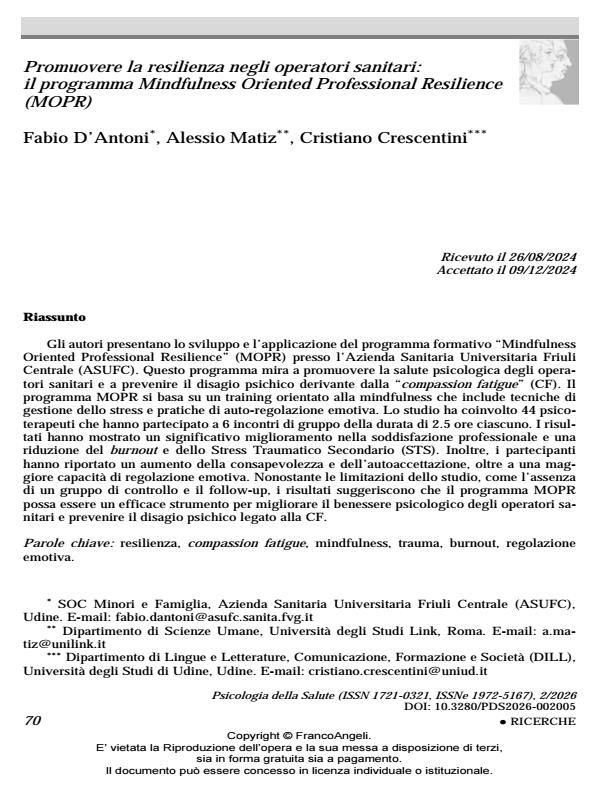
The authors present the development and implementation of the “Mindfulness Oriented Professional Resilience” (MOPR) training program at the Azienda Sanitaria Universitaria Friuli Centrale (ASUFC). This program aims to promote the psychological health of healthcare professionals and prevent psychological distress caused by compassion fatigue (CF). The MOPR program is based on mindfulness training, including stress management techniques and self-care practices. The study involved 44 psychotherapists, who participated in 6 group sessions lasting 2.5 hours each. The results showed a significant improvement in professional satisfaction and a reduction in burnout and secondary traumatic stress (STS). Additionally, participants reported increased mindfulness and self-acceptance, as well as enhanced emotional regulation. Despite the study’s limitations, such as the absence of a control group and the follow-up period, the results suggest that the MOPR program can be an effective tool for improving the psychological well-being of healthcare professionals and preventing CF-related distress.
Keywords: Resilience, compassion fatigue, mindfulness, trauma, burnout, emotional regulation.
- Beck, C. T. (2011). Secondary traumatic stress in nurses: a systematic review. Archives of Psychiatric Nursing, 25(1): 1–10.
- Adriaenssens, J., de Gucht, V. and Maes, S. (2012). The impact of traumatic events on emergency room nurses: findings from a questionnaire survey. International Journal of Nursing Studies, 49(11): 1411–1422.
- Aguzzoli, C., De Santi, A. and Geraci, A. (2021). Benessere e gestione dello stress secondo il modello biopsicosociale: focus su scuola, università e sanità. In Rapporto ISTISAN 21/4. https://www.iss.it/documents/20126/9340614/21-4+web.pdf/f02115e9-9f9f-8ca8-7328-c968080d4c92?t=1711721191072
- Andrews, G. and Faulkner, D. (2004). A glossary of terms for community health care and services for older persons. In Ageing and Health Technical Report (Vol. 5). https://iris.who.int/bitstream/handle/10665/68896/WHO_WKC_Tech.Ser.04.2.pdf
- Babineau, T., Thomas, A. and Wu, V. (2019). Physician burnout and compassion fatigue: Individual and institutional response to an emerging crisis. Current Treatment Options in Pediatrics, 5(1): 1–10.
- Beck, C. T. and Gable, R. K. (2012). A mixed methods study of secondary traumatic stress in labor and delivery nurses. Journal of Obstetric, Gynecologic, and Neonatal Nursing: JOGNN, 41(6): 747–760.
- Beck, C. T., Cusson, R. M. and Gable, R. K. (2017). Secondary Traumatic Stress in NICU Nurses: A Mixed-Methods Study. Advances in Neonatal Care: Official Journal of the National Association of Neonatal Nurses, 17(6): 478–488. DOI: 10.1097/ANC.000000000000042
- Bennett-Levy, J. and Finlay-Jones, A. (2018). The role of personal practice in therapist skill development: a model to guide therapists, educators, supervisors and researchers. Cognitive behaviour therapy, 47(3): 185–205. DOI: 10.1080/16506073.2018.143467
- Berceli, D. and Napoli, M. (2006). A Proposal for a Mindfulness-Based Trauma Prevention Program for Social Work Professionals. Complementary Health Practice Review, 11(3): 153–165. DOI: 10.1177/153321010629798
- Bercier, M. L. and Maynard, B. R. (2015). Interventions for secondary traumatic stress with mental health workers: A systematic review. Research on Social Work Practice, 25(1): 81–89. DOI: 10.1177/104973151351714
- Buranapin, S., Limphaibool, W., Jariangprasert, N. and Chaiprasit, K. (2023). Enhancing organizational resilience through mindful organizing. Sustainability, 15(3): 2681.
- Chiesa, A. and Crescentini, C. (2023). Gli interventi basati sulla mindfulness. Quali sono, come agiscono, quando utilizzarli. Roma: Giovanni Fioriti Editore.
- Cleary, E., Curran, D., Dyer, K., Simms, J. and Hanna, D. (2024). Contributing factors to secondary traumatic stress and vicarious posttraumatic growth in therapists. Journal of traumatic stress, 37(1): 103–112.
- Cocker, F. and Joss, N. (2016). Compassion Fatigue among Healthcare, Emergency and Community Service Workers: A Systematic Review. International Journal of Environmental Research and Public Health, 13(6).
- Collins, S. and Long, A. (2003). Too tired to care? The psychological effects of working with trauma. Journal of psychiatric and mental health nursing, 10(1): 17–27.
- Conversano, C., Ciacchini, R., Orrù, G., Di Giuseppe, M., Gemignani, A. and Poli, A. (2020). Mindfulness, Compassion, and Self-Compassion Among Health Care Professionals: What’s New? A Systematic Review. Frontiers in psychology, 11: 1683.
- D’Antoni, F., Feruglio, S., Matiz, A., Cantone, D. and Crescentini, C. (2022). Mindfulness meditation leads to increased dispositional mindfulness and interoceptive awareness linked to a reduced dissociative tendency. Journal of Trauma and Dissociation: The Official Journal of the International Society for the Study of Dissociation (ISSD), 23(1): 8–23. DOI: 10.1080/15299732.2021.193493
- D’Antoni, F., Matiz, A. and Crescentini, C. (2025). The Arousal Modulation Model Questionnaire (AMMQ): Development, validation, and transdiagnostic applications. European Journal of Trauma & Dissociation, 9(3).
- De Monte, A. and Aguzzoli, C. (2020). Standard 2020 per ospedali e servizi sanitari che promuovono la salute (pp. 1–24). ARCS (Azienda Regionale di Coordinamento per la Salute) e CC Rete HPH del Friuli-Venezia Giulia. https://arcs.sanita.fvg.it/media/uploads/2021/12/29/Italian 2020 HPH Standards v2.pdf
- Dominguez-Gomez, E. and Rutledge, D. N. (2009). Prevalence of secondary traumatic stress among emergency nurses. Journal of Emergency Nursing, 35(3): 194–199.
- Duffy, E., Avalos, G. and Dowling, M. (2015). Secondary traumatic stress among emergency nurses: a cross-sectional study. International Emergency Nursing, 23(2): 53–58.
- Dunn, R., Callahan, J. L., Swift, J. K. and Ivanovic, M. (2013). Effects of pre-session centering for therapists on session presence and effectiveness. Psychotherapy research: journal of the Society for Psychotherapy Research, 23(1): 78–85. DOI: 10.1080/10503307.2012.73171
- Escuriex, B. F. and Labbé, E. E. (2011). Health care providers’ mindfulness and treatment outcomes: A critical review of the research literature. Mindfulness, 2(4): 242–253.
- Fabbro, F. and Crescentini, C. (2016). La meditazione orientata alla mindfulness nella ricerca psicologica. Ricerche Di Psicologia, 4: 457–472.
- Fabbro, F. and Crescentini, C. (2017). Metodo ed efficacia della meditazione orientata alla mindfulness. Giornale Italiano di Psicologia, 2: 293–296. DOI: 10.1421/8733
- Figley, C. R. (1995a). Compassion fatigue as secondary traumatic stress disorder: An overview. In Figley C. R. (Ed.), Compassion fatigue: Coping with secondary traumatic stress disorder in those who treat the traumatized (pp. 1–20). New York: Routledge.
- Figley, C. R. (1995b). Coping with secondary traumatic stress disorder in those who treat the traumatized. In Figley C. R. (Ed.), Compassion fatigue: Coping with secondary traumatic stress disorder in those who treat the traumatized. New York: Routledge Taylor & Francis Group.
- Figley, C. R. and Ludick, M. (2017). Secondary traumatization and compassion fatigue. In Cook J. M. and Gold S. N. (Eds.), APA handbook of trauma psychology: Foundations in knowledge (pp. 573–593). Washington, DC: American Psychological Association.
- Flarity, K., Gentry, J. E. and Mesnikoff, N. (2013). The Effectiveness of an Educational Program on Preventing and Treating Compassion Fatigue in Emergency Nurses. Advanced Emergency Nursing Journal, 35(3). https://journals.lww.com/aenjournal/fulltext/2013/ 07000/the_effectiveness_of_an_educational_program_on.8.aspx
- Forbes, D., Bisson, J. I., Monson, C. M. and Berliner, L. (Eds.). (2020). Effective treatments for PTSD: Practice guidelines from the International Society for Traumatic Stress Studies, 3rd ed. New York: The Guilford Press.
- Garnett, A., Hui, L., Oleynikov, C. and Boamah, S. (2023). Compassion fatigue in healthcare providers: a scoping review. BMC Health Services Research, 23(1): 1336.
- Garrote-Caparrós, E., Bellosta-Batalla, M., Moya-Albiol, L. and Cebolla, A. (2022). Effectiveness of mindfulness-based interventions on psychotherapy processes: A systematic review. Clinical psychology & psychotherapy, 29(3): 783–798.
- Gentry, J. E., Baggerly, J. and Baranowsky, A. (2004). Training-as-treatment: effectiveness of the Certified Compassion Fatigue Specialist Training. International Journal of Emergency Mental Health, 6(3): 147–155.
- Gentry, J. E., Baranowsky, A. B. and Dunning, K. (2002). Accelerated Recovery Program (ARP) For Compassion Fatigue. In Figley C. R. (Ed.), Compassion fatigue: Coping with secondary traumatic stress disorder in those who treat the traumatized (pp. 123–137). New York: Taylor & Francis Group.
- Gevirtz, R., Lehrer, P. M. and Schwartz, M. S. (2016). Cardiorespiratory biofeedback. Biofeedback: A Practitioner’s Guide, 196–213.
- Graves, J., Joyce, C. and Hegazi, I. (2022). From Empathy to Compassion Fatigue: A Narrative Review of Implications in Healthcare (S. Ventura (ed.); p. Ch. 1). IntechOpen.
- Gunaratana, H. (2002). Mindfulness in Plain English, Wisdom Publication.
- Hayes, S. C., Strosahl, K. D. and Wilson, K. G. (2013). ACT. Teoria e pratica dell’Acceptance and Commitment Therapy. Milano: Raffaello Cortina.
- Iani, L., Lauriola, M. and Cafaro, V. (2020). The assessment of mindfulness skills: the “what” and the “how”. Journal of Mental Health (Abingdon, England), 29(2): 144–151. DOI: 10.1080/09638237.2017.138573
- Joinson, C. (1992). Coping with compassion fatigue. Nursing, 22(4): 116, 118-119, 120.
- Kabat-Zinn, J. (2008). Riprendere i sensi. Guarire sé stessi e il mondo attraverso la consapevolezza (7° edizione). Milano: TEA.
- Kabat-Zinn, J. (2019). Dovunque tu vada ci sei già. In cammino verso la consapevolezza (7° edizione). Milano: Corbaccio.
- Kabat-Zinn, J. (2021). Vivere momento per momento. Sconfiggere lo stress, il dolore, l’ansia e la malattia con la mindfulness (6° edizione). Milano: Corbaccio.
- Kellogg, M. B., Knight, M., Dowling, J. S. and Crawford, S. L. (2018). Secondary Traumatic Stress in Pediatric Nurses. Journal of Pediatric Nursing, 43: 97–103.
- Kelly, L., Runge, J. and Spencer, C. (2015). Predictors of Compassion Fatigue and Compassion Satisfaction in Acute Care Nurses. Journal of Nursing Scholarship: An Official Publication of Sigma Theta Tau International Honor Society of Nursing, 47(6): 522–528.
- Khazan, I. Z. (2023). Manuale clinico del biofeedback. Una guida per il training e la pratica con la mindfulness. Milano: FrancoAngeli.
- Kintzle, S., Yarvis, J. S. and Bride, B. E. (2013). Secondary traumatic stress in military primary and mental health care providers. Military Medicine, 178(12): 1310–1315. DOI: 10.7205/MILMED-D-13-0008
- Klein, A., Taieb, O., Xavier, S., Baubet, T. and Reyre, A. (2020). The benefits of mindfulness-based interventions on burnout among health professionals: A systematic review. Explore (New York, N.Y.), 16(1): 35–43.
- Lehrer, P., Vaschillo, B., Zucker, T., Graves, J., Katsamanis, M., Aviles, M. and Wamboldt, F. (2013). Protocol for Heart Rate Variability Biofeedback Training. Biofeedback, 41(3): 98–109. DOI: 10.5298/1081-5937-41.3.0
- Mangoulia, P., Koukia, E., Alevizopoulos, G., Fildissis, G. and Katostaras, T. (2015). Prevalence of Secondary Traumatic Stress Among Psychiatric Nurses in Greece. Archives of Psychiatric Nursing, 29(5): 333–338.
- Mastenbroek, N. J. J. M., Jaarsma, A. D. C., Scherpbier, A. J. J. A., van Beukelen, P. and Demerouti, E. (2014). The role of personal resources in explaining well-being and performance: A study among young veterinary professionals. European Journal of Work and Organizational Psychology, 23(2): 190–202. DOI: 10.1080/1359432X.2012.72804
- Matiz, A., Fabbro, F., Paschetto, A., Cantone, D., Paolone, A. R. and Crescentini, C. (2020). Positive impact of mindfulness meditation on mental health of female teachers during the COVID-19 outbreak in Italy. International journal of environmental research and public health, 17(18): 6450.
- McCollum, E. E. and Gehart, D. R. (2010). Using mindfulness meditation to teach beginning therapists therapeutic presence: A qualitative study. Journal of Marital and Family Therapy, 36(3): 347–360.
- Neff, K. D. (2019). La self-compassion. Il potere dell’essere gentili con sé stessi. Milano: FrancoAngeli.
- Neff, K. D. (2023). Self-Compassion: Theory, Method, Research, and Intervention. Annual Review of Psychology, 74: 193–218.
- Ogden, P. and Fisher, J. (2016). Psicoterapia sensomotoria. Interventi per il trauma e l’attaccamento. Milano: Raffaello Cortina.
- Ogden, P., Minton, K. and Pain, C. (2023). Il trauma e il corpo. Un approccio sensomotorio alla psicoterapia. Milano: Raffaello Cortina.
- Pagani, M. and Carletto, S. (2019). Il cervello che cambia. Neuroimaging: il contributo alle neuroscienze. Milano: Mimesis.
- Palestini, L., Prati, G., Pietrantoni, L. and Cicognani, E. (2009). La qualità della vita professionale nel lavoro di soccorso: un contributo alla validazione italiana della Professional Quality of Life Scale (ProQOL) [The professional quality of life in accident and emergency work: A contribution to the Italian validation of the Professional Quality of Life Scale (ProQOL)]. Psicoterapia Cognitiva e Comportamentale, 15(2): 205–227.
- Partlak Günüsen, N., Üstün, B., Serçekus Ak, P. and Büyükkaya Besen, D. (2019). Secondary traumatic stress experiences of nurses caring for cancer patients. International Journal of Nursing Practice, 25(1): e12717.
- Pereira, J. A., Barkham, M., Kellett, S. and Saxon, D. (2017). The Role of Practitioner Resilience and Mindfulness in Effective Practice: A Practice-Based Feasibility Study. Administration and policy in mental health, 44(5): 691–704.
- Pérez, V., Menéndez-Crispín, E. J., Sarabia-Cobo, C., de Lorena, P., Fernández-Rodríguez, A. and González-Vaca, J. (2022). Mindfulness-Based Intervention for the reduction of Compassion Fatigue and Burnout in nurse caregivers of institutionalized older persons with dementia: A randomized controlled trial. International Journal of Environmental Research and Public Health, 19(18).
- Polimeni, J., Andreatti, M. and Aguzzoli, C. (2022). La Rete Health Promoting Hospitals and Health Services (HPH) nella Regione Friuli Venezia Giulia: uno strumento utile per promuovere il benessere degli operatori sanitari. Organizzazione sanitaria, 4: 3-14.
- Polk, K. L., Schoendorff, B., Webster, M. and Olaz, F. O. (2021). La matrice ACT. Guida all’utilizzo nella pratica clinica. Milano: FrancoAngeli.
- Porges, S. W. (2014). La teoria polivagale. Fondamenti neurofisiologici delle emozioni, dell’attaccamento, della comunicazione e dell’autoregolazione. Giovanni Fioriti Editore.
- Quinal, L., Harford, S. and Rutledge, D. N. (2009). Secondary traumatic stress in oncology staff. Cancer Nursing, 32(4): E1-7.
- Ratrout, H. F. and Hamdan-Mansour, A. M. (2020). Secondary traumatic stress among emergency nurses: Prevalence, predictors, and consequences. International Journal of Nursing Practice, 26(1): e12767.
- Ray, S. L., Wong, C., White, D. and Heaslip, K. (2013). Compassion Satisfaction, Compassion Fatigue, work life conditions, and Burnout among frontline mental health care professionals. Traumatology, 19(4): 255–267. DOI: 10.1177/153476561247114
- Rosenberg, S. and Porges, S. W. (2023). Vago - Il Mio Nervo più Importante. Cesena: Macro Edizioni.
- Ruini, C., Ottolini, F., Rafanelli, C., Ryff, C. D. and Fava, G. A. (2003). Italian validation of Psychological Well-Being Scales (PWB). Rivista di Psichiatria, 38(3): 117–130.
- Ryff, C. D. and Keyes, C. L. M. (1995). The structure of psychological well-being revisited. Journal of Personality and Social Psychology, 69(4): 719–727. DOI: 10.1037/0022-3514.69.4.71
- Salimi, S., Pakpour, V., Rahmani, A., Wilson, M. and Feizollahzadeh, H. (2020). Compassion Satisfaction, Burnout, and Secondary Traumatic Stress Among Critical Care Nurses in Iran. Journal of Transcultural Nursing: Official Journal of the Transcultural Nursing Society, 31(1): 59–66. DOI: 10.1177/104365961983887
- Siegel, D. J. (2021). La mente relazionale. Neurobiologia dell’esperienza interpersonale (3° edizione). Milano: Raffaello Cortina.
- Sirigatti, S., Stefanile, C., Giannetti, E., Iani, L., Penzo, I. and Mazzeschi, A. (2009). Assessment of factor structure of Ryff’s psychological well-being scales in Italian adolescents. Giunti Organizzazioni Speciali, 259(56): 30–50.
- Southwick, S. M., Bonanno, G. A., Masten, A. S., Panter-Brick, C. and Yehuda, R. (2014). Resilience definitions, theory, and challenges: Interdisciplinary perspectives. European Journal of Psychotraumatology, 5(25338): 1–14.
- Stamm, H. B. (2002). Measuring Compassion Satisfaction as well as Fatigue. In Figley C.R. (Ed.), Treating Compassion Fatigue (pp. 1–13). New York: Routledge.
- Stamm, H. B. (2009). Compassion Satisfaction and Fatigue (ProQOL) Version 5. www.proqol.org
- Stevens, K. and Al-Abbadey, M. (2024). Compassion fatigue and global compassion fatigue in practitioner psychologists: A qualitative study. Current Psychology, 43(8): 7259–7274.
- Taylor, N. Z. and Millear, P. M. R. (2016). The contribution of mindfulness to predicting burnout in the workplace. Personality and Individual Differences, 89: 123–128. https://doi.org/
- Tsouvelas, G., Kalaitzaki, A., Tamiolaki, A., Rovithis, M. and Konstantakopoulos, G. (2022). Secondary traumatic stress and dissociative coping strategies in nurses during the COVID-19 pandemic: The protective role of resilience. Archives of Psychiatric Nursing, 41: 264–270.
- World Health Organization (2022). WHO guidelines on mental health at work. Geneva: World Health Organization. https://iris.who.int/bitstream/handle/10665/363177/9789240053052-eng.pdf
- World Health Organization (WHO) (2019). International statistical classification of diseases and related health problems (11th ed.). Geneva: World Health Organization. https:// icd.who.int/en
- Young, J. L., Derr, D. M., Cicchillo, V. J. and Bressler, S. (2011). Compassion satisfaction, burnout, and secondary traumatic stress in heart and vascular nurses. Critical Care Nursing Quarterly, 34(3): 227–234.
- Zhang, D., Lee, E. K. P., Mak, E. C. W., Ho, C. Y. and Wong, S. Y. S. (2021). Mindfulness-based interventions: an overall review. British medical bulletin, 138(1): 41–57.
Fabio D’Antoni, Alessio Matiz, Cristiano Crescentini, Promuovere la resilienza negli operatori sanitari: il programma Mindfulness Oriented Professional Resilience (MOPR) in "PSICOLOGIA DELLA SALUTE" 2/2026, pp 70-94, DOI: 10.3280/PDS2026-002005