Violenza contro le persone anziane: il punto di vista delle assistenti sociali
Titolo Rivista WELFARE E ERGONOMIA
Autori/Curatori Francesca Corradini
Anno di pubblicazione 2026 Fascicolo 2026/1
Lingua Italiano Numero pagine 14 P. 169-182 Dimensione file 55 KB
DOI 10.3280/WE2026-0001013
Il DOI è il codice a barre della proprietà intellettuale: per saperne di più
clicca qui
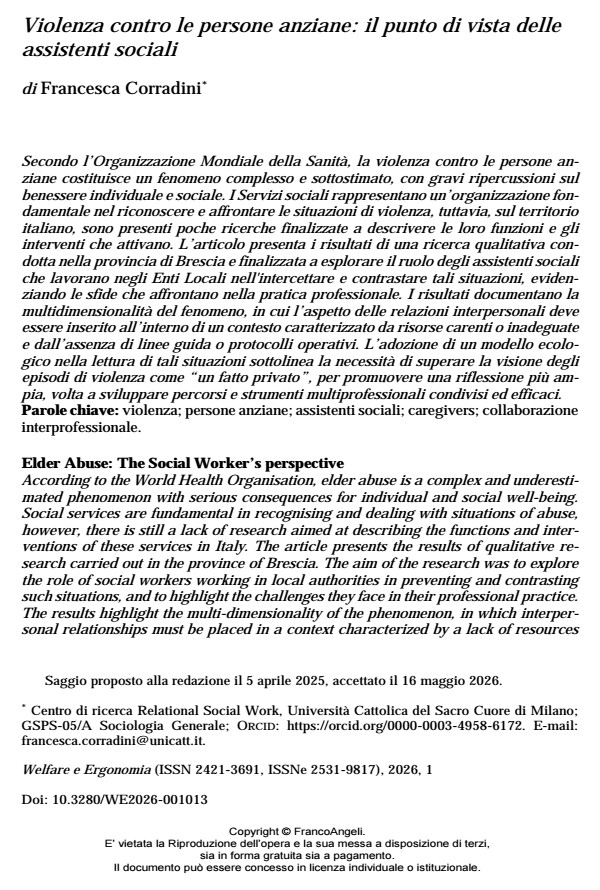
Qui sotto puoi vedere in anteprima la prima pagina di questo articolo.
Se questo articolo ti interessa, lo puoi acquistare (e scaricare in formato pdf) seguendo le facili indicazioni per acquistare il download credit. Acquista Download Credits per scaricare questo Articolo in formato PDF
FrancoAngeli è membro della Publishers International Linking Association, Inc (PILA), associazione indipendente e non profit per facilitare (attraverso i servizi tecnologici implementati da CrossRef.org) l’accesso degli studiosi ai contenuti digitali nelle pubblicazioni professionali e scientifiche.
Secondo l’Organizzazione Mondiale della Sanità, la violenza contro le persone anziane costituisce un fenomeno complesso e sottostimato, con gravi ripercussioni sul benessere individuale e sociale. I Servizi sociali rappresentano un’organizzazione fondamentale nel riconoscere e affrontare le situazioni di violenza, tuttavia, sul territorio italiano, sono presenti poche ricerche finalizzate a descrivere le loro funzioni e gli interventi che attivano. L’articolo presenta i risultati di una ricerca qualitativa condotta nella provincia di Brescia e finalizzata a esplorare il ruolo degli assistenti sociali che lavorano negli Enti Locali nell'intercettare e contrastare tali situazioni, evidenziando le sfide che affrontano nella pratica professionale. I risultati documentano la multidimensionalità del fenomeno, in cui l’aspetto delle relazioni interpersonali deve essere inserito all’interno di un contesto caratterizzato da risorse carenti o inadeguate e dall’assenza di linee guida o protocolli operativi. L’adozione di un modello ecologico nella lettura di tali situazioni sottolinea la necessità di superare la visione degli episodi di violenza come “un fatto privato”, per promuovere una riflessione più ampia, volta a sviluppare percorsi e strumenti multiprofessionali condivisi ed efficaci.
Parole chiave:violenza; persone anziane; assistenti sociali; caregivers; collaborazione interprofessionale.
- Anand J., Begley E., O’Brien M., Taylor B. and Killick C. (2013). Conceptualising elder abuse across local and global contexts: Implications for policy and professional practice on the island of Ireland. The Journal of Adult Protection, 15(6): 280-289. DOI: 10.1108/JAP-03-2013-0011.
- Beaulieu M. and Leclerc N. (2006). Ethical and psychosocial issues raised by the practice in cases of mistreatment of older adults. Journal of Gerontological Social Work, 46(3-4): 161-186.
- Bergeron L.R. and Gray B. (2003). Ethical Dilemmas of Reporting Suspected Elder Abuse. Social Work, 48(1): 96-105.
- Braun J. (2021). Preventing Harm to Vulnerable Older Adults: A Social Justice Perspective. Research on Social Work Practice, 31(6): 561-575. DOI: 10.1177/10497315211010959
- Braun V. and Clarke V. (2022). Thematic analysis: a practical guide. Cham: SAGE Publications Ltd.
- Bronfenbrenner U. (1979). The ecology of human development. Cambridge: Harvard University Press.
- Brownell P. and Wolden A. (2003). Elder abuse intervention strategies: Social service or criminal justice?. Journal of Gerontological Social Work, 40(1-2): 83-100.
- Da Roit B., Spada S., Perocco F. and Matutini E. (2025). La violenza domestica nei confronti delle donne anziane in Italia: le politiche di contrasto alle prese con sessismo, ageismo e familismo. Welfare e Ergonomia, XI(2): 151-168. DOI: 10.3280/WE2025-002011
- Dias I. and Fraga S. (2024). “Older people are weak”: Perceptions and meanings of ageing and abuse against older people. Frontiers in Sociology, 8, 1329005.
- Fazzi I. (2021). Il maltrattamento dell’anziano in RSA. Analisi del fenomeno, strumenti per l’individuazione, strategie di prevenzione. Sant’Arcangelo di Romagna: Maggioli.
- Fearing G., Sheppard C.L., McDonald L., Beaulieu M. and Hitzig S.L. (2017). A systematic review on community-based interventions for elder abuse and neglect. Journal of Elder Abuse & Neglect, 29(2-3): 102-133. DOI: 10.1080/08946566.2017.1308286
- Fundinho J.F., Pereira D.C. and Ferreira-Alves J. (2021). Theoretical approaches to elder abuse: A systematic review of the empirical evidence. The Journal of Adult Protection, 23(6): 370-383. DOI: 10.1108/JAP-04-2021-0014
- Hörl J. (2018). The Victim-Perpetrator Problem in Elder Abuse and Neglect. In: Kratcoski P.C. and Edelbacher M., editors, Perspectives on Elderly Crime and Victimization, Springer International Publishing, pp. 161-172. DOI: 10.1007/978-3-319-72682-3_9
- Khanlary Z., Maarefvand M., Biglarian A. and Heravi-Karimooi M. (2016). The effect of a family-based intervention with a cognitive-behavioral approach on elder abuse. Journal of Elder Abuse and Neglect, 28(2): 114-126. DOI: 10.1080/08946566.2016.1141738
- McCausland B., Knight L., Page L. and Trevillion K. (2016). A systematic review of the prevalence and odds of domestic abuse victimization among people with dementia. International Review of Psychiatry, 28(5): 475-484. DOI: 10.1080/09540261.2016.1215296
- Milne A., Cambridge P., Beadle-Brown J., Mansell J. and Whelton B. (2013). The characteristics and management of elder abuse: Evidence and lessons from a UK case study. European Journal of Social Work, 16(4): 489-505. DOI: 10.1080/13691457.2012.722983
- Mosqueda L., Wiglesworth A., Moore A.A., Nguyen A., Gironda M. and Gibbs L. (2016). Variability in findings from adult protective services investigations of elder abuse in California. Journal of Evidence-Informed Social Work, 13(1): 34-44. DOI: 10.1080/15433714.2014.939383
- Phelan A. and Ayalon L. (2020). The intersection of ageism and elder abuse. In: Phelan A., editor, Advances in Elder Abuse Research. Practice, Legislation and Policy, pp. 11-22. Cham: Springer.
- Phelan A. and O’Donnell D. (2020). An ecological perspective on elder abuse interventions. In: Phelan A., editor, Advances in Elder Abuse Research. Practice, Legislation and Policy, pp. 193-221. Cham: Springer.
- Pillemer K., Burnes D., Riffin C. and Lachs M.S. (2016). Elder abuse: Global situation, risk factors, and prevention strategies. The Gerontologist, 56(S2): S194-S205.
- Powell M.E. and Berman J. (2006). Effects of dependency on compliance rates among elder abuse victims at the New York City department for the aging, elderly crime victim’s unit. Journal of Gerontological Social Work, 46(3-4): 229-247.
- Pregno C. (2018). Servizio sociale e anziani. Roma: Carocci Faber.
- Rowan J.M., Yonashiro-Cho J., Wilber K.H. and Gassoumis Z.D. (2020). Who is in the revolving door? Policy and practice implications of recurrent reports to adult protective services. Journal of Elder Abuse and Neglect, 32(5): 489-508. DOI: 10.1080/08946566.2020.1852142
- Rudatis S.F. (2020). L’assistente sociale e la violenza contro le donne over 65. I luoghi della cura online, 4. iluoghidelacura.it.
- Sethi D., Wood S., Mitis F., Bellis M., Penhale B., Iborra Marmolejo I., Lowenstein A., Manthorpe G. and Ulvestad Kärki F. (eds) (2011). European report on preventing elder maltreatment. Geneva: World Health Organization.
- Sherwood-Johnson F., Rummery K., Lawrence J., Mackay K., Ramsay K. and McGregor R. (2023). Dangerous care: developing theory to safeguard older adults in caring relationships in the UK. The Journal of Adult Protection, 25(3): 156-166. DOI: 10.1108/JAP-10-2022-0023
- Teaster P.B., Lindberg B.W. and Zhao Y. (2020). Elder abuse policy, past, present, and future trends, In: Phelan A., editor, Advances in Elder Abuse Research. Practice, Legislation and Policy, Cham: Springer, pp. 53-71. DOI: 10.1007/978-3-030-25093-5_5
- Wamara C.K. (2022). Social Work Response to Elder Abuse in Uganda: Voices from Practitioners. Journal of Gerontological Social Work, 65(4): 361-381. DOI: 10.1080/01634372.2021.1968093
- World Health Organization (WHO) (2022). Tackling abuse of older people: five priorities for the United Nations Decade of Healthy Ageing (2021-2030). Geneva: World Health Organization.
- World Health Organization (WHO) (2021). Global report on ageism. Geneva: World Health Organization. -- https://www.who.int/teams/social-determinants-of-health/demographic-change-and-healthy-ageing/combatting-ageism/global-report-on-ageism.
- Yan E., Ng H.K.L., Sun R., Lai D.W.L., Cheng S.T., Lou V.W.Q., Fong D.Y.T. and Kwok T. (2022). Resilience as a protective factor against elder abuse by family caregivers: Findings from a cross-sectional study in Hong Kong. The Journal of Adult Protection, 24(5-6): 255-269. DOI: 10.1108/JAP-06-2022-0012
- Yonashiro-Cho J., Rowan J.M., Gassoumis Z.D., Gironda M.W. and Wilber K.H. (2019). Toward a better understanding of the elder abuse forensic center model: Comparing and contrasting four programs in California. Journal of Elder Abuse and Neglect, 31(4-5): 402-423. DOI: 10.1080/08946566.2019.1647326
Francesca Corradini, Violenza contro le persone anziane: il punto di vista delle assistenti sociali in "WELFARE E ERGONOMIA" 1/2026, pp 169-182, DOI: 10.3280/WE2026-0001013