The job to represent oneself towards the work. The individual facing the building and the recognition of the professional value and identity

Journal title SOCIOLOGIA DEL LAVORO
Author/s Marco Ruffino
Publishing Year 2013 Issue 2013/129
Language Italian Pages 20 P. 137-156 File size 306 KB
DOI 10.3280/SL2013-129009
DOI is like a bar code for intellectual property: to have more infomation click here

Below, you can see the article first page

If you want to buy this article in PDF format, you can do it, following the instructions to buy download credits
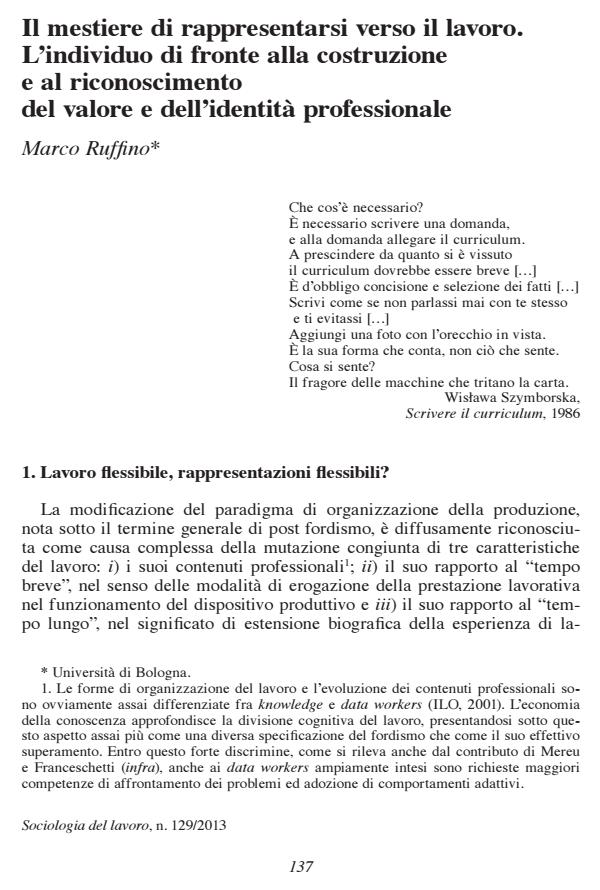
Article preview

FrancoAngeli is member of Publishers International Linking Association, Inc (PILA), a not-for-profit association which run the CrossRef service enabling links to and from online scholarly content.

The paper discuss the work representations, moving from the perspective of the individual involved in a job or looking for it. The thesis consists of three arguments: the work representation is changing from the specification of a clear position in the professional space to the "convenient reshaping" of the individual experience gained by the formal, non formal and informal learning; the individual is committed, at the same time, in two different representation processes, respectively related to the identity toward the work and to the competencies set owned, sees as a non-contextual and plural resources. This double exercise may cause critical consequences in the relations between the "to be" (as a social identity) and the "to have" (reusable competencies) dimensions; the representation capability toward the work has to be seen as a professional core component and a key bargaining resource in the labour market. In specific, the meta-cognitive aspects are gaining a clear centrality. This process is not neutral in terms of real rights, leading a more incisive individualization of inequality, especially for the individuals with poor capabilities. To conclude, the author stress the opportunity to redirect the sociological and political attention from the "representation" in itself (as a protocol signalling the position toward the work) to the "representing" (in the meaning of key process co-constructive between individual and society, with a correlative suite of rights, duties and functionings). This implies to rethink active welfare schemes and the role of the institutions, in the capabilities perspective.

Keywords: Work representations, individualization, competencies, cognitive biography, professional standards, certification

  1. Giddens A. (1994), Le conseguenze della modernità, Bologna: il Mulino
  2. Hobsbawm E.J. (1997), Il secolo breve. 1914/1991, Milano: Rizzoli
  3. Hyland T. (1996), National Vocational Qualifications, Skills Training and Employers’ Needs: beyond Beaumont and Dearing, in Journal of Vocational Education & Training, vol. 48. n. 4: 349-365
  4. Isfol-Istat (2007), Nomenclatura e classificazione delle Unità Professionali, Roma
  5. Istat (2001), Classificazione delle professioni, Roma: Metodi e norme, Serie C
  6. Joras M., Ravier J.-N. (1993), Comprendre le bilan de compétences, Paris: Editions Liaisons
  7. Lang S., Laumer S., Maier Ch., Eckhardt A. (2011), Drivers, challenges and consequences of E-recruiting: a literature review, in Proceedings of the 49th SIGMIS annual conference on Computer personnel research (SIGMIS-CPR ’11), New York, NY, USA: ACM
  8. Lave J., Wenger E. (1991), Situated learning: Legitimate Peripheral Participation, Cambridge: Cambridge University Press
  9. March J.G. (1998), Prendere decisioni, Bologna: il Mulino
  10. Moscovici S. (1989), “Il fenomeno delle rappresentazioni sociali”, in Moscovici S. e Farr, R.M., Rappresentazioni sociali, Bologna: il Mulino
  11. Nonaka I.,, Takeuchi H. (1997), The knowledge-creating company, Milano: Guerini e Associati
  12. Peterson N.G., Mumford M.D., Borman W.C., Jeanneret P.R., Fleishman E.A., Levin K.Y., Campion M.A., Mayfield M.S., Morgeson F.P., Pearlman K., Gowing, M.K., Lancaster A.R., Silver M.B., Dye D.M. (2001), Understanding Work Using The Occupational Information Network (O*NET): Implications For Practice And Research, in Personnel Psychology, vol. 54, pp. 451-492
  13. Polanyi M. (1962), Personal Knowledge. Towards a Post-Critical Philosophy, London: Routledge
  14. Raccomandazione del Parlamento europeo e del Consiglio del 23 aprile 2008 sulla costituzione del Quadro europeo delle qualifiche per l’apprendimento permanente
  15. Rifkin J.P. (2004), The End of Work: the decline of the global labor force and the dawn of the post-market era. Updated for the 21st Century, New York: J.P. Tarcher/Penguin
  16. Ruffino M. (2010), Individualizzazione della diseguaglianza sociale e politiche delle capacitazioni, in Sociologia del Lavoro, n. 120, pp. 34-49. DOI: 10.3280/ SL2010-120003
  17. Ruffino M., Tolomelli C. (2002), ICT: algoritmi e affetti. Apprendimento e saperi socio economici nella produzione del software, Milano: FrancoAngeli
  18. Rullani E. (2004), Economia della conoscenza, Roma: Carocci
  19. Sennett R. (1999), L’uomo flessibile. Le conseguenze del nuovo capitalismo sulla vita personale, Milano: Feltrinelli
  20. Shapiro C., Varian H. (1999), Information rules. A strategic guide to network economy, Harvard: Harvard Business School Press
  21. Streeck W. (2000), Il modello sociale europeo: dalla ridistribuzione alla solidarietà competitiva, in Stato e Mercato, 58, pp. 3-24. DOI: 10.1425/440
  22. Timmermans S., Epstein S. (2010), A World of Standards but not a Standard World: Toward a Sociology of Standards and Standardization, in Annual Review of Sociology, vol. 36, pp. 69-89
  23. Weick K.E. (1993), Organizzare. La psicologia sociale dei processi organizzativi, Torino: Isedi
  24. Williamson O.E. (1981), The economics od Organization: The Transaction Cost Approach, The American Journal of Sociology, vol. 87, n. 3, pp. 548-577
  25. Arthur M.B., Defillippi R.J., Lindsay V.J. (2008), On Being a Knowledge Worker, in Organizational Dynamics, vol. 37, n. 4: 365-377
  26. Bagnara S. (2008), Trasformazione e complessità dei lavoratori della conoscenza: le identità delle persone, in Butera F., Bagnara S., Cesaria R., Di Guardo S. (a cura di), Knowledge working. Lavoro, lavoratori, società della conoscenza, Milano: Mondadori Università
  27. Bauman Z. (2002), La società individualizzata. Come cambia la nostra esperienza, Bologna: il Mulino
  28. Beck U. (2008), Conditio Humana. Il rischio nell’età globale, Roma-Bari: Laterza
  29. Berger P.L., Luckman T. (1969), La realtà come costruzione sociale, Bologna: il Mulino
  30. Berton F., Richiardi M., Sacchi S. (2009), Flex-insecurity. Perché in Italia la flessibilità diventa precarietà, Bologna: il Mulino
  31. Bjørnåvold J., Coles M. (2008), Governing education and training; the case of qualifications frameworks, European journal of vocational training, n. 42/43: 203-235
  32. Boland R.J., Tenkasi R.V. (1995), Perspective Making and Perspective Taking in Community of Knowing, in Organization Science, vol. 6. n. 4: 350-372
  33. Bonami J.-F. (2000), Valider les acquis professionnels, Paris: Èditions d’Organisation
  34. Bureau M.-C., Tuchszirer C. (2010), La validation des acquis de l’expérience est-elle un moyen de reconnaissance du travail?, in Sociologie du travail, 52: 55-70
  35. Butera F. (2008), Chi sono, perché sono tanti e così importanti i lavori e i lavoratori della conoscenza, in Butera F. Bagnara S., Cesaria R., Di Guardo S., op. cit.
  36. Cedefop (2000), Making learning visible. Identification, assessment and recognition of non-formal learning in Europe, Thessaloniki: Cedefop
  37. Colasanto M. (2010), Forza e debolezza del nuovo welfare, in Sociologia del lavoro, n. 117: 29-39. DOI: 10.3280/SL2010-117003
  38. Cook S.D.N., Brown J.S. (1999), Bridging epistemologies: The generative dance between organizational knowledge and organizational knowing, in Organization Science, vol. 10, n. 4: 381-400
  39. Demetrio D. (1995), Raccontarsi. L’autobiografia come cura di sé, Milano: Cortina
  40. Esping-Andersen G. (1999), Social Foundations of Postindustrial Economies, Oxford: Oxford University Press
  41. Levy-Leboyer C. (1993), Le bilan de compétences, Paris: Les Èditions d’Organisation
  42. Farzad M., Paivandi S. (2000), Reconnaissance et validation des acquis en formation, Paris: Anthropos
  43. Foucault M. (1992), Tecnologie del sé, in Martin L, Gutman H. e Hutton P., a cura di, Un seminario con Michel Foucault, Torino: Bollati Boringhieri
  44. Fragnière G. (1996), Questions de définitions, in Oecd, Qualifications et compétences professionnelles dans l’enseignement technique et la formation professionnelles. Èvalutation et certification, Paris
  45. Fuchs Ch. (2010), Labor in Informational Capitalism and on the Internet, in The Information Society, 26: 179-196
  46. Gallo F., Scalisi P., Scarnera A. (2009), a cura di, L’indagine sulle professioni. Contenuti, metodologia e organizzazione, in Metodi e norme, n. 42, Roma: Istat

Marco Ruffino, Il mestiere di rappresentarsi verso il lavoro. L’individuo di fronte alla costruzione e al riconoscimento del valore e dell’identità professionale in "SOCIOLOGIA DEL LAVORO " 129/2013, pp 137-156, DOI: 10.3280/SL2013-129009