Crisi, incertezza, conflitto: il territorio come opportunità
Journal title ARCHIVIO DI STUDI URBANI E REGIONALI
Author/s Giancarlo Paba, Camilla Perrone
Publishing Year 2013 Issue 2013/106
Language Italian Pages 7 P. 112-118 File size 89 KB
DOI 10.3280/ASUR2013-106009
DOI is like a bar code for intellectual property: to have more infomation
click here
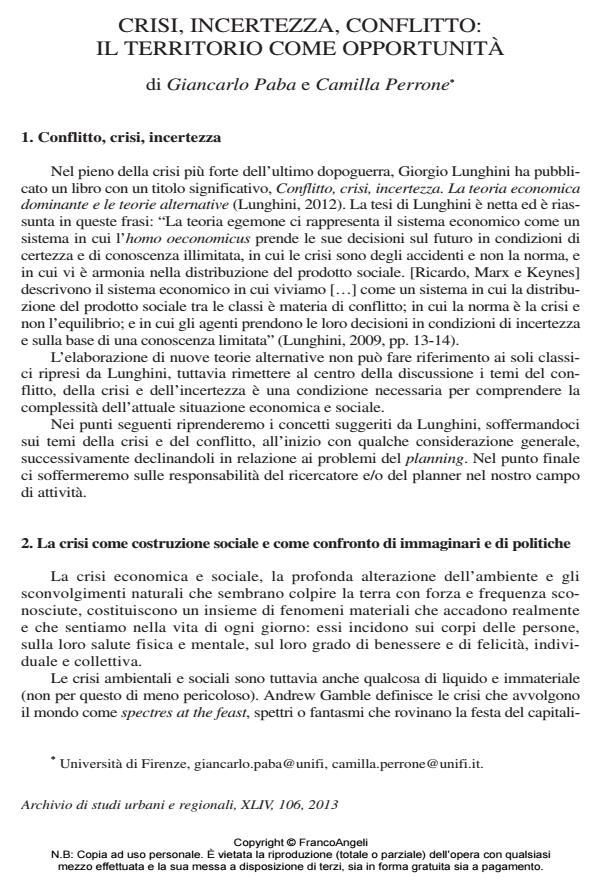
Below, you can see the article first page
If you want to buy this article in PDF format, you can do it, following the instructions to buy download credits
FrancoAngeli is member of Publishers International Linking Association, Inc (PILA), a not-for-profit association which run the CrossRef service enabling links to and from online scholarly content.
- Harvey D. (2012). The urban roots of financial crises: Reclaiming the city for anti-capitalist struggle. In: Panitch L., Albo G. e Chibber V., eds., Socialist Register: The Crisis and the Left. New York: Monthly Review Press
- Krugman P. (2012). Fuori da questa crisi, adesso! Milano: Garzanti
- Kunzman K. R. (2011). Dopo la crisi economica globale: implicazioni sulle politiche per il futuro del territorio europeo. Territorio, 58:7-17.
- Lunghini G. (2012). Conflitto, crisi, incertezza. Torino: Bollati Boringhieri
- Magnaghi A. (2012). Le ragioni di una sfida. In: Magnaghi A., a cura di, Il territorio come bene comune. Firenze: Firenze University Press.
- Paba G., a cura di (2002). Insurgent city. Racconti e geografie di un’altra Firenze. Livorno: Mediaprint.
- Perrone C. (2012a). Per una pianificazione a misura di territorio. Firenze: Firenze University Press.
- Perrone C. (2012b). A chi/che serve partecipare? Diritti, responsabilità, opportunità. In: Perrone C., a cura di, Giochi di potere. Partecipazione, piani e politiche territoriali. Torino: Ute
- Sager T. (2011). Neo-liberal urban planning policies: A literature survey 1990-2010. Progress in Planning, 76:147-199.
- Balducci A. (2012). Trading zone, un concetto utile per alcuni dilemmi della pianificazione. Crios, 2:33-45
- Becattini G. (2009). Ritorno al territorio. Bologna: il Mulino
- Brenner N., Marcuse P. e Mayer M., eds. (2012). Cities for People, not for Profit: Critical Urban Theory and the Right to the City. London: Routledge.
- Clarke J. e Newman J. (2010). Summoning spectres: Crises and their construction. Journal of Education Policy, 25, 6: 709-715. DOI: 10.1080/02680939.2010.513745
- Crosta P. (2010). Pratiche. Il territorio è “l’uso che se ne fa”. Milano: FrancoAngeli
- Davis D. E. e Raman P. (2012). The physicality of citizenship: The built environmental foundation of insurgent urbanism in cities around the globe. Crios, 3: 27-44.
- Fareri P. (2009). Rallentare. Il disegno delle politiche urbane. Milano: FrancoAngeli
- Fuller C. (2010). Crisis and institutional change in urban governance. Environment and Planning A, 42: 1121-1137. DOI: 10.1068/a42245
- Gallino L. (2012). La lotta di classe dopo la lotta di classe. Bari-Roma: Laterza
- Gamble A. (2009). The Spectre at the Feast: Capitalist Crisis and the Politics of Recession. Basingstoke: Macmillan
Giancarlo Paba, Camilla Perrone, Crisi, incertezza, conflitto: il territorio come opportunità in "ARCHIVIO DI STUDI URBANI E REGIONALI" 106/2013, pp 112-118, DOI: 10.3280/ASUR2013-106009