Quality of life and sexual satisfaction: a survey on a sample of women suffering of endometriosis
Journal title RIVISTA DI SESSUOLOGIA CLINICA
Author/s Alessandra Recine, Valentina Cosmi, Luca Pierleoni, Marta Giuliani, Maria Grazia Porpora, Chiara Simonelli
Publishing Year 2013 Issue 2013/2
Language Italian Pages 15 P. 81-95 File size 309 KB
DOI 10.3280/RSC2013-002005
DOI is like a bar code for intellectual property: to have more infomation
click here
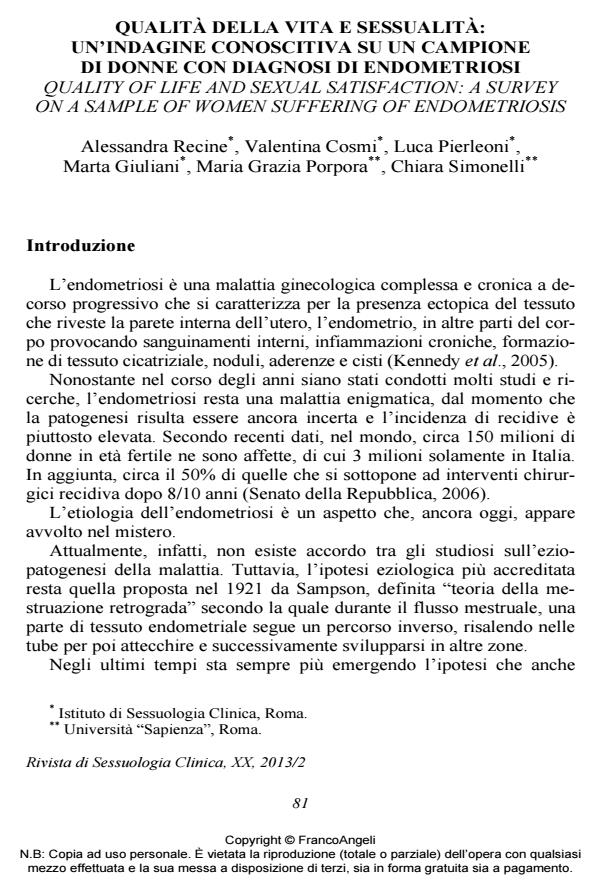
Below, you can see the article first page
If you want to buy this article in PDF format, you can do it, following the instructions to buy download credits
FrancoAngeli is member of Publishers International Linking Association, Inc (PILA), a not-for-profit association which run the CrossRef service enabling links to and from online scholarly content.
The aim of the present study is to evaluate the impact of endometriosis on the quality of life and sexual satisfaction in an Italian sample of women suffering from endometriosis and verify the hypotesis that the disease has a strong negative impact on both aspects. The study involved 120 women who had been diagnosed with endometriosis (EG) and 120 healthy women (CG). A socioanagraphic questionnaire, the WHOQOL-Bref and the Italian version of McCoy Female Sexuality Questionnaire (MFSQ) were administered to participants. Data analysis showed that the EG obtained lower score than CG in three domains of WHOQOL (physical, psychological and social relationship), in Sexuality domain but not in Relational of MFSQ. Therefore results indicate that women with endometriosis are not less satisfied about the relationship with their partner compared to healthy women.
Keywords: Endometriosis, quality of life, sexual-affective life, relationship with partner.
- Ferrero S., Esposito F., Abbamonte L.H., Anserini P., Remorgida V., Ragni N. (2005). Quality of sex life in women with endometriosis and deep dyspareunia. Fertility and Sterility, 83, 3: 573-9. DOI: 10.1016/j.fertnstert.2004.07.973
- Fritzer N., Haas D., Oppelt P., Renner St., Hornung D., Wölfler M., Ulrich U., Fischerlehner G., Sillem M., Hudelist G. (2013). More than just bad sex: sexual dysfunction and distress in patients with endometriosis. European Journal of Obstetrics & Gynecology and Reproductive Biology, in press. DOI: 10.1016/j.ejogrb.2013.04.001
- Graziottin A. (a cura di) (2005). Il dolore segreto. Mondadori, Milano.
- Huntington A., Gilmour J. (2005). A life shaped by pain: women and endometriosis. Journal of Clinical Nursing, 14: 1124-32. DOI: 10.1111/j.1365-2702.2005.01231
- Jones G., Jenkinson C., Kennedy S. (2004). The impact of endometriosis upon quality of life: A qualitative analysis. Journal of Psychosomatic Obstetrics and Gynaecology, 25: 123-33. DOI: 10.1080/01674820400002279
- Kennedy S., Bergqvist A., Chapron C., D’Hooghe T., Dunselman G., Greb R., Hummelshoj L., Prentice A., Saridogan E.; (2005). ESHRE guideline for the diagnosis and treatment of endometriosis. Human Reproduction, 20, 10: 2698-704. DOI: 10.1093/humrep/dei135
- Lorençatto C., Petta C.A., Navarro M.J., Bahamondes, L., Matos A. (2006). Depression in women with endometriosis with and without chronic pelvic pain. Acta Obstetricia Gynecologica Scandinavica, 85, 1: 88-92. DOI: 10.1080/00016340500456118
- Mendes N. (2012). Psychological approach to endometriosis: women’s pain experience and quality of life improvement. Psicologia, Saúde & Doenças, 13, 1: 36-48. ISSN: 1645-0086.
- McCoy N.L. (2000). The McCoy Female Sexuality Questionnaire. Quality of Life Research, 9, 6a: 739-45. DOI: 10.1023/A:1008925906947
- Rellini A., Nappi R.E., Vaccaio P., Ferdeghini F., Abbiati I., Meston C.M. (2005). Validation of the McCoy Female Sexuality Questionnaire in an Italian sample. Archives of Sexual Behaviour, 34, 6: 641-47. DOI: 10.1007/s10508-005-7915-8
- Sepulcri P., Amaral V.F. (2009). Depressive symptoms, anxiety, and quality of life in women with pelvic endometriosis. European Journal of Obstetrics, Gynecology and Reproductive Biology, 142, 1: 53-6. DOI: 10.1016/j.ejogrb.2008.09.003
- Senato della Repubblica (18 gennaio 2006). Indagine conoscitiva sul fenomeno dell’Endometriosi come malattia sociale, 9° resoconto stenografico. Tipografia del Senato, Roma.
- Signorile P.G., Baldi A. (2010). Endometriosis: new concepts in the pathogenesis. The International Journal of Biochemistry & Cell Biology, 42: 778-80. DOI: 10.1016/j.biocel.2010.03.008
- Simonelli C., Fabrizi A. (2006). Le disfunzioni sessuali e l’approccio integrato. In: Simonelli C., a cura di, L’approccio integrato in sessuologia clinica, Franco Angeli, Milano.
- The WHOQOL Group (1996). WHOQOL-BREF-introduction, administration, scoring and generic version of the assessment. World Health Organization Geneva.
- Barnack J., Chrisler J. (2007). The experience of chronic illness in women: A comparison between women with endometriosis and women with chronic migraine headaches. Women & Health, 46: 115-133. DOI: 10.1300/J013v46n01_08
- Bizzotto M. (1995). Il grido di Giobbe: l’uomo, la malattia, il dolore della cultura contemporanea. San Paolo Edizioni, Milano.
- Denny E. (2004). Women’s experience of endometriosis. Journal of Advanced Nursing, 46: 641-8. DOI: 10.1111/j.1365-2648.2004.03055.x
- Fauconnier A., Chapron C., Dubisson J-B., Vieira M., Bousset B., Bréart G. (2002). Relation between pain symptoms and the anatomic location of deep infiltrating endometriosis. Fertility and Sterility, 78: 719-26. DOI: 10.1016/S0015-0282(02)03331-9
- Fernandez I., Reid C., Dziurawiec S. (2006). Living with Endometriosis: the perspective of male partners. Journal of Psychosomatic Research, 61, 4: 433-38. DOI: 10.1016/j.jpsychores.2006.06.003
Alessandra Recine, Valentina Cosmi, Luca Pierleoni, Marta Giuliani, Maria Grazia Porpora, Chiara Simonelli, Qualità della vita e sessualità: un’indagine conoscitiva su un campione Di donne con diagnosi di endometriosi in "RIVISTA DI SESSUOLOGIA CLINICA" 2/2013, pp 81-95, DOI: 10.3280/RSC2013-002005