Psychiatric workers and family members. towards a deconstruction of the blaming
Journal title PSICOBIETTIVO
Author/s Silvia Carbone
Publishing Year 2014 Issue 2013/3
Language Italian Pages 1 P. 101-121 File size 153 KB
DOI 10.3280/PSOB2013-003006
DOI is like a bar code for intellectual property: to have more infomation
click here
Below, you can see the article first page
If you want to buy this article in PDF format, you can do it, following the instructions to buy download credits
FrancoAngeli is member of Publishers International Linking Association, Inc (PILA), a not-for-profit association which run the CrossRef service enabling links to and from online scholarly content.
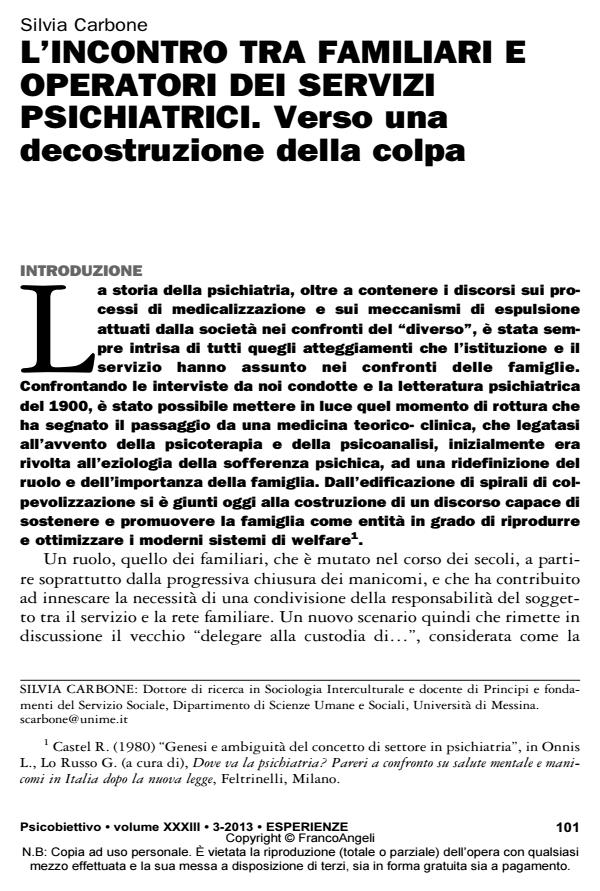
The last decade, family’s role is therefore redefined and it has gained importance to become the main focus for dialogue for mental health services. The new interactions between the mental health services and the family have led to different requests and, thus, different expectations, tools and resources. Both services and family are essential to the patient’s journey towards rehabilitation, but the road is not without obstacles and conflict. Can the multiplication of opportunities for contact between psychiatric worker and family members, foster the emergence of attitudes of blame on the part of the psychiatric worker to the family members, based on the influence of these theoretical orientations systemic-relational beginning of the twentieth century that reorganized in the family to be a contributory cause of the suffering of their loved? This research was conducted in structures of public intervention in Rome. The characteristic of the relational context of investigation led to favor qualitative analysis tools. Twenty-six interviews were conducted with psychiatric worker.
Keywords: Family; Mental Health; Sociology; Blaming; Health Services Research.
- Bateson G. (1972) Verso un’ecologia della mente (trad. it. Adelphi, Milano, 1977)
- Barbetta P. (2008) Lo schizofrenico della famiglia, Meltemi, Roma
- Alanen Y. (1966) The family in the pathogenesis of schizophrenic and neurotic disorders, Munksgaard, Denmark
- Aluffi G. (2001) Dal manicomio alla famiglia. L’inserimento etero filiale supportato di adulti sofferenti di disturbi psichici, FrancoAngeli, Milano
- Ancora A., Sbardella A. (2011) L’approccio transculturale nei servizi psichiatrici. Un confronto tra gli operatori, FrancoAngeli, Milano
- Barton Evans F. (1996) Harry Stack Sullivan: interpersonal theory and psychotherapy, Routledge, New York
- Basaglia F. (a cura di) (1997) Che cos’è la psichiatria, Baldini & Castoldi, Milano
- Basaglia F. (a cura di) (2010) L’istituzione negata. Rapporto da un ospedale psichiatrico, Dalai, Milano
- Bowen M. (1978) Family Therapy in Clinical Practice, Aronson, New York
- Brown G.W. (1959) Experiences of discharged chronic schizophrenic mental hospital patients in various types of living group, Millibank Memorial Found Quarterly, USA
- Cammarota A. (2009) L’altro da raccontare. Un approccio coloniale con i nativi del Centro America, FrancoAngeli, Milano
- Cipolla C. (a cura di) (2002) Principi di sociologia, FrancoAngeli, Milano
- Cipolla C. (a cura di) (2004) Manuale di sociologia della salute. Teoria, FrancoAngeli, Milano
- Creer C., Wing J.K. (1974) Schizophrenia at Home, Institute of Psychiatry, London
- Dell’Acqua P. (2010) Fuori come va? Famiglie e persone con schizofrenia. Manuale per un uso ottimistico delle cure e dei servizi, Feltrinelli, Milano
- Donati P. (a cura di) (1983) Verso una nuova sociologia della salute, FrancoAngeli,
- Milano Fiorino V. (2002) Matti, indemoniati e vagabondi. Dinamiche di internamento manicomiale tra Otto e Novecento, Marsilio, Torino
- Ferruta A., Marcelli M. (2007) Un lavoro terapeutico. L’infermiere in psichiatria, FrancoAngeli, Milano
- Foucault M. (1976) Storia della follia nell’età classica (trad. it. Bur Storia, Milano)
- Galimberti U. (1983) Il corpo. Antropologia, psicoanalisi, fenomenologia, Feltrinelli, Milano
- Gambini P. (2007) Psicologia della famiglia. La prospettiva sistemico relazionale, FrancoAngeli, Milano
- Giddens A., Sutton P.W. (2010) Sociology: introductory readings, Polity Press, USA
- Goffman E. (1961) Asylums. Le istituzioni totali: meccanismi dell’esclusione e della violenza (trad. it. Einaudi, Torino, 2003)
- Goldenberg H. (2004) Family therapy: an overview, Thomson Brooks, Belmont USA
- Hoenig J., Hamilton M.W. (1966) “The burden on the household in an extramural psychiatric service”, in Freeman H.L., New aspects of the mental health services, Pergamon, Oxford
- Kasani J., Knight E., Sage P. (1934) “The parent-child relationship in schizophrenia, Journal of nervous and mental disease”, British Medical Journal, 79: 249-263
- Laing R.D., Esterson A. (1970) Normalità e follia nella famiglia. Undici storie di donne, Einaudi, Torino
- Lidz T. (1958) “Schizophrenia and family”, Journal for the Study of Interpersonal Processes, 21
- Lodolini G.R. (2005) La famiglia nell’immaginario della psichiatria tra vittima e carnefice, Associazione Droga Che Fare Oggi
- Mannoni M. (1975) Le psychiatre, son fou et la psychanalyse (trad. it Coop. Edizioni Jaca Book, Milano)
- Onnis L., Lo Russo G. (a cura di) (1980) Dove va la psichiatria? Pareri a confronto su salute mentale e manicomi in Italia dopo la nuova legge, Feltrinelli, Milano
- Reichamm F.F. (1940) “Notes on the mother role in family group”, Bulletin of the Menninger Clinic, 4
- Rosen J.N. (2010) Direct Analysis. Selected Papers, Kessinger Publishing, USA
- Saraceno B. (1995) La fine dell’intrattenimento. Manuale di riabilitazione psichiatrica, Etas, Milano
- Scotti F. (2002) “Osservare e comprendere”, Quaderni di Psicoterapia infantile, 46
- Sullivan H.S. (1972) Interpersonal theory and psychotherapy (trad. it. Feltrinelli, Milano)
- Warner R. (1997) Recovery from schizophrenia: psychiatry and political economy, Brunner-Routledge, East Sussex
Silvia Carbone, L’incontro tra familiari e operatori dei servizi psichiatrici. Verso una decostruzione della colpa in "PSICOBIETTIVO" 3/2013, pp 101-121, DOI: 10.3280/PSOB2013-003006