Does Local Creative Employment Affect Firm Innovativeness? Microeconometric Evidence from Italy

Journal title SCIENZE REGIONALI
Author/s Roberto Antonietti
Publishing Year 2015 Issue 2015/3
Language English Pages 25 P. 5-29 File size 358 KB
DOI 10.3280/SCRE2015-003001
DOI is like a bar code for intellectual property: to have more infomation click here

Below, you can see the article first page

If you want to buy this article in PDF format, you can do it, following the instructions to buy download credits
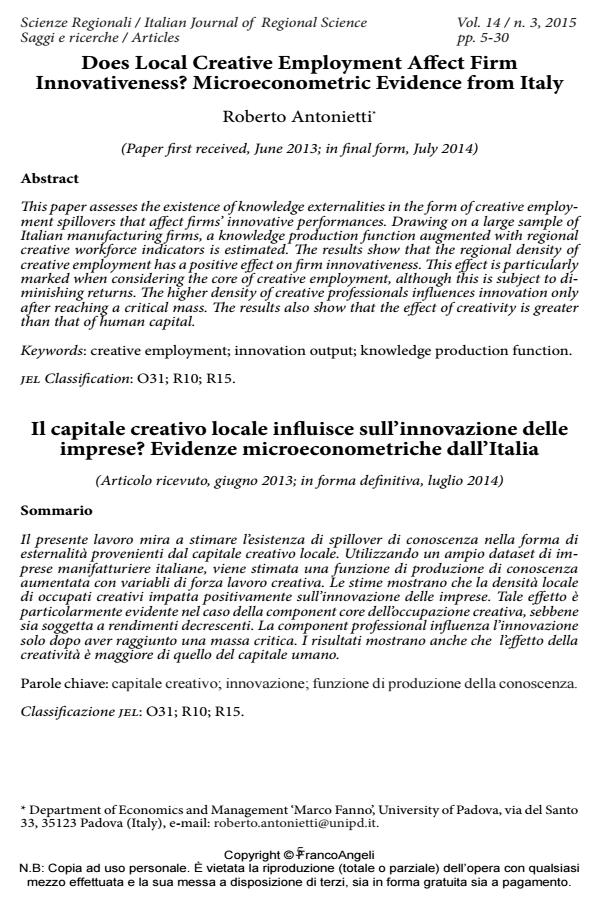
Article preview

FrancoAngeli is member of Publishers International Linking Association, Inc (PILA), a not-for-profit association which run the CrossRef service enabling links to and from online scholarly content.

  1. Moretti E., 2004a, «Workers’ Education, Spillovers, and Productivity: Evidence From Plant Level Production Functions». American Economic Review, 94, 3: 656 690. DOI: 10.1257/0002828041464623
  2. Moretti E., 2004b, «Human Capital Externalities in Cities». In: Henderson J.V., Thisse F. (eds.), Handbook of Regional and Urban Economics. Amsterdam: North Holland, 4: 2243 2291.
  3. oecd, 2008, oecd Science, Technology and Industry Outlook. Paris: oecd (chapter 5).
  4. Pfirrmann O., 1994, «The Geography of Innovation in Small and Medium Sized Firms in West Germany». Small Business Economics, 6, 1: 27 41. DOI: 10.1007/BF01066111
  5. Schiller D., Revilla Diez J., 2010, «Local Embeddedness of Knowledge Spillover Agents: Empirical Evidence from German Star Scientists». Papers in Regional Science, 89, 2: 275 294. DOI: 10.1111/j.14355957.2010.00294.x
  6. Shefer D., Frenkel A., 1998, «Local Milieu and Innovations: Some Empirical Results». Annals of Regional Science 32, 1: 185 200. DOI: 10.1007/s001680050069
  7. Simonton D.K., 2011, «Big C Creativity in the Big City». In: Andersson E., Andersson A.E., Mellander C. (eds.), Handbook of Creative Cities. Cheltenham: Edward Elgar, 72 84.
  8. Spencer G., 2012, «Creative Economies of Scale». Journal of Economic Geography, 12, 1: 247 271. DOI: 10.1093/jeg/lbr002
  9. Sternberg R.J., 2006, «Introduction». In: Kaufman J.C., Sternberg R.J. (eds.), The International Handbook of Creativity. Cambridge: Cambridge U.P., 1 10.
  10. Stolarick K., Florida R., 2006, «Creativity, Connections and Innovation: A Study of Linkages in the Montreal Region». Environment and Planning A, 38, 10: 1799 1817. DOI: 10.1068/a3874
  11. Tranos E., 2013, «Networks in the Innovation Process». In: Fisher M.M., Nijkamp P. (eds.), Handbook of Regional Science. New York: Springer Verlag, 489 504.
  12. unctad, 2010, Creative Economy Report 2010. Geneva: undp, New York: unctad.
  13. Unicredit, 2008, Decima Indagine sulle Imprese Manifatturiere Italiane. Rapporto Corporate n. 1. Rome: Unicredit Bank Group.
  14. Varga A., Anselin L., Acs Z.J., 2000, «Geographic and Sectoral Characteristics of Academic Knowledge Externalities». Papers in Regional Science 79, 4: 435 443. DOI: 10.1007/PL00011486
  15. Wojan T.R., McGranahan D.A., 2007, «Ambient Returns: Creative Capital’s Contribution to Local Manufacturing Competitiveness». Agricultural and Resource Economics Review, 36, 1: 133 148.
  16. Wooldridge J.M., 2010, Econometric Analysis of Cross Section and Panel Data. Cambridge (MA): mit Press (2nd ed.).
  17. Yu L., Nickerson J.V., Sakamoto Y., 2012, Collective Creativity: Where we are and where we Might go. Proceedings of «Collective Intelligence 2012».
  18. Abramovsky L., Harrison R., Simpson H., 2007, «University Research and the Location of Business R&D». Economic Journal, 117, 519: 114 141. DOI: 10.1111/j.14680297.2007.02038.x
  19. Acemoglu D.K., 1996, «A Microfoundation for Social Increasing Returns in Human Capital Accumulation». Quarterly Journal of Economics, 111, 3: 779 803. DOI: 10.2307/2946672
  20. Acosta M., Coronado D., Flores E., 2011, «University Spillovers and New Busi ness Location in High Technology Sectors: Spanish Evidence». Small Business Economics, 36, 3: 365 376. DOI: 10.1007/s1118700992244
  21. Amabile T., 1996, Creativity in Context. Colorado: Westview Press.
  22. Andersen K.V., Hansen H.K., Isaksen A., Raunio M., 2011, «Nordic City Regions in the Creative Class Debate – Putting the Creative Class Thesis to a Test».
  23. Industry and Innovation, 17, 2: 215 240. DOI: 10.1080/13662711003633496
  24. Andersson R., Quigley J.M., Wilhelmsson J.M., 2005, «Agglomeration and the spatial distribution of creativity». Papers in Regional Science, 84, 3: 445 464. DOI: 10.1111/j.14355957.2005.00049
  25. Anselin L., Varga A., Acs Z.J., 1997, «Local Geographic Spillovers Between University Research and High Technology Innovations». Journal of Urban Economics, 42, 3: 422 438. DOI: 10.1006/juec.1997.2032
  26. Antonietti R., Cainelli G., 2011, «The Role of Spatial Agglomeration in a Struc tural Model of Innovation, Productivity and Export: A Firm Level Analysis».
  27. Annals of Regional Science, 46, 3: 577 600. DOI: 10.1007/s0016800903597
  28. Audretsch D.B., Feldman M.P., 1996, «R&D Spillovers and the Geography of Innovation and Production». American Economic Review, 86, 3: 630 640.
  29. Audretsch D.B., Feldman M.P., 2004, «Knowledge Spillovers and the Geography of Innovation». In: Henderson V.J., Thisse J.F. (eds.), Handbook of Urban and Regional Economics, vol. 4. Amsterdam: North Holland, 2713 2739.
  30. Audrets ch D.B., Keilbach M., 2004, «Entrepreneurship C apit a l and E conomic Per for mance». Reg ional Studies , 38, 8: 949 959. DOI: 10.1080/0034340042000280956
  31. Audretsch D.B., Keilbach M., 2007, «The Theory of Knowledge Spillover En trepreneurship». Journal of Management Studies, 44, 7: 1242 1254. DOI: 10.1007/s1118700891573
  32. Baptista R., Mendonça J., 2010, «Proximity to Knowledge Sources and the Loca tion of Knowledge Based Start ups». Small Business Economics, 30, 1: 49 58. DOI: 10.1007/s0016800902894
  33. Basile R.G., Capello R., Caragliu A., 2012, «Technological Interdependence and Regional Growth in Europe: Proximity and Synergy in Knowledge Spillovers». Papers in Regional Science, 91, 4: 697 722. DOI: 10.1111/j.14355957.2012.00438.x
  34. Becattini G., 1990, «The Marshallian Industrial District as a Socio Economic Notion». In: Becattini G., Pyke F., Sengenberger W. (eds.), Industrial Districts and Inter Firm Cooperation in Italy. Geneva: International Labor Studies, 37 51.
  35. Bertacchini E.E., Borrione P., 2012, «The Geography of the Italian Creative Economy: the Special Role of the Design and Craft Based Industries». Regional Studies, 47, 2: 135 147. DOI: 10.1080/00343404.2011.628652
  36. Boschma R.A., Fritsch M., 2009, «Creative Class and Regional Growth: Empiri cal Evidence from Seven European Countries». Economic Geography, 85, 4: 391 423. DOI: 10.1111/j.19448287.2009.01048.x
  37. Cainelli G., De Liso N., 2005, «Innovation in Industrial Districts: Evi dence f rom Italy». Industr y and Innovation, 12, 3: 383 398. DOI: 10.1080/13662710500195991
  38. Cainelli G., Mancinelli S., Mazzanti M., 2007, «Social Capital and Innovation Dynamics in District Based Local Systems». Journal of Socio Economics, 36, 6: 932 948. DOI: 10.1016/j.socec.2007.01.023
  39. Camagni R., 1991, «Technological Change, Uncertainty and Innovation Net works: Towards a Dynamic Theory of Economic Space». In: Camagni R. (ed.), Innovation Networks: Spatial Perspectives. London: Belhaven Pinter.
  40. Camagni R., Capello R., 2013, «Regional Innovation Patterns and the EU Regional Policy Reform: Towards Smart Innovation Policies». Growth and Change, 44, 2: 355 389. DOI: 10.1111/grow.12012
  41. Capello R., Faggian A., 2005, «Collective Learning and Relational Capi tal in Local Innovation Processes». Regional Studies, 39, 1: 75 87. DOI: 10.1080/0034340052000320851
  42. Carlino G.A., Chatterjee S., Hunt R.M., 2007, «Urban Density and the Rate of Invention». Journal of Urban Economics, 61, 3: 389 419. DOI: 10.1016/j.jue.2006.08.003
  43. Chesbrough H.W., 2003, Open Innovation. The New Imperative for Creating and Profiting from Technology. Cambridge (MA): Harvard Business School Press.
  44. Ciccone A., Hall R.E., 1996, «Productivity and the Density of Economic Activity». American Economic Review, 86, 1: 54 70.
  45. Ciriaci D., 2011, Design and European Firms’ Innovative Performance: Evidence from European cis Non Anonymous Data. Seville. ipts: Working Paper on Corporate r&d and Innovation, n. 08/2011.
  46. Cook D.O., Kieschnick R., McCullough B.D., 2008, «Regression Analysis of Proportions in Finance with Self Selection». Journal of Empirical Finance 15, 5: 860 867. DOI: 10.1016/j.jempfin.2008.02.001
  47. Cragg J., 1971, «Some Statistical Models for Limited Dependent Variables with Application to the Demand for Durable Goods». Econometrica, 39, 5: 829 844. DOI: 10.2307/1909582
  48. Crepon B., Duguet E., Mairesse J., 1998, «Research, Innovation and Productivity: an Econometric Analysis at the Firm Level». Economics of Innovation and New Technology 7, 2:115 158. DOI: 10.1080/10438599800000031
  49. Currid E., 2007, The Warhol Economy. How Fashion, Art & Music Drive New York City. Princeton: Princeton U.P.
  50. Currid E., Williams S., 2010, «The Geography of Buzz: Art, Culture and the Social Milieu in Los Angeles and New York». Journal of Economic Geography 10, 3: 389 422. DOI: 10.1093/jeg/lbp032
  51. dcms, 2001, Creative Industries Mapping Document 2001. London: Department of Culture, Media and Sport (2nd ed.).
  52. Feldman M.P., Audretsch D.B., 1999, «Innovation in Cities: Science Based Diversity, Specialization and Localized Competition». European Economic Review, 43, 2: 409 429. DOI: 10.1016/S00142921(98)000476
  53. Florida R., 2002a, The Rise of the Creative Class. New York: Basic Books.
  54. Florida R., 2002b, «The Economic Geography of Talent». Annals of the Association of American Geographers, 92, 4: 743 755. DOI: 10.1111/14678306.00314
  55. Florida R., 2002c, «Bohemia and Economic Geography». Journal of Economic Geography, 2, 1: 55 71. DOI: 10.1093/jeg/2.1.55
  56. Florida R., Tinagli I., 2005, Italy in the Creative Age. Milan: Creativity Group Europe.
  57. Florida R., Mellander C., Stolarick K., 2008, «Inside the Black Box of Regional Development – Human Capital, the Creative Class and Tolerance». Journal of Economic Geography, 8, 5: 615 649. DOI: 10.1093/jeg/lbn023
  58. Glaeser E.L., 1999, «Learning in Cities». Journal of Urban Economics, 46, 2: 254 277. DOI: 10.1006/juec.1998.2121
  59. Glaeser E.L., 2005, «Review of Richard Florida’s The Rise of the Creative Class». Regional Science and Urban Economics, 35, 5: 593 596. DOI: 10.1016/j.regsciurbeco.2005.01.005
  60. Greunz L., 2004, «Industrial Structure and Innovation – Evidence from European Regions». Journal of Evolutionary Economics, 14, 5: 563 592. DOI: 10.1007/s0019100402348
  61. Griliches Z., 1979, «Issues in Assessing the Contribution of Research and Development to Productivity Growth». The Bell Journal of Economics, 10, 1: 92 116. DOI: 10.2307/3003321
  62. Hall B.H., Lotti F., Mairesse J., 2013, «Evidence on the Impact of R&D and ict Investment on Innovation and Productivity in Italian Firms».
  63. Economics of Innovation and New Technology, 22, 3: 300 328. DOI: 10.1080/10438599.2012.708134
  64. Hollanders H., Van Cruysen A., 2009, Design, Creativity and Innovation: A Scoreboard Approach, European Innovation Scoreboard 2008. Bruxelles: European Commission.
  65. Howe J., 2006, «The Rise of Crowdsourcing» Wired Magazine, 14, 6: 1 4.
  66. ilo, 2012, International Standard Classification of Occupations, isco 08. Geneva: International Labour Office.
  67. istat, 2001, XIV Census of Population and Housing. Rome: istat.
  68. Jaffe A.B., 1989, «Real Effects of Academic Research». American Economic Review, 79, 5: 957 970.
  69. Johansson B. and Lööf H., 2009, Innovation, R&D and Productivity – Assessing Alternative Specifications of cdm Models. Stockholm: cesis, Working Paper n. 159.
  70. Knudsen B., Florida R., Stolarick K., Gates G., 2008, «Density and Creativity in U.S. Regions». Annals of the Association of American Geographers, 98, 2: 461 478. DOI: 10.1080/00045600701851150
  71. Laursen K., Salter A., 2005, «Open for Innovation: The Role of Openness in Explaining Innovation Performance Among UK Manufacturing Firms». Strategic Management Journal, 27, 2: 131 150. DOI: 10.1002/smj.507
  72. Lee Y.S., Florida R., Acs Z., 2004, «Creativity and Entrepreneurship: A Regional Analysis of New Firm Formation». Regional Studies, 38, 8: 879 891. DOI: 10.1080/0034340042000280910
  73. Lööf H., Heshmati A., 2002, «Knowledge Capital and Performance Heteroge neity: A Firm Level Innovation Study». International Journal of Production Economics, 76, 1: 61 85. DOI: 10.1016/S09255273(01)001475
  74. Lorenzen M., Andersen K.V., 2007, The Geography of the European Creative Class: A Rank Size Analysis. druid: Working Paper n. 07 17.
  75. Lucas R., 1988, «On the Mechanics of Economic Development». Journal of Monetary Economics, 22, 1: 3 42. DOI: 10.1016/03043932(88)901687
  76. Mairesse J., Mohnen P., 2001, To be or not to be Innovative: An Exercise in Measurement. nber. Working Paper n. 8644.
  77. Mairesse J., Mohnen P., 2002, «Accounting for Innovation and Measuring In novativeness: An Illustrative Framework and an Application». American Economic Review, 92, 2: 226 230. DOI: 10.1257/000282802320189302
  78. Mairesse J., Mohnen P., 2010, «Using Innovation Surveys for Econometric Analysis». In: Hall B.H., Rosenberg N. (eds.), Handbook of the Economics of Innovation. Amsterdam: North Holland (vol. 2, chapter 26).
  79. Mansfield E., 1995, «Academic Research Underlying Industrial Innovations: Sources, Characteristics, and Financing». Review of Economics and Statistics, 77, 1: 55 65. DOI: 10.2307/2109992
  80. Marlet G., van Woerkens C., 2007, «The Dutch Creative Class and How It Fosters Urban Employment Growth». Urban Studies, 44, 13: 2605 2626. DOI: 10.1080/00420980701558434
  81. Marrocu E., Paci R., 2012, «Education or Creativity: What Matters Most for Economic Performance?». Economic Geography, 88, 4: 369 401. DOI: 10.1111/j.19448287.2012.01161.x
  82. Martin P., Mayer T., Mayneris F., 2011, «Spatial Concentration and Plant Level Productivity in France». Journal of Urban Economics, 69, 2: 182 195. DOI: 10.1016/j.jue.2010.09.002
  83. Massard N., Riou S., 2002, «L’Impact des Structures Locales sur l’Innovation en France: Specialisation ou Diversité?». Régions et Dèveloppement, 16: 111 136.
  84. McGranahan D., Wojan T., 2007, «Recasting the Creative Class to Examine Growth Processes in Rural and Urban Counties». Regional Studies, 41, 2: 197 216. DOI: 10.1080/00343400600928285
  85. Mellander C., Florida R., 2011, «Creativity, Talent, and Regional Wages in Sweden». Annals of Regional Science, 46, 3: 637 660. DOI: 10.1007/s001680090354z
  86. Miles I., Green L., 2010, «Innovation and Creative Services». In Gallouj F., Djellal F. (eds.), The Handbook of Innovation and Services. Cheltenham: Edward Elgar, 178 196.

  • Do the creative industries support growth and innovation in the wider economy? Industry relatedness and employment growth in Italy Niccolò Innocenti, Luciana Lazzeretti, in Industry and Innovation /2019 pp.1152
    DOI: 10.1080/13662716.2018.1561360
  • Economic complexity and firm performance in the cultural and creative sector: Evidence from Italian provinces Chiara Burlina, Patrizia Casadei, Alessandro Crociata, in European Urban and Regional Studies /2023 pp.152
    DOI: 10.1177/09697764221125336
  • La formula dell'export per le province italiane: classe creativa + specializzazione manifatturiera Roberto Antonietti, Gildo Soggia, in ECONOMIA E SOCIETÀ REGIONALE 1/2015 pp.125
    DOI: 10.3280/ES2015-001008
  • The cultural and creative economy in Italy: Spatial patterns in peripheral areas Alessandro Crociata, Adriana C Pinate, Giulia Urso, in European Urban and Regional Studies /2025 pp.53
    DOI: 10.1177/09697764231222221

Roberto Antonietti, Does Local Creative Employment Affect Firm Innovativeness? Microeconometric Evidence from Italy in "SCIENZE REGIONALI " 3/2015, pp 5-29, DOI: 10.3280/SCRE2015-003001