Using Contribution Analysis for assessing the impact of an Italian L2 learning platform
Journal title RIV Rassegna Italiana di Valutazione
Author/s Alberto Vergani, Emanuela Bonini, Giulia De Bernardi
Publishing Year 2025 Issue 2025/93
Language English Pages 20 P. 9-28 File size 765 KB
DOI 10.3280/RIV2025-093002
DOI is like a bar code for intellectual property: to have more infomation
click here
Below, you can see the article first page
If you want to buy this article in PDF format, you can do it, following the instructions to buy download credits
FrancoAngeli is member of Publishers International Linking Association, Inc (PILA), a not-for-profit association which run the CrossRef service enabling links to and from online scholarly content.
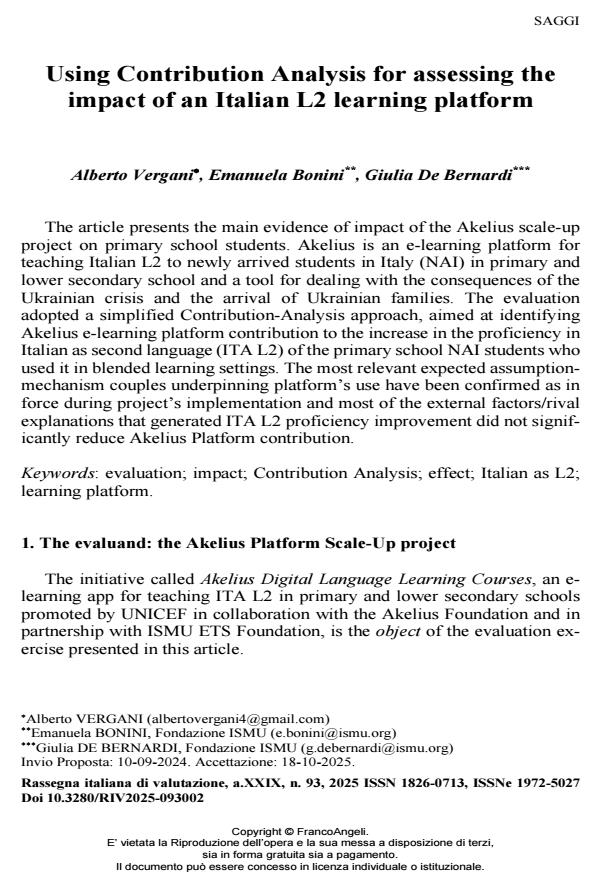
The article presents the main evidence of impact of the Akelius scale-up project on primary school students. Akelius is an e-learning platform for teaching Italian L2 to newly arrived students in Italy (NAI) in primary and lower secondary school and a tool for dealing with the consequences of the Ukrainian crisis and the arrival of Ukrainian families. The evaluation adopted a simplified Contribution-Analysis approach, aimed at identifying Akelius e-learning platform contribution to the increase in the proficiency in Italian as second language (ITA L2) of the primary school NAI students who used it in blended learning settings. The most relevant expected assumption-mechanism couples underpinning platform’s use have been confirmed as in force during project’s implementation and most of the external factors/rival explanations that generated ITA L2 proficiency improvement did not signif-icantly reduce Akelius Platform contribution.
Keywords: evaluation; impact; Contribution Analysis; effect; Italian as L2; learning platform.
Alberto Vergani, Emanuela Bonini, Giulia De Bernardi, Using Contribution Analysis for assessing the impact of an Italian L2 learning platform in "RIV Rassegna Italiana di Valutazione" 93/2025, pp 9-28, DOI: 10.3280/RIV2025-093002