Inclusione e giustizia sociale nella mobilità studentesca: pratiche e percezioni degli studenti di Sapienza Università di Roma
Journal title RIV Rassegna Italiana di Valutazione
Author/s Gabriella D’Ambrosio, Barbara Sonzogni
Publishing Year 2025 Issue 2025/93
Language Italian Pages 18 P. 64-81 File size 775 KB
DOI 10.3280/RIV2025-093004
DOI is like a bar code for intellectual property: to have more infomation
click here
Below, you can see the article first page
If you want to buy this article in PDF format, you can do it, following the instructions to buy download credits
FrancoAngeli is member of Publishers International Linking Association, Inc (PILA), a not-for-profit association which run the CrossRef service enabling links to and from online scholarly content.
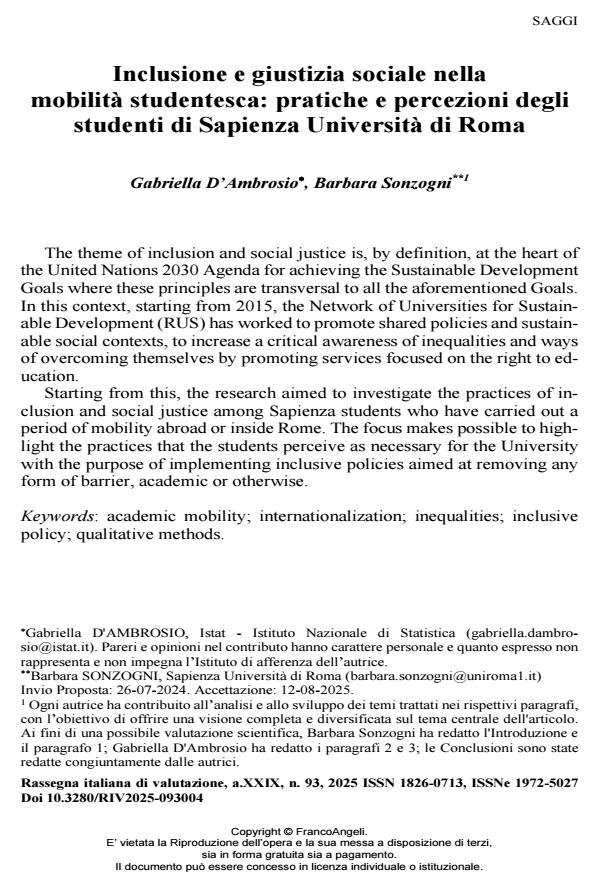
The theme of inclusion and social justice is, by definition, at the heart of the United Nations 2030 Agenda for achieving the Sustainable Development Goals where these principles are transversal to all the aforementioned Goals. In this context, starting from 2015, the Network of Universities for Sustain-able Development (RUS) has worked to promote shared policies and sustain-able social contexts, to increase a critical awareness of inequalities and ways of overcoming themselves by promoting services focused on the right to ed-ucation. Starting from this, the research aimed to investigate the practices of in-clusion and social justice among Sapienza students who have carried out a period of mobility abroad or inside Rome. The focus makes possible to high-light the practices that the students perceive as necessary for the University with the purpose of implementing inclusive policies aimed at removing any form of barrier, academic or otherwise.
Keywords: academic mobility; internationalization; inequalities; inclusive policy; qualitative methods.
- Bezzi, C. (2007a). Cos’è la valutazione. Un’introduzione ai concetti, le parole chiave e i problemi metodologici. Milano: FrancoAngeli.
- Bezzi, C. (2007b). Il disegno della valutazione. Milano: FrancoAngeli.
- Bista K., Allen R. M., Chan R. Y. (2022). Impacts of Covid-19 on International Students and the Future of Student Mobility. International Perspectives and Experiences. London: Routledge.
- Booth, T., Ainscow, M. (2011). Index for Inclusion: Developing learning and participation in schools. Bristol: Centre for Studies on Inclusive Education.
- Bracht, O., Engel, C., Janson K., Over, A., Schomburg H., Teichler, U. (2006). The Profes-sional Value of Erasmus Mobility. University of Kassel: International Centre for Higher Educa-tion Research.
- Brunetti, I., Biasi, V. (2019). Processi inclusivi e qualità della scuola: approcci teorici e metodologici. Roma: Armando Editore.
- Brynjolfsson, E., McAfee, A. (2014). The Second Machine Age: Work, Progress, and Pros-perity in a Time of Brilliant Technologies. New York: W. W. Norton & Company.
- Chelimsky, E. (1997). The Coming Transformations in Evaluation. In E. Chelimsky, W.R. Shadish (Eds.), Evaluation for the 21st Century: A Handbook (pp. 1-26). Thousand Oaks, CA: Sage.
- Chiappetta Cajola, L., Grion, V. (2021). Valutare per includere: Proposte operative e rifles-sioni critiche per un approccio inclusivo alla valutazione. Italian Journal of Educational Re-search, 27(1), 41-54.
- Cohen, L., Manion, L., Morrison, K. (2009). Research Methods in Education. London: Routledge.
- Collins, P. H. (2000). Black Feminist Thought: Knowledge, Consciousness, and the Politics of Empowerment. London: Routledge.
- Crenshaw, K. (1989). Demarginalizing the Intersection of Race and Sex: A Black Feminist Critique of Anti-discrimination Doctrine, Feminist Theory and Antiracist Politics. The Univer-sity of Chicago Legal Forum, 1989(1), 139-167.
- Dahrendorf, R. (1968). Class and Class Conflict in Industrial Society. Stanford: Stanford University Press.
- D’Angelo, I. (2021). Inclusione scolastica e innovazione educativa: modelli e pratiche. Mi-lano: FrancoAngeli.
- Devlin, M., Kristensen, S., Krzaklewska, E., Nico, M. (2017). Learning mobility, social in-clusion and non-formal education. Access, processes and outcomes. Strasbourg Cedex: Council of Europe Publishing.
- European Commission (2019). Erasmus+ Higher Education Impact Study. Brussels: Publi-cations Office of the European Union.
- Farnell T., Matijevic, A.S., Schmidt, N.Š. (2021). The Impact of COVID-19 on Higher Ed-ucation. A Review of Emerging Evidence: Analytical Report. Brussels: Publications Office of the European Union.
- Fraser, N. (1995). From Redistribution to Recognition? Dilemmas of Justice in a ‘Post-So-cialist’ Age. New Left Review, 212, 68-93.
- Grion, V. (2017). La valutazione come opportunità. Teorie e pratiche per dare valore alla scuola. Roma: Carocci.
- Hooks, B. (1981). Ain’t I a Woman: Black Women and Feminism. Boston’s South End: South End Press.
- Kimmel, K., Volet, S. (2012). Understanding motivation, engagement and experiences of intercultural interactions at university: A person-in-multiple contexts perspective. European Journal of Psychology of Education, 27(2), 227-245. https://doi.org/10.1007/s10212-011-0084-3
- Marshall, T. H. (1950). Citizenship and Social Class. Cambridge: Cambridge University Press.
- Mertens, D. M. (2009). Transformative Research and Evaluation. New York: Guilford Press.
- Nada, C. I., Legutko, J. (2022). “Maybe we did not learn that much academically, but we learn more from experience” - Erasmus mobility and its potential for transformative learning. International Journal of Intercultural Relations, 87, 183-192. https://doi.org/10.1016/j.ijintrel.2022.03.002
- Nussbaum, M. (2000). Women and Human Development: The Capabilities Approach. Cam-bridge: Cambridge University Press.
- Organizzazione per la Cooperazione e lo Sviluppo Economico (2012). Equity and Quality in Education: Supporting Disadvantaged Students and Schools. Paris: OECD Publishing.
- Organizzazione delle Nazioni Unite (2015). Risoluzione adottata dall’Assemblea Generale il 25 settembre 2015. Trasformare il nostro mondo: l’Agenda 2030 per lo Sviluppo Sostenibile. Testo disponibile al sito: https://unric.org/it/wp-content/uploads/sites/3/2019/11/Agenda-2030-Onu-italia.pdf
- Patton, M. Q. (2008). Utilization-Focused Evaluation. Thousand Oaks, CA: Sage.
- Quacquarelli Symonds (2021). How the coronavirus pandemic reshaped international higher education. Testo disponibile al sito: https://www.qs.com/portfolio-items/how-the-coro-navirus-pandemic-reshaped-international-higher-education/
- Rawls, J. (1971). A Theory of Justice. Harvard: Harvard University Press.
- Sassen, S. (2014). Expulsions: Brutality and Complexity in the Global Economy. Harvard: Harvard University Press.
- Scriven, M. (1991). Evaluation Thesaurus. Newbury Park, CA: Sage. Scriven, M. (2007). Key Evaluation Checklist. Evaluation Checklists Project. Sen, A. (1999). Development as Freedom. New York: Knopf.
- Stame, N. (2007). L’analisi valutativa. Roma-Bari: Laterza.
- Stavem, J. (2014). Student Mobility. Creating an Environment for Social and Academic Suc-cess. United Kingdom, Rowman & Littlefield. DOI: 10.2307/3211287
- Stufflebeam, D. L., Coryn, C. L. S. (2014). Evaluation Theory, Models, and Applications. San Francisco, CA: Jossey-Bass.
- van Dijk, J. (2005). The Deepening Divide: Inequality in the Information Society. New York: SAGE Publications.
- United Nations Department of Economic and Social Affairs. (2016). Leaving No One Be-hind: The Imperative of Inclusive Development. Report on the World Social Situation 2016. New York: United Nations.
- Vedung, E. (1997). Public Policy and Program Evaluation. New Brunswick, NJ: Transac-tion Publishers.
- Vieira, K. A. L., de Queiroz, G. M. (2017). Hermeneutic Content Analysis: a method of textual analysis. International Journal of Business Market and Management, 2(8), 8-15.
- Young, I. M. (1990). Justice and the Politics of Difference. Princeton: Princeton University Press.
Gabriella D’Ambrosio, Barbara Sonzogni, Inclusione e giustizia sociale nella mobilità studentesca: pratiche e percezioni degli studenti di Sapienza Università di Roma in "RIV Rassegna Italiana di Valutazione" 93/2025, pp 64-81, DOI: 10.3280/RIV2025-093004