Il modello di profilazione quanti-qualitativo del Programma GOL: una prima valutazione
Journal title RIV Rassegna Italiana di Valutazione
Author/s Giovanna Linfante, Debora Radicchia, Enrico Toti
Publishing Year 2025 Issue 2025/93
Language Italian Pages 25 P. 82-106 File size 1118 KB
DOI 10.3280/RIV2025-093005
DOI is like a bar code for intellectual property: to have more infomation
click here
Below, you can see the article first page
If you want to buy this article in PDF format, you can do it, following the instructions to buy download credits
FrancoAngeli is member of Publishers International Linking Association, Inc (PILA), a not-for-profit association which run the CrossRef service enabling links to and from online scholarly content.
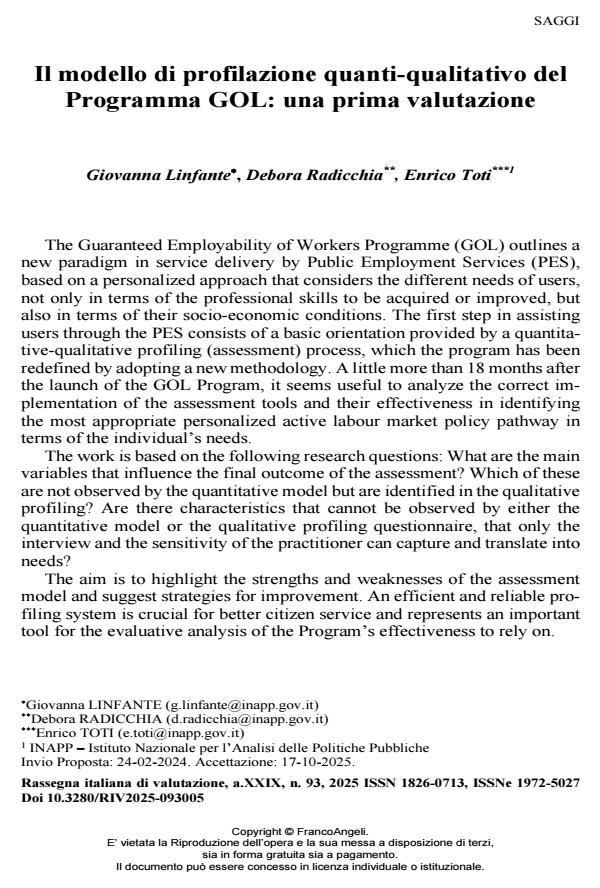
The Guaranteed Employability of Workers Programme (GOL) outlines a new paradigm in service delivery by Public Employment Services (PES), based on a personalized approach that considers the different needs of users, not only in terms of the professional skills to be acquired or improved, but also in terms of their socio-economic conditions. The first step in assisting users through the PES consists of a basic orientation provided by a quantita-tive-qualitative profiling (assessment) process, which the program has been redefined by adopting a new methodology. A little more than 18 months after the launch of the GOL Program, it seems useful to analyze the correct im-plementation of the assessment tools and their effectiveness in identifying the most appropriate personalized active labour market policy pathway in terms of the individual’s needs. The work is based on the following research questions: What are the main variables that influence the final outcome of the assessment? Which of these are not observed by the quantitative model but are identified in the qualitative profiling? Are there characteristics that cannot be observed by either the quantitative model or the qualitative profiling questionnaire, that only the interview and the sensitivity of the practitioner can capture and translate into needs? The aim is to highlight the strengths and weaknesses of the assessment model and suggest strategies for improvement. An efficient and reliable pro-filing system is crucial for better citizen service and represents an important tool for the evaluative analysis of the Program’s effectiveness to rely on.
Keywords: active labour market policies; unemployment; public employ-ment services; profiling; evaluation; machine learning.
- Allhutter, D., Cech, F., Fischer, F., Grill, G., Mager, A. (2020). Algorithmic profiling of job seekers in Austria: how austerity politics are made effective. Frontiers in Big Data, 3:5.
- Bach RL, Kern C, Mautner H., Kreuter F (2023). The impact of modeling decisions in statistical profiling. Data & Policy, 5: e32.
- Barnes, S-A., Wright, S., Irving, P., Deganis, I. (2015). Identification of latest trends and current developments in methods to profile jobseekers in European public employment services. Final report, Brussels: Directorate-General for Employment, Social Affairs and Inclusion. European Commission.
- Breiman, L. (2001). Random Forests. Machine learning 45, 5–32
- Centra, M., De Minicis, M., Marocco, M., Gualtieri, V. (2016). Profiling e garanzia giovani, in Canal T. (a cura di), L’Italia fra Jobs Act ed Europa 2020, Isfol, I libri del Fondo Sociale Europeo, Spoleto (PG), Del Gallo Editori
- Chouldechova A., Benavides-Prado D., Fialko O., Vaithianathan R. (2018). A case study of algorithm-assisted decision making in child maltreatment hotline screening decisions. In Conference on Fairness, Accountability and Transparency, pp. 134–148. New York, NY: PMLR. Desiere, S., K. Langenbucher and L. Struyven (2019), Statistical profiling in public employment services: An international comparison, OECD Social, Employment and Migration
- Working Papers, No. 224, OECD Publishing, Paris, https://doi.org/10.1787/b5e5f16e-en
- Desiere S., Struyven L. (2021). Using artificial intelligence to classify jobseekers: The accuracy-equity trade-off. Journal of Social Policy 50(2), 367–385.
- Duell N, Thurau L., Vetter T. (2016). Long-Term Unemployment in the EU: Trends and Policies. Gütersloh: Bertelsmann Stiftung Gütersloh.Eberts, R.W., O’Leary, C.J., Wandner, S.A. (2002), Targeting employment services, WE Upjohn Institute.
- Eubanks, V. (2018). Automating inequality: How high-tech tools profile, police, and punish the poor, St. Martin’s Press.
- Henman, P. (2004). Targeted! Population segmentation, electronic surveillance and governing the unemployed in Australia. International Sociology, 19(2), 173–191.
- Howard P.D., Dixon L. (2012). The construction and validation of the OASys violence predictor: Advancing violence risk assessment in the English and Welsh correctional services. Criminal Justice and Behavior 39(3), 287–307.
- Kleinberg, J., Mullainathan, S., Raghavan, M. (2016). Inherent trade-offs in the fair determination of risk scores. arXiv preprint arXiv:1609.05807.
- Kleinberg, J., Lakkaraju, Leskovec, J., Ludwig, J., Mullainathan, S. (2018). Human Decisions and Machine Predictions, The Quarterly Journal of Economics, Volume 133, Issue 1, February 2018, Pages 237–293, https://doi.org/10.1093/qje/qjx032
- Körtner, J., Bonoli, G. (2021). Predictive Algorithms in the Delivery of Public Employment Services. SocArXiv j7r8y, Center for Open Science.
- Lepri B., Oliver N., Letouzé E., Pentland A., Vinck P. (2018). Fair, transparent, and accountable algorithmic decision-making processes. The premise, the proposed solutions, and the open challenges. Philosophy & Technology 31, 611–627.
- Linfante G., Radicchia D., Toti E. (2023). Strumenti per l’attuazione dell’assessment. La profilazione quantitativa degli utenti dei Servizi per l’impiego, Collana Focus Anpal n.145.
- Linfante G., Radicchia D., Toti E., (2024). Analisi valutativa del modello di assessment del programma Gol, Collana Focus Anpal, n. 168.
Giovanna Linfante, Debora Radicchia, Enrico Toti, Il modello di profilazione quanti-qualitativo del Programma GOL: una prima valutazione in "RIV Rassegna Italiana di Valutazione" 93/2025, pp 82-106, DOI: 10.3280/RIV2025-093005