Noise e bias cognitivi nella valutazione dei progetti: evidenze e apprendimenti dall’esperienza del Servizio Civile Universale Provinciale di Trento
Journal title RIV Rassegna Italiana di Valutazione
Author/s Gianluca Braga, Erica Melloni
Publishing Year 2025 Issue 2025/93
Language Italian Pages 25 P. 107-131 File size 1045 KB
DOI 10.3280/RIV2025-093006
DOI is like a bar code for intellectual property: to have more infomation
click here
Below, you can see the article first page
If you want to buy this article in PDF format, you can do it, following the instructions to buy download credits
FrancoAngeli is member of Publishers International Linking Association, Inc (PILA), a not-for-profit association which run the CrossRef service enabling links to and from online scholarly content.
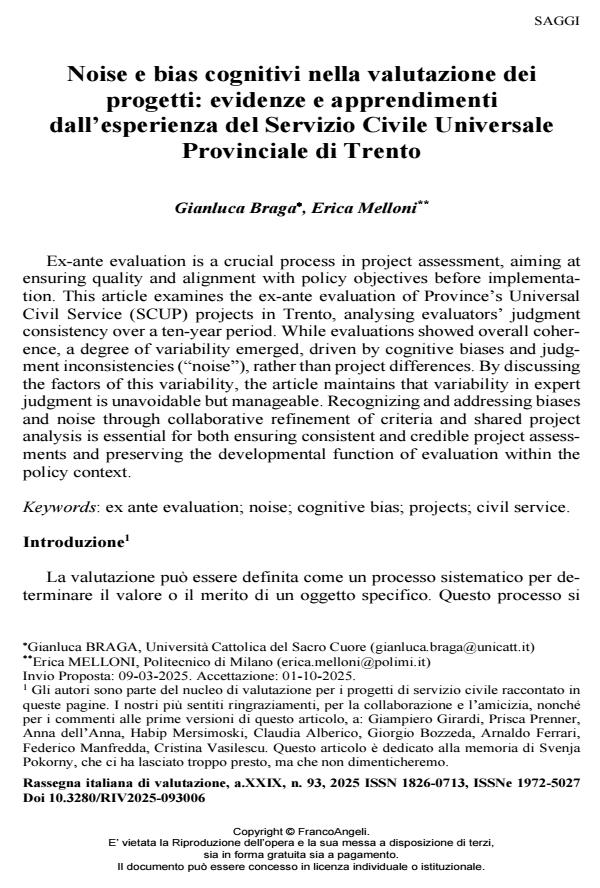
Ex-ante evaluation is a crucial process in project assessment, aiming at ensuring quality and alignment with policy objectives before implementa-tion. This article examines the ex-ante evaluation of Province’s Universal Civil Service (SCUP) projects in Trento, analysing evaluators’ judgment consistency over a ten-year period. While evaluations showed overall coher-ence, a degree of variability emerged, driven by cognitive biases and judg-ment inconsistencies (“noise”), rather than project differences. By discussing the factors of this variability, the article maintains that variability in expert judgment is unavoidable but manageable. Recognizing and addressing biases and noise through collaborative refinement of criteria and shared project analysis is essential for both ensuring consistent and credible project assess-ments and preserving the developmental function of evaluation within the policy context.
Keywords: ex ante evaluation; noise; cognitive bias; projects; civil service.
- Beebe B. (1983). Mother-infant mutual influence and precursors of self and object representation. In Masling J. (ed). Empirical Studies of Psychoanalytic Theories. Vol. 2. Hillsdale, NJ: Analytic Press.
- Beck A.T., Rush A.J., Shaw B.F., Emery G. (1979). Cognitive Therapy of Depression. New York: Guilford Press
- Benedetti G. (1988). Intervento nel dibattito sulla relazione di John Gunderson al Convegno Internazionale New Trends in Schizophrenia. Bologna, 14-17 aprile (incisione su nastro).
- Boltanski L., Claverie E., Offenstadt N., Van Damme S. (a cura di). (2007). Affaires, scandales et grandes causes. De Socrate à Pinochet. Paris: Stock.
- Busetti, S., Righettini, M. S., & Sbalchiero, S. (2025). Noise at the street level: revealing unwanted variability in seismic safety. Public Management Review, 1–25. https://doi.org/10.1080/14719037.2024.2445038
- Ferrandes G., Mandich P. (2012). Riflessioni sulla medicina predittiva e sulla necessità di integrazione delle discipline: proposta di un modello di consulenza genetica integrata. Psicologia della salute, 3: 11-28. DOI: 10.3280/PDS2012-00300
- Forza, A., Menegon, G., & Rumiati, R. (2017). In Il giudice emotivo. La decisione tra ragione ed emozione (pp. 141–173). Bologna: Il Mulino
- Glasson, J., Therivel, R., & Chadwick, A. (2012). Introduction to environmental impact assessment (4th ed.). Abingdon, UK: Routledge.
- Gulotta G. (2013). Osservazioni alle linee guida psicoforensi per un processo sempre più giusto, in Costanzo A., Gulotta G. (2013). Errore giudiziario, imparzialità del Giudice, osservazioni alle linee guida psicoforensi (per un processo sempre più giusto), in Giustizia Insieme, 2(3), pp. 142-154. DOI: 10.4399/9788854879348
- Hastie, R., & Dawes, R. M. (2009). Rational choice in an uncertain world: The psychology of judgment and decision making (2nd ed.). Sage.
- Highhouse, S. (2008). Stubborn reliance on intuition and subjectivity in employee selection. Personnel Psychology, 61(3), 427-451. https://doi.org/10.1111/j.1754-9434.2008.00058.x
- House, E. R., & Howe, K. R. (1999). Values in evaluation and social research. Thousand Oaks, CA: Sage.
- Iyengar, S. S., & Lepper, M. R. (2000). When choice is demotivating: Can one desire too much of a good thing? Journal of Personality and Social Psychology, 79(6), 995-1006. DOI: 10.1037//0022-3514.79.6.99
- Larrick, R. P. (2004). Debiasing. In D. J. Koehler & N. Harvey (Eds.), Blackwell handbook of judgment and decision making (pp. 316-338). Blackwell Publishing
- Kahneman, D., Sibony, O., & Sunstein, C. R. (2021). Noise: A flaw in human judgment. New York, NY: Little, Brown Spark.
- Kahneman, D., Slovic, P., & Tversky, A. (Eds.). (1982). Judgment under uncertainty: Heuristics and biases. Cambridge University Press
- Malhotra, N. K. (1982). Information load and consumer decision making. Journal of Consumer Research, 8(4), 419-430. DOI: 10.1086/20888
- Merini A. (a cura di). (1977). Psichiatria nel territorio. Milano: Feltrinelli.
- Montier, J. (2007). Behavioural investing: A practitioner's guide to applying behavioural finance. John Wiley & Sons.
- Morewedge, C. K., Yoon, H., Scopelliti, I., Symborski, C. W., Korris, J. H., & Kassam, K. S. (2015). Debiasing Decisions: Improved Decision Making With a Single Training Intervention. Policy Insights from the Behavioral and Brain Sciences, 2(1), 129-140. https://doi.org/10.1177/2372732215600886 (Original work published 2015)
- Mulgan, G. (2003). Measuring social value. London, UK: Centre for Strategy and Evaluation.
- Nardo, M., Saisana, M., Saltelli, A., Tarantola, S., Hoffman, A., & Giovannini, E. (2005). Handbook on constructing composite indicators: Methodology and user guide. Paris, France: OECD.
- Olson, J.M., Goffin, R.D., & Haynes, G.A. (2007). Relative versus absolute measures of explicit attitudes: Implications for predicting diverse attitude-relevant criteria. Journal of personality and social psychology, 93 6, 907-26 . DOI: 10.1037/0022-3514.93.6.90
- Park, C. W., & Lessig, V. P. (1981). Familiarity and its impact on consumer decision biases and heuristics. Journal of Consumer Research, 8(2), 223-230. https://www.jstor.org/stable/2488834
- Patton, M. Q. (2002). Qualitative research & evaluation methods (3rd ed.). Thousand Oaks, CA: Sage.
- Ratner, K. G., Dotsch, R., Wigboldus, D. H., van Knippenberg, A., & Amodio, D. M. (2014). Visualizing minimal ingroup and outgroup faces: implications for impressions, attitudes, and behavior. Journal of personality and social psychology, 106(6), 897–911. https://doi.org/10.1037/a0036498.
- Rossi, P. H., Lipsey, M. W., & Freeman, H. E. (2004). Evaluation: A systematic approach (7th ed.). Thousand Oaks, CA: Sage.
- Scriven, M. (1991). Evaluation thesaurus (4th ed.). Newbury Park, CA: Sage.
- Shepperd, M., Mair, C., & Jørgensen, M. (2018). An Experimental Evaluation of a De-biasing Intervention for Professional Software Developers. In Proceedings of the 33rd Annual ACM Symposium on Applied Computing (SAC '18). Association for Computing Machinery, New York, NY, USA, 1510–1517. https://doi.org/10.1145/3167132.3167293
- Stake, R. E. (2004). Standards-based & responsive evaluation. Thousand Oaks, CA: Sage. Tonfoni, G. (2015). La singolarità di un caso accademico interdisciplinare italiano: prospettive per una valutazione equa e sostenibile di ricerche antropolinguistiche di progressiva rilevanza filologica in euro-zona. https://doi.org/10.6092/UNIBO/AMSACTA/4150
- Vedung, E. (2010). Public policy evaluation: Types, roles, and designs. Basingstoke, UK: Palgrave Macmillan.
- Weiss, C. H. (1998). Evaluation: Methods for studying programs and policies (2nd ed.). Upper Saddle River, NJ: Prentice Hall.
Gianluca Braga, Erica Melloni, Noise e bias cognitivi nella valutazione dei progetti: evidenze e apprendimenti dall’esperienza del Servizio Civile Universale Provinciale di Trento in "RIV Rassegna Italiana di Valutazione" 93/2025, pp 107-131, DOI: 10.3280/RIV2025-093006