The Places of Bread: Mills, Warehouses, Ovens, and Stapole in the Urban Structure of Early Modern Genoa
Journal title STORIA URBANA
Author/s Sofia Gullino
Publishing Year 2026 Issue 2024/179
Language Italian Pages 24 P. 33-56 File size 972 KB
DOI 10.3280/SU2024-179002
DOI is like a bar code for intellectual property: to have more infomation
click here
Below, you can see the article first page
If you want to buy this article in PDF format, you can do it, following the instructions to buy download credits
FrancoAngeli is member of Publishers International Linking Association, Inc (PILA), a not-for-profit association which run the CrossRef service enabling links to and from online scholarly content.
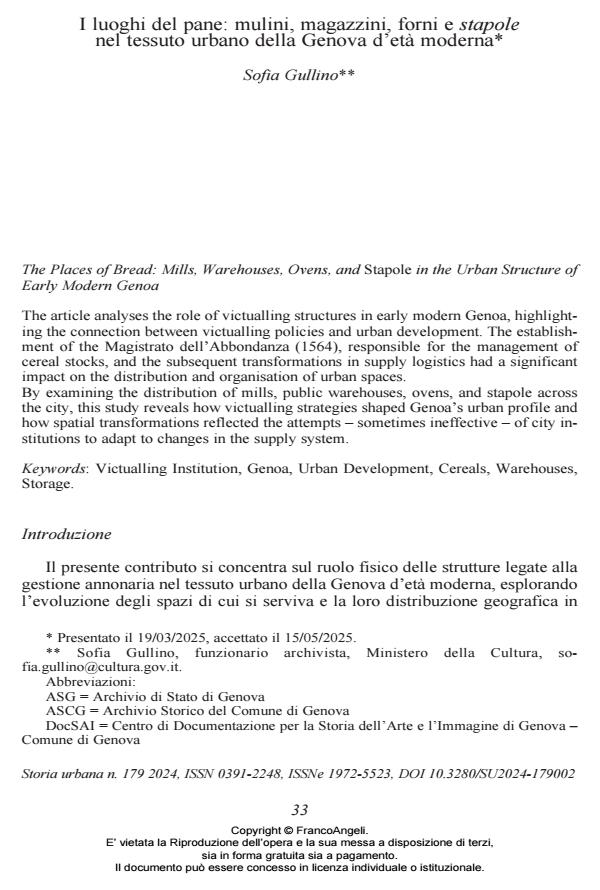
The article analyses the role of victualling structures in early modern Genoa, highlight-ing the connection between victualling policies and urban development. The establish-ment of the Magistrato dell’Abbondanza (1564), responsible for the management of cereal stocks, and the subsequent transformations in supply logistics had a significant impact on the distribution and organisation of urban spaces. By examining the distribution of mills, public warehouses, ovens, and stapole across the city, this study reveals how victualling strategies shaped Genoa’s urban profile and how spatial transformations reflected the attempts – sometimes ineffective – of city in-stitutions to adapt to changes in the supply system.
Keywords: Victualling Institution, Genoa, Urban Development, Cereals, Warehouses, Storage.
Sofia Gullino, I luoghi del pane: mulini, magazzini, forni e stapole nel tessuto urbano della Genova d’età moderna in "STORIA URBANA " 179/2024, pp 33-56, DOI: 10.3280/SU2024-179002