The impact of ESG investing on corporate profitability: Evidence from publicly-owned enterprises in emerging markets

Journal title ECONOMIA PUBBLICA
Author/s Minh Vinh Vo, Thuy Vi Le, Cao Ky Anh Dang, Thanh Vinh Nguyen
Publishing Year 2026 Issue 2025/3
Language English Pages 36 P. 347-382 File size 219 KB
DOI 10.3280/EP2025-003002
DOI is like a bar code for intellectual property: to have more infomation click here

Below, you can see the article first page

If you want to buy this article in PDF format, you can do it, following the instructions to buy download credits
Article preview

FrancoAngeli is member of Publishers International Linking Association, Inc (PILA), a not-for-profit association which run the CrossRef service enabling links to and from online scholarly content.

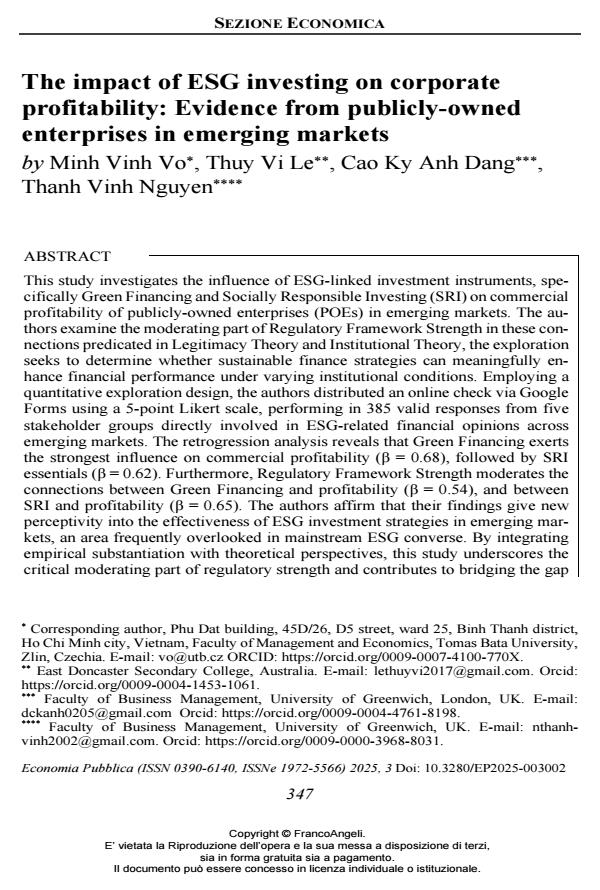
This study investigates the influence of ESGlinked investment instruments, specifically Green Financing and Socially Responsible Investing (SRI) on commercial profitability of publiclyowned enterprises (POEs) in emerging markets. The authors examine the moderating part of Regulatory Framework Strength in these connections predicated in Legitimacy Theory and Institutional Theory, the exploration seeks to determine whether sustainable finance strategies can meaningfully enhance financial performance under varying institutional conditions. Employing a quantitative exploration design, the authors distributed an online check via Google Forms using a 5point Likert scale, performing in 385 valid responses from five stakeholder groups directly involved in ESGrelated financial opinions across emerging markets. The retrogression analysis reveals that Green Financing exerts the strongest influence on commercial profitability (ß = 0.68), followed by SRI essentials (ß = 0.62). Furthermore, Regulatory Framework Strength moderates the connections between Green Financing and profitability (ß = 0.54), and between SRI and profitability (ß = 0.65). The authors affirm that their findings give new perceptivity into the effectiveness of ESG investment strategies in emerging markets, an area frequently overlooked in mainstream ESG converse. By integrating empirical substantiation with theoretical perspectives, this study underscores the critical moderating part of regulatory strength and contributes to bridging the gap between sustainability practices and profitability issues of POEs in under regulated economies.

Keywords: corporate profitability of POEs, emerging markets, green financing, socially responsible investing, regulatory frameworks

Jel codes: G30, L32

  1. Aguilera R.V., Rupp D.E., Williams C.A., Ganapathi J. (2007). Putting the S Back in Corporate Social responsibility: a Multilevel Theory of Social Change in Organizations. Academy of Management Review, 32(3): 836863.
  2. Alberti di Catenaja G., Traini S., Gironi R., Berardi D. (2024). I nuovi ESRS per le utility: dalla rendicontazione non finanziaria a quella di sostenibilità. Economia pubblica, LI(3): 465498.
  3. Ameli N., Drummond P., Bisaro A., Grubb M., Chenet H. (2019). Climate finance and disclosure for institutional investors: why transparency is not enough. Climatic Change, 160(4).
  4. Anand A., Rottig D., Parameswar N., ZwergVillegas A.M. (2023). Diving deep into the dark side: A review and examination of research on organizational misconduct in emerging markets. Business Ethics, the Environment & Responsibility, 32(2): 612637.
  5. Assaf A., Klotzle M.C., Palazzi R.B., Demir E. (2025). Connectedness across environmental, social, and governance (ESG) indices: evidence from emerging markets. Research in International Business and Finance, 73, 102596.
  6. Auer B.R., Schuhmacher F. (2016). Do socially (ir)responsible investments pay? New evidence from international ESG data. The Quarterly Review of Economics and Finance, 59: 5162.
  7. Babbie E. (2010). The practice of social research (12th ed.). Wadsworth.
  8. Bansal P., DesJardine M.R. (2014). Business sustainability: It is about time. Strategic Organization, 12(1): 7078. DOI: 10.1177/1476127013520265
  9. Branco M.C., Rodrigues L.L. (2006). Corporate Social Responsibility and ResourceBased Perspectives. Journal of Business Ethics, 69(2): 111132.
  10. Bruton G.D., Peng M.W., Ahlstrom D., Stan C., Xu K. (2015). Stateowned enterprises around the world as hybrid organizations. Academy of Management perspectives, 29(1): 92114.
  11. Campbell J.L. (2007). Why would corporations behave in socially responsible ways? an institutional theory of corporate social responsibility. Academy of Management Review, 32(3): 946967.
  12. Caruso R., Balestra A. (2022). Le società benefit in Italia: tra bene comune e identità. Economia pubblica, XLIX(1): 117139.
  13. Chen M., Chen J. (2023). Natural resources extraction in emerging economies: Does it promote sustainable development or crowdout real sector?. Resources Policy, 83, 103751.
  14. Christensen T., Lægreid P., Røvik K. A. (2020). Organization theory and the public sector: Instrument, culture and myth. Routledge.
  15. Climate Bonds Initiative (2023). Green Bonds Market Report 2023. London: CBI Publications.
  16. Creswell J.W., Creswell J.D. (2018). Research design: Qualitative, quantitative, and mixed methods approaches (5th ed.). Sage.
  17. Crifo P., Forget V. D. (2014). The economics of Corporate Social Responsibility: A firmlevel perspective survey. Journal of Economic Surveys, 29(1): 112130.
  18. Deegan C. (2002). The legitimising effect of social and environmental disclosures – a theoretical foundation. Accounting, Auditing & Accountability Journal, 15(3): 282311. DOI: 10.1108/09513570210435852
  19. Deng X., Kang J.K., Low B.S. (2013). Corporate social responsibility and stakeholder value maximization: Evidence from mergers. Journal of Financial Economics, 110(1): 87109.
  20. DiMaggio P.J., Powell W.W. (1983). The iron cage revisited: Institutional isomorphism and collective rationality in organizational fields. American Sociological Review, 48(2): 147160. DOI: 10.2307/2095101
  21. Eccles R.G., Ioannou I., Serafeim G. (2014). The impact of corporate sustainability on organizational processes and performance. Management Science, 60(11): 28352857.
  22. ElAlfy A., Palaschuk N., ElBassiouny D., Wilson J., Weber O. (2020). Scoping the evolution of corporate social responsibility (CSR) research in the sustainable development goals (SDGs) era. Sustainability, 12(14), 5544.
  23. Epstein M.J., Roy M.J. (2001). Sustainability in action: Identifying and measuring the key performance drivers. Long Range Planning, 34(5): 585604. DOI: 10.1016/S00246301(01)00084X
  24. Fatemi A., Glaum M., Kaiser S. (2018). ESG performance and firm value: The moderating role of disclosure. Global Finance Journal, 38(10440283): 4564.
  25. Flammer C. (2021). Corporate green bonds. Journal of Financial Economics, 142(2): 499516.
  26. Freeman R.E. (1984). Strategic management: A stakeholder approach. Boston, MA: Pitman.
  27. Friedman M. (1970). The social responsibility of business is to increase its profits. The New York Times Magazine, 13 September. https://www.nytimes.com/1970/09/13/archives/afriedmandoctrinethesocialresponsibilityofbusinessisto.html.
  28. GarcíaSánchez I.M., Hussain N., MartínezFerrero J., RuizBarbadillo E. (2019). Impact of disclosure and assurance quality of corporate sustainability reports on access to finance. Corporate Social Responsibility and Environmental Management, 26(4): 832848.
  29. Gefen D., Straub D. (2005). A practical guide to factorial validity using PLSGraph: Tutorial and annotated example. Communications of the Association for Information systems, 16(1), 5.
  30. Ghoshal S. (2005). Bad Management Theories Are Destroying Good Management Practices. Academy of Management Learning & Education, 4(1): 7591.
  31. Goulder L.H., Parry I.W. (2008). Instrument choice in environmental policy. Review of Environmental Economics and Policy.
  32. Hair J.F., Black W.C., Babin B.J., Anderson R.E. (2009). Multivariate data analysis (7th ed.). Pearson.
  33. Hair J.F., Hult G.T.M., Ringle C., Sarstedt M. (2014). A Primer on Partial Least Squares Structural Equation Modeling (PLSSEM). SAGE Publications.
  34. Hayek F.A. (1944). The Road to Serfdom. London: Routledge.
  35. He W. (2011). Governance transparency and capital allocation: a note. Abacus, 47(1): 109118.
  36. International Monetary Fund (IMF) (2023). Global Financial Stability Report: Profitability in Emerging Economies. Washington D.C.: IMF Publications.
  37. Ioannou I., Serafeim G. (2012). What drives corporate social performance? The role of nationlevel institutions. Journal of International Business Studies, 43(9): 834864.
  38. Jennings P.D., Zandbergen P.A. (1995). Ecologically sustainable organizations: An institutional approach. Academy of Management Review, 20(4): 10151052.
  39. Kharb R., Shri C., Singh P., Bhatia S., Saini N. (2024). Modelling the barriers of green financing in achieving environmental sustainability: An analysis using TISM. Environment, Development and Sustainability, 134.
  40. Li J., Wang K., Mei Y. (2024). StateOwned Capital Participation and Corporate Environmental, Social, and Governance Performance: Evidence from Chinese Private Firms. Journal of the Knowledge Economy, 128.
  41. Lins K. V., Servaes H., Tamayo A. (2017). Social capital, trust, and firm performance: The value of corporate social responsibility during the financial crisis. The Journal of Finance, 72(4): 17851824.
  42. Ma W., Wu J., Wu J. (2024). Corporate litigation risk, institutional investor shareholding and corporate ESG performance. International Review of Economics & Finance, 95, 103448.
  43. Marano V., Kostova T. (2021). Unpacking the Institutional Complexity in Adoption of CSR Practices in Multinational Enterprises. Journal of Management Studies, 53(1): 2854.
  44. Martiny A., Taglialatela J., Testa F., Iraldo F. (2024). Determinants of environmental social and governance (ESG) performance: A systematic literature review. Journal of Cleaner Production, 456, 142213.
  45. Matten D., Moon J. (2008). “Implicit” and “explicit” CSR: A conceptual framework for a comparative understanding of corporate social responsibility. Academy of Management Review, 33(2): 404424.
  46. Michelon G., Pilonato S., Ricceri F. (2015). CSR reporting practices and the quality of disclosure. Journal of Business Ethics, 129(3): 789802.
  47. Mikael T. L., Mabhungu I. (2024). Performance reporting practices in stateowned enterprises: A systematic literature review. Africa’s Public Service Delivery & Performance Review, 12(1), 8.
  48. Mill J.S. (1863). Utilitarianism. London: Parker, Son, and Bourn.
  49. North D.C. (1990). Institutions, Institutional Change and Economic Performance. Cambridge: Cambridge University Press. DOI: 10.1017/CBO9780511808678
  50. O’Brien R. M. (2007). A caution regarding rules of thumb for variance inflation factors. Quality & Quantity, 41(5): 673690.
  51. Puzzonia M. (2018). The impact of ESG investment, how company and university can collaborate to realize it with local innovation. Journal of Intercultural Management, 10(3): 171194.
  52. Rawls J. (1971). A Theory of Justice, Cambridge: Harvard University Press. Renneboog L., Ter Horst J., Zhang C. (2008). Socially responsible investments: In stitutional aspects, performance, and investor behavior. Journal of Banking & Finance, 32(9): 17231742.
  53. Revelli C. (2017). Socially responsible investing (SRI): From mainstream to margin?. Research in International Business and Finance, 39: 711717.
  54. Scatigna M., Xia F.D., Zabai A., Zulaica O. (2021). Achievements and challenges in ESG markets. BIS Quarterly Review, December. Sage Publications.
  55. Setiawan S., Ismalina P., Nurhidajat R., Tjahjaprijadi C., Munandar Y. (2021). Green Finance in Indonesia’s Low Carbon Sustainable Development. International Journal of Energy Economics and Policy, 11(5): 191203.
  56. Singhania M., Saini N. (2023). Institutional framework of ESG disclosures: Comparative analysis of developed and developing countries. Journal of Sustainable Finance & Investment, 13(1): 516559. DOI: 10.1080/20430795.2021.1964810
  57. Soldatos G.T. (2020). Publicprivate investment substitutabilitycomplementarity, taxation, and bank competition. Economia pubblica, XLVI(3): 4161.
  58. Solaimani S. (2024). From compliance to capability: On the role of data and technology in environment, social, and governance. Sustainability, 16(14), 6061.
  59. Solangi Y.A., Alyamani R., Asghar M., Ali S., Magazzino C. (2025). The Impact of Social Investment and Green Finance on Sustainable Development: Evidence from Emerging Market Economies. Sustainable Development.
  60. Suchman M.C. (1995). Managing legitimacy: Strategic and institutional approaches. Academy of Management Review, 20(3): 571610. DOI: 10.2307/258788
  61. World Bank (2020). Developing a National Green Taxonomy: A World Bank Guide. World Bank (2021). World Development Report: The Role of Private Sector in Emerging Markets. Washington D.C.: World Bank.
  62. Yu M., Zhou Q., Cheok M.Y., Kubiczek J., Iqbal N. (2021). Does green finance improve energy efficiency? New evidence from developing and developed economies. Economic Change and Restructuring.

Minh Vinh Vo, Thuy Vi Le, Cao Ky Anh Dang, Thanh Vinh Nguyen, The impact of ESG investing on corporate profitability: Evidence from publicly-owned enterprises in emerging markets in "ECONOMIA PUBBLICA " 3/2025, pp 347-382, DOI: 10.3280/EP2025-003002