Against a “Pseudo-Enlightenment” That Excludes “Half the World”:Reflec- tions on a Possible Comparison between Amalia Holst and Kant
Journal title RIVISTA DI STORIA DELLA FILOSOFIA
Author/s Federico Rampinini
Publishing Year 2026 Issue 2025/4
Language Italian Pages 18 P. 619-636 File size 212 KB
DOI 10.3280/SF2025-004006
DOI is like a bar code for intellectual property: to have more infomation
click here
Below, you can see the article first page
If you want to buy this article in PDF format, you can do it, following the instructions to buy download credits
FrancoAngeli is member of Publishers International Linking Association, Inc (PILA), a not-for-profit association which run the CrossRef service enabling links to and from online scholarly content.
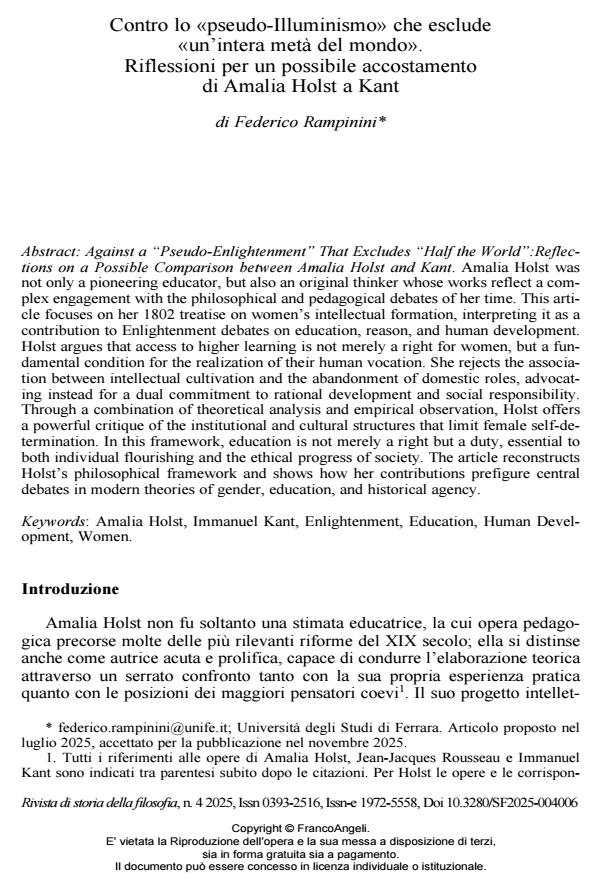
Amalia Holst was not only a pioneering educator, but also an original thinker whose works reflect a com- plex engagement with the philosophical and pedagogical debates of her time. This arti- cle focuses on her 1802 treatise on women’s intellectual formation, interpreting it as a contribution to Enlightenment debates on education, reason, and human development. Holst argues that access to higher learning is not merely a right for women, but a fun- damental condition for the realization of their human vocation. She rejects the associa- tion between intellectual cultivation and the abandonment of domestic roles, advocat- ing instead for a dual commitment to rational development and social responsibility. Through a combination of theoretical analysis and empirical observation, Holst offers a powerful critique of the institutional and cultural structures that limit female self-de- termination. In this framework, education is not merely a right but a duty, essential to both individual flourishing and the ethical progress of society. The article reconstructs Holst’s philosophical framework and shows how her contributions prefigure central debates in modern theories of gender, education, and historical agency.
Keywords: Amalia Holst, Immanuel Kant, Enlightenment, Education, Human Devel- opment, Women.
Federico Rampinini, Contro lo «pseudo-Illuminismo» che esclude «un’intera metà del mondo». Riflessioni per un possibile accostamento di Amalia Holst a Kant in "RIVISTA DI STORIA DELLA FILOSOFIA" 4/2025, pp 619-636, DOI: 10.3280/SF2025-004006