Territorial equity and the socio-health responsiveness in Veneto
Journal title ECONOMIA E SOCIETÀ REGIONALE
Author/s Barbara Bonvento
Publishing Year 2026 Issue 2026/1
Language Italian Pages 18 P. 119-136 File size 290 KB
DOI 10.3280/ES2026-001009
DOI is like a bar code for intellectual property: to have more infomation
click here
Below, you can see the article first page
If you want to buy this article in PDF format, you can do it, following the instructions to buy download credits
FrancoAngeli is member of Publishers International Linking Association, Inc (PILA), a not-for-profit association which run the CrossRef service enabling links to and from online scholarly content.
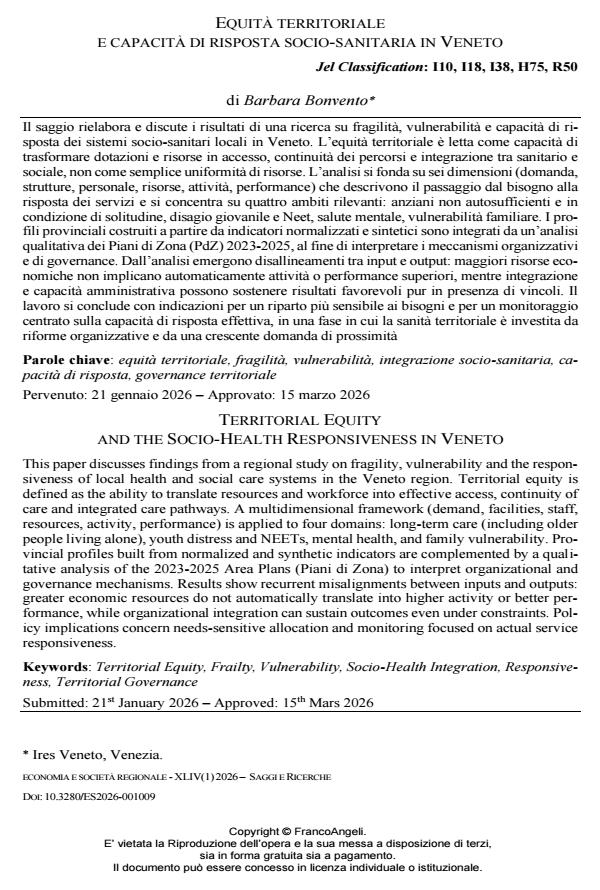
This paper discusses findings from a regional study on fragility, vulnerability and the responsiveness of local health and social care systems in the Veneto region. Territorial equity is defined as the ability to translate resources and workforce into effective access, continuity of care and integrated care pathways. A multidimensional framework (demand, facilities, staff, resources, activity, performance) is applied to four domains: longterm care (including older people living alone), youth distress and NEETs, mental health, and family vulnerability. Provincial profiles built from normalized and synthetic indicators are complemented by a qualitative analysis of the 20232025 Area Plans (Piani di Zona) to interpret organizational and governance mechanisms. Results show recurrent misalignments between inputs and outputs: greater economic resources do not automatically translate into higher activity or better performance, while organizational integration can sustain outcomes even under constraints. Policy implications concern needssensitive allocation and monitoring focused on actual service responsiveness.
Keywords: Territorial Equity, Frailty, Vulnerability, SocioHealth Integration, Responsiveness, Territorial Governance
Jel codes: I10, I18, I38, H75, R50
- Bonvento B. (2025). Integrazione sociosanitaria: tra fragilità e vulnerabilità.Ires Veneto <https://iresveneto.it/lintegrazionesociosanitariaunpercorsotrafragilitaevulnerabilita/>.
- Brown K. (2015). Vulnerability and Young People: Care and Social Control in Policy and Practice. Bristol: Bristol University Press.
- Braveman P., Gruskin S. (2003). Defining equity in health. Journal of Epidemiology and Community Health, 57(4): 254258.
- Costa G. (2020). Vulnerability and frailty in public health, in health policies, and in study methods. Epidemiologia & Prevenzione, 44 (56) Suppl 1: 1417. DOI: 10.19191/EP20.56.S1.P014.069
- Hanlon P. et al. (2024). The relationship between frailty and social vulnerability: a systematic review. The Lancet Healthy Longevity, 5.3: e214e226. DOI: 10.1016/S26667568(23)002635
- Lauria L., Lega I., Pizzi E., Bortolus R., Battilomo S., Tamburini C., Donati S., a cura di (2022). Indagine nazionale sui consultori familiari 20182019. Risultati generali. Roma: Istituto Superiore di Sanità. (Rapporti Istisan 22/16 Pt. 1).
- Mazziotta M., Pareto A. (2020). Gli indici sintetici. Torino: Giappichelli. Ministero della Salute (2024). Rapporto salute mentale: dati SISM 2023. Roma: Ministero della Salute.
- Ministero della Salute – Ufficio di statistica (2025). Annuario Statistico del Servizio Sanitario Nazionale. Assetto organizzativo, attività e fattori produttivi del SSN. Anno 2023. Roma: Ministero della Salute.
- Ranci C., Arlotti M., Lamura G., Martinelli F., a cura di (2023). La solitudine dei numeri ultimi. Invecchiare da soli nell’epoca della pandemia. Bologna: il Mulino.
- Starace F., a cura di (2024). Rapporto Siep 2024. La salute mentale nell’Italia del regionalismo <https://siep.it/quadernosiep/>.
- Whitehead M. (1992). The concepts and principles of equity and health. Copenhagen: World Health Organization, Regional Office for Europe.
Barbara Bonvento, Equità territoriale e capacità di risposta socio-sanitaria in Veneto in "ECONOMIA E SOCIETÀ REGIONALE " 1/2026, pp 119-136, DOI: 10.3280/ES2026-001009