The tax regime of gastronomy, among tourism, cultural heritage and excellent agri-food products
Journal title RIVISTA ITALIANA DI DIRITTO DEL TURISMO
Author/s Lorenzo del Federico, Paola Milioto
Publishing Year 2026 Issue 2026/47
Language Italian Pages 23 P. 27-49 File size 234 KB
DOI 10.3280/DT2026-047002
DOI is like a bar code for intellectual property: to have more infomation
click here
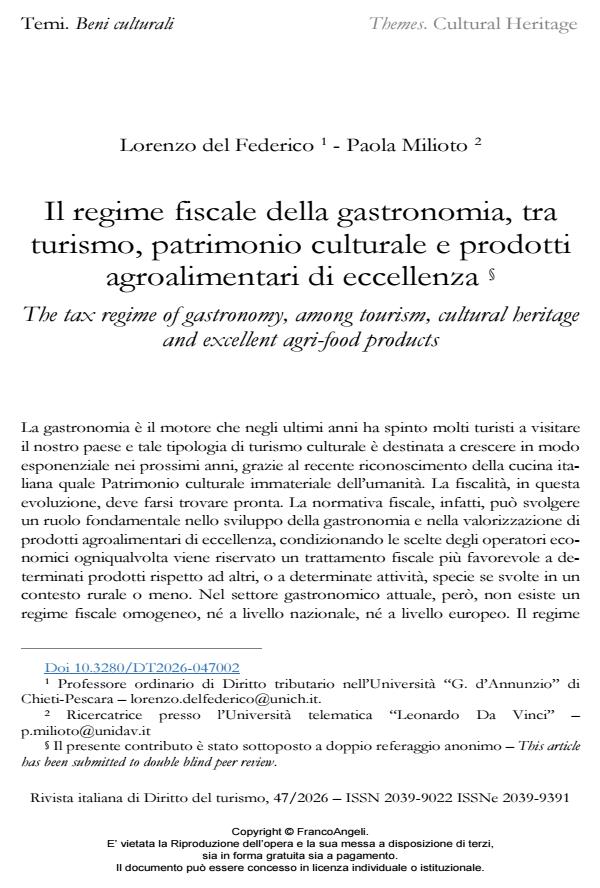
Below, you can see the article first page
If you want to buy this article in PDF format, you can do it, following the instructions to buy download credits
FrancoAngeli is member of Publishers International Linking Association, Inc (PILA), a not-for-profit association which run the CrossRef service enabling links to and from online scholarly content.
Gastronomy is the engine that has attracted many tourists to our country in recent years, and this type of cultural tourism is set to grow exponentially in the coming years, thanks to the recent recognition of Italian cuisine as an Intangible Cultural Heritage of Humanity. The tax system must be ready for this evolution. Tax regulations, indeed, can play a fundamental role in the development of the gastronomy and of excellent agri-food products, conditioning the choices of economic operators whenever better tax treatment is given to certain products than to others; or to certain activities, in particular if they are carried out in a rural context or not. In the actual gastronomy field, there is no homogeneous tax regime, both at the national and European levels. So, the tax regime is not unique and, starting from the “ordinary” model dedicated to agricultural income, it provides for numerous exceptions, specific to each product, creating asymmetries and disparities.
Lorenzo del Federico, Paola Milioto, Il regime fiscale della gastronomia, tra turismo, patrimonio culturale e prodotti agroalimentari di eccellenza in "RIVISTA ITALIANA DI DIRITTO DEL TURISMO" 47/2026, pp 27-49, DOI: 10.3280/DT2026-047002