On the use of a Pre-Analysis Plan: An application in the social sciences

Journal title ECONOMIA PUBBLICA
Author/s Barbara Ermini, Fabio Fiorillo, Silvia Mattiozzi, Francesca Mariani, Luca Salvati
Publishing Year 2026 Issue 2026/1
Language English Pages 29 P. 7-35 File size 536 KB
DOI 10.3280/EP2026-001001
DOI is like a bar code for intellectual property: to have more infomation click here

Below, you can see the article first page

If you want to buy this article in PDF format, you can do it, following the instructions to buy download credits
Article preview

FrancoAngeli is member of Publishers International Linking Association, Inc (PILA), a not-for-profit association which run the CrossRef service enabling links to and from online scholarly content.

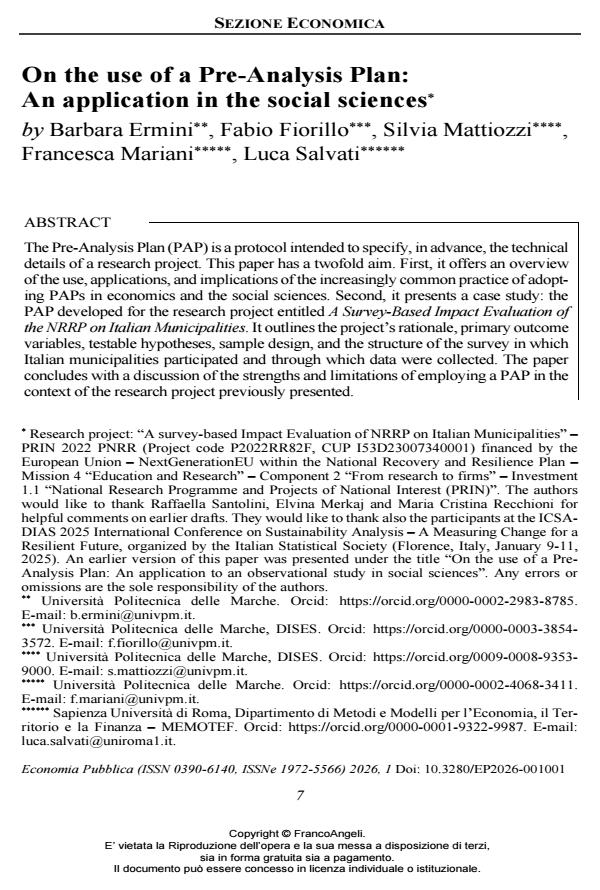
The Pre-Analysis Plan (PAP) is a protocol intended to specify, in advance, the technical details of a research project. This paper has a twofold aim. First, it offers an overview of the use, applications, and implications of the increasingly common practice of adopting PAPs in economics and the social sciences. Second, it presents a case study: the PAP developed for the research project entitled A Survey-Based Impact Evaluation of the NRRP on Italian Municipalities. It outlines the project’s rationale, primary outcome variables, testable hypotheses, sample design, and the structure of the survey in which Italian municipalities participated and through which data were collected. The paper concludes with a discussion of the strengths and limitations of employing a PAP in the context of the research project previously presented.

Keywords: Pre-Analysis Plan, NRRP, Italian municipalities, digitalization, territorial development, social inclusion

Jel codes: B40, C54, R58

  1. ANCI (2024). Gli investimenti per comuni e città nel PNRR. Dossier, Associazione Nazionale Comuni Italiani, 30 Apr.
  2. Angrist J. D., Pischke J.-S. (2010). The credibility revolution in empirical econom-ics: How better research design is taking the Con out of econometrics. Journal of Economic Perspectives, 24(2): 3-30, June.
  3. Arcidiacono P., Hotz V. J., Maurel A., Romano T. (2020). Ex ante returns and oc-cupational choice. Journal of Political Economy, 128(12): 4475-4522. DOI: 10.1086/710559
  4. Aucejo E. M., French J., Araya M. P. U., Zafar B. (2020). The impact of covid-19 on student experiences and expectations: Evidence from a survey. Journal of Public Economics, 191, 104271.
  5. Banerjee A. V., Duflo E., Kremer M. (2020b). The Influence of Randomized Con-trolled Trials on Development Economics Research and on Development Policy. The MIT Press, 01.
  6. Banerjee A., Duflo E., Finkelstein A., Katz L. F., Olken B. A., Sautmann A. (2020a). In Praise of Moderation: Suggestions for the Scope and Use of Pre-Analysis Plans for RCTs in Economics. NBER Working Papers 26993, National Bureau of Economic Research, Inc, April.
  7. Brodeur A., Cook N. M., Hartley J. S., Heyes A. (2024). Do preregistration and pre-analysis plans reduce p-hacking and publication bias? Evidence from 15,992 test statistics and suggestions for improvement. Journal of Political Economy Micro-economics, 2(3): 527-561. DOI: 10.1086/730455
  8. Brodeur A., Cook N., Heyes A. (2020). Methods matter: p-hacking and publication bias in causal analysis in economics. The American Economic Review, 110(11): 3634-3660.
  9. Brodeur A., Le M., Sangnier M., Zylberberg Y. (2016). Star wars: The empirics strike back. American Economic Journal: Applied Economics, 8(1): 1-32, Janu-ary.
  10. Burlig F. (2018). Improving transparency in observational social science research: A pre-analysis plan approach. Economics Letters, 168: 56-60.
  11. Camera dei Deputati (2025). Documentazione Parlamentare – Il Piano Nazionale di Ripresa e Resilienza. -- https://temi.camera.it/leg19/pnrr/missioni.html. Acces-sed: 2025/09/09.
  12. Casey K., Glennerster R., Miguel E. (2012). Reshaping institutions: Evidence on aid impacts using a preanalysis plan. The Quarterly Journal of Economics, 127(4): 1755-1812, 11.
  13. Christensen G., Miguel E. (2018). Transparency, reproducibility, and the credibility of economics research. Journal of Economic Literature, 56(3): 920-80, Septem-ber.
  14. Chuang E., Vykstra S. (2015). A Guide to Pre-Analysis Plans. Technical report, In-novations for Poverty Action.
  15. Coffman L. C., Niederle M. (2015). Pre-analysis Plans Have Limited Upside, Espe-cially Where Replications are Feasible. Journal of Economic Perspectives, 29(3): 81-98, Summer.
  16. Finkelstein A., Taubman S., Wright B., Bernstein M., Gruber J., Newhouse J. P., Allen H., Baicker K., Oregon Health Study Group (2012). The Oregon Health Insurance Experiment: Evidence from the First Year. The Quarterly Journal of Economics, 127(3): 1057-1106, 07.
  17. Franco A., Malhotra N., Simonovits G. (2014). Publication bias in the social sci-ences: Unlocking the file drawer. Science, 345(6203): 1502-1505.
  18. Giustinelli P., Shapiro M. D. (2024). Seate: Subjective ex ante treatment effect of health on retirement. American Economic Journal: Applied Economics, 16(2): 278-317, April.
  19. Heckman J. J., Vytlacil E. (2005). Structural equations, treatment effects, and econ-ometric policy evaluation. Econometrica, 73(3): 669-738.
  20. Humphreys M., Sanchez de la Sierra R., Van der Vindt P. (2013). Fishing, commit-ment, and communication: A proposal for comprehensive nonbinding research registration. Political Analysis, 21(1): 1-20.
  21. Imai T., Toussaert S., Baillon A., Dreber Almenberg A., Erta S., Johannesson M., Neyse L., Villeval M. C. (2025). Pre-Registration and Pre-Analysis Plans in Ex-perimental Economics. IZA Discussion Papers 17821, Institute of Labor Eco-nomics (IZA), Apr.
  22. Imbens G. V., Rubin D. B. (2015). Causal Inference in Statistics Social, and Bio-medical Sciences. Cambridge University Press.
  23. Ioannidis J. P. A., Stanley T. D., Doucouliagos H. (2017). The Power of Bias in Economics Research. The Economic Journal, 127(605): F236-F265, 10.
  24. ISTAT (2024). PNRR, aggiornato e ampliato il cruscotto ISTAT-RGS, 18 Jun.
  25. Italia Domani. NRRP financial framework. -- https://www.italiadomani.gov.it/content/ sogei-ng/it/en/il-piano/Risorse/le-risorse-per-la-crescita/il-quadro-finanziario-del-pnrr.html, 2024. Accessed: 2024/06/15.
  26. Italia Domani. Piano Nazionale di Ripresa e Resilienza NextGenerationItalia. --https://www.italiadomani.gov.it/it/strumenti/documenti/archivio-documenti/piano-nazionale-di-ripresa-e-resilienza.html, 2021. Accessed: 2025/04/09.
  27. Kasy M., Spiess J. (2024). Optimal Pre-Analysis Plans: Statistical Decisions Subject to Implementability. NBER Working Papers 26993, National Bureau of Eco-nomic Research, Inc.
  28. Mariani F., Ciommi M., Recchioni M. C. (2024). A new class of composite indica-tors: The penalized power mean. European Journal of Operational Research, 317(3): 1015-1035.
  29. Miguel E., Camerer C., Casey K., Cohen J., Esterling K. M., Gerber A., Glennerster R., Green D. P., Humphreys M., Imbens G., Laitin D., Madon T., Nelson L., Nosek B. A., Petersen M., Sedlmayr R., Simmons J. P., Simonsohn U., Van der Laan M. (2014). Promoting transparency in social science research. Science, 343(6166): 30-31.
  30. Montella M., Mostacci F. (2024). Come si cambia: il PNRR dopo la revisione. la-voce.info, 18 Apr.
  31. Neumark D. (1999). The Employment Effects of Recent Minimum Wage Increases: Evidence from a Pre-Specified Research Design. Working Paper 7171, National Bureau of Economic Research, June.
  32. Neumark D. (2001). The employment effects of minimum wages: Evidence from a prespecified research design the employment effects of minimum wages. Indus-trial Relations: A Journal of Economy and Society, 40(1): 121-144. DOI: 10.1111/0019-8676.00199
  33. Nosek B. A., Ebersole C. R., DeHaven A. C., Mellor D. T. (2018). The Preregistra-tion Revolution. Technical Report 2dxu5, Center for Open Science, March.
  34. Ofosu G. K., Posner D. N. (2020). Do Pre-Analysis Plans hamper publication?. AEA Papers and Proceedings, 110: 70-74, May.
  35. Ofosu G. K., Posner D. N. (2023). Pre-Analysis Plans: An early stocktaking. Per-spectives on Politics, 21(1): 174-190. DOI: 10.1017/S1537592721000931
  36. Olken B. A. (2015). Promises and perils of Pre-Analysis Plans. Journal of Economic Perspectives, 29(3): 61-80, September.
  37. Polinesi G., Mariani F., Recchioni M. C., Lamonica G. R. (2024). More than One Story from Composite Indices: A Beta-Bernoulli Approach and Policy Making Decision Scenarios. Working paper.
  38. Sacchi A., Rubino P. (2024). Il disegno e l’attuazione del PNRR: investimenti, di-mensione territoriale e percorsi di sviluppo. Argomenti, (24), luglio. DOI: 10.14276/1971-8357.3897
  39. UPB (2022). I bandi destinati agli enti territoriali: obiettivi specifici e vincoli terri-toriali. Flash 1, Ufficio Parlamentare di Bilancio, 20 Jan.
  40. Viswall M., Zafar B. (2021). Human capital investments and expectations about ca-reer and family. Journal of Political Economy, 129(5): 1361-1424. DOI: 10.1086/713100

Barbara Ermini, Fabio Fiorillo, Silvia Mattiozzi, Francesca Mariani, Luca Salvati, On the use of a Pre-Analysis Plan: An application in the social sciences in "ECONOMIA PUBBLICA " 1/2026, pp 7-35, DOI: 10.3280/EP2026-001001