John Stuart Mill’s System of Taxation reconsidered
Journal title HISTORY OF ECONOMIC THOUGHT AND POLICY
Author/s Michel S. Zouboulakis
Publishing Year 2026 Issue 2026/1
Language English Pages 11 P. 149-159 File size 53 KB
DOI 10.3280/SPE2026-001006
DOI is like a bar code for intellectual property: to have more infomation
click here
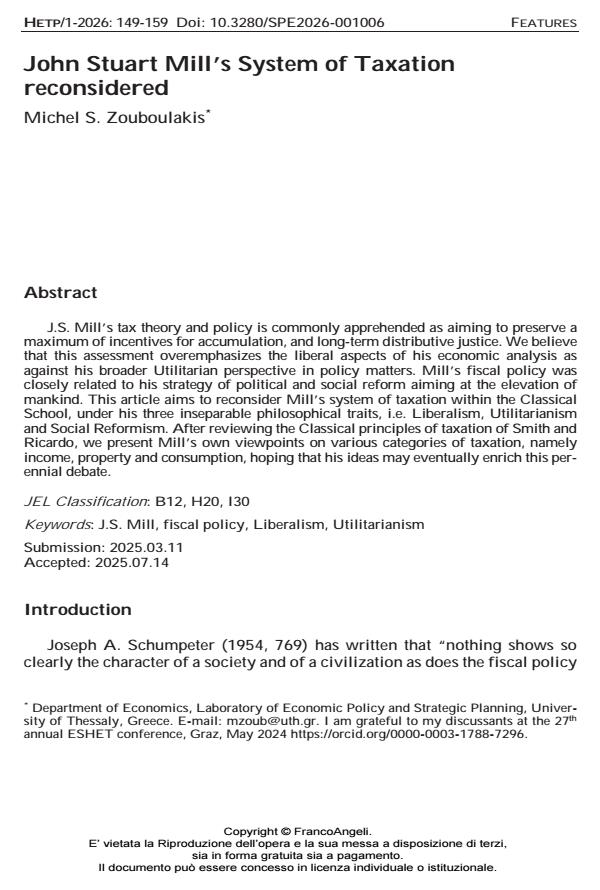
Below, you can see the article first page
If you want to buy this article in PDF format, you can do it, following the instructions to buy download credits
FrancoAngeli is member of Publishers International Linking Association, Inc (PILA), a not-for-profit association which run the CrossRef service enabling links to and from online scholarly content.
J.S. Mill’s tax theory and policy is commonly apprehended as aiming to preserve a maximum of incentives for accumulation, and longterm distributive justice. We believe that this assessment overemphasizes the liberal aspects of his economic analysis as against his broader Utilitarian perspective in policy matters. Mill’s fiscal policy was closely related to his strategy of political and social reform aiming at the elevation of mankind. This article aims to reconsider Mill’s system of taxation within the Classical School, under his three inseparable philosophical traits, i.e. Liberalism, Utilitarianism and Social Reformism. After reviewing the Classical principles of taxation of Smith and Ricardo, we present Mill’s own viewpoints on various categories of taxation, namely income, property and consumption, hoping that his ideas may eventually enrich this perennial debate.
Keywords: J.S. Mill, fiscal policy, Liberalism, Utilitarianism
Jel codes: B12, H20, I30
Michel S. Zouboulakis, John Stuart Mill’s System of Taxation reconsidered in "HISTORY OF ECONOMIC THOUGHT AND POLICY" 1/2026, pp 149-159, DOI: 10.3280/SPE2026-001006