The influence of managers’ characteristics on qualitative materiality factors: Some empirical evidence
Journal title FINANCIAL REPORTING
Author/s Alessandra Allini, Ilaria Martino, Adele Caldarelli
Publishing Year 2026 Issue 2026/1
Language English Pages 29 P. 111-139 File size 168 KB
DOI 10.3280/fr202519992
DOI is like a bar code for intellectual property: to have more infomation
click here
Below, you can see the article first page
If you want to buy this article in PDF format, you can do it, following the instructions to buy download credits
FrancoAngeli is member of Publishers International Linking Association, Inc (PILA), a not-for-profit association which run the CrossRef service enabling links to and from online scholarly content.
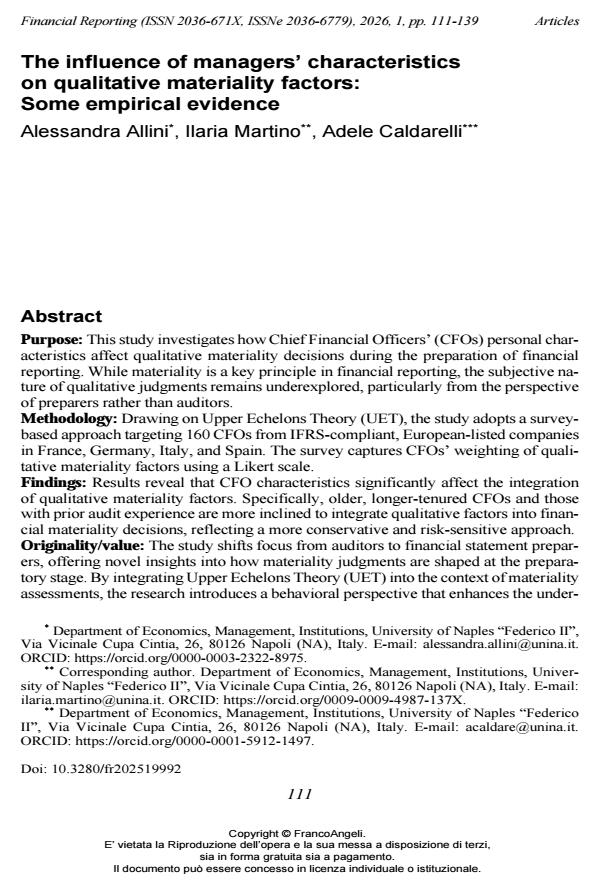
Purpose: This study investigates how Chief Financial Officers’ (CFOs) personal characteristics affect qualitative materiality decisions during the preparation of financial reporting. While materiality is a key principle in financial reporting, the subjective nature of qualitative judgments remains underexplored, particularly from the perspective of preparers rather than auditors. Methodology: Drawing on Upper Echelons Theory (UET), the study adopts a survey-based approach targeting 160 CFOs from IFRS-compliant, European-listed companies in France, Germany, Italy, and Spain. The survey captures CFOs’ weighting of qualitative materiality factors using a Likert scale. Findings: Results reveal that CFO characteristics significantly affect the integration of qualitative materiality factors. Specifically, older, longer-tenured CFOs and those with prior audit experience are more inclined to integrate qualitative factors into financial materiality decisions, reflecting a more conservative and risk-sensitive approach. Originality/value: The study shifts focus from auditors to financial statement preparers, offering novel insights into how materiality judgments are shaped at the preparatory stage. By integrating Upper Echelons Theory (UET) into the context of materiality assessments, the research introduces a behavioral perspective that enhances the understanding of how executive characteristics shape accounting judgments. This approach expands the boundaries of behavioral accounting literature and provides new insights into the subjective dimensions of financial statement preparation. Practical implications: Findings have implications for standard setters, regulators, and corporate governance by emphasizing the role of CFO characteristics in ensuring consistent and transparent financial reporting. Understanding these behavioral dynamics can inform better training, policy design, and oversight mechanisms.
Keywords: materiality, CFOs characteristics, qualitative factors
Jel codes: M41
- Abu-Bader, S. H. (2021). Using statistical methods in social science research: With a complete SPSS guide. Oxford University Press, USA.
- Acito, A. A., Burks, J. J., & Johnson, W. B. (2019). The materiality of accounting errors: Evidence from SEC comment letters. Contemporary Accounting Research, 36(2), 839-868. DOI: 10.1111/1911-3846.12458
- Barua, A., Davidson, L. F., Rama, D. V., & Thiruvadi, S. (2010). CFO gender and accruals quality. Accounting Horizons, 24(1), 25-39.
- Bianchi, S. (2019). Disclosure initiative and related research projects, Financial Reporting, 1, 145-153. DOI: 10.3280/FR2019-001005
- Bishop, C. C., DeZoort, F. T., & Hermanson, D. R. (2017). The effect of CEO social influence pressure and CFO accounting experience on CFO financial reporting decisions. Auditing: A Journal of Practice & Theory, 36(1), 21-41.
- Bochkay, K., Chychyla, R., & Nanda, D. (2019). Dynamics of CEO disclosure style. The Accounting Review, 94(4), 103-140.
- Brennan, N. M., & Gray, S. J. (2005). The impact of materiality: accounting’s best kept secret. Asian Academy of Management Journal of Accounting and Finance, 1, 1-31.
- Brochet, F., & Welch, K. (2011). Top executive background and financial reporting choice. Harvard Business School Research Paper, (1765928).
- Bu-Peow NG., T., & Tan, H. T. (2007). Effects of qualitative factor salience expressed client concern, and qualitative materiality thresholds on auditors’ audit adjustment decisions. Contemporary Accounting Research, 24(4), 1171-1192.
- Caglio, A., Dossi, A., & Van der Stede, W. A. (2018). CFO role and CFO compensation: An empirical analysis of their implications. Journal of Accounting and Public Policy, 37(4), 265-281.
- Campa, D., Ginesti, G., & Allini, A. (2024). CFO characteristics and real earnings management. European Accounting Review, 33(4), 1397-1430. DOI: 10.1080/09638180.2023.2169734
- Cardillo, E., & Molina, S. (2011). IAS-IFRS e rendicontazione socio-ambientale: una verifica della estendibilità dei principi generali del Framework alla valutazione della qualità dei documenti volontari. Financial Reporting, (1). DOI: 10.3280/FR2011-001003
- Chahyadi, C., & Abusalim, B. (2011). The role of education and experience in CFO career and compensation. Journal of Accounting and Finance, 11(3), 26-35.
- Chen, H., Hua, S., & Sun, X. C. (2018). CEO Age and the Persistence of Internal Control Deficiencies. Journal of Accounting & Finance, 18(7), 2158-3625.
- Choudhary, P., Merkley, K., & Schipper, K. (2019). Auditors’ quantitative materiality judgments: Properties and implications for financial reporting reliability. Journal of Accounting Research, 57(5), 1303-1351.12286. DOI: 10.1111/1475-679X
- Christensen, B., Schmardebeck, R., & Seidel, T. (2022). Do auditors’ incentives affect materiality assessments of prior-period misstatements?. Accounting, Organizations and Society, 101, 101332.
- Cisi, M., Del Baldo, M., Marelli, A., Ricci, F., & Scafarto, V. (2022). Non-financial Disclosure and Materiality: Exploring the Role of CFOs. In Non-financial Disclosure and Integrated Reporting, 445-475. Springer, Cham. DOI: 10.1007/978-3-030-90355-8_26
- Condie, E. R., Obermire, K. M., Seidel, T. A., & Wilkins, M. S. (2021). Prior Audit Experience and CFO Financial Reporting Aggressiveness. Auditing: A Journal of Practice & Theory, 40(4), 99-121. DOI: 10.2308/AJPT-2020-012
- Dao, M., H. Huang, K. Y. Chen, and T. Huang, (2014). Can management turnover restore the financial statement credibility of restating firms? Further evidence, Journal of Business Finance and Accounting, 41, 893-925.jbfa.12081.
- Doron, M., Baker, C. R., & Zucker, K. D. (2019). Bookkeeper-controller-CFO: the rise of the chief financial and chief accounting officer. Accounting Historians Journal, 46(2), 1-8.
- Edgley, C. (2014). A genealogy of accounting materiality. Critical Perspectives on Accounting, 25(3), 255-271.
- Edgley, C., Jones, M. J., & Atkins, J. (2015). The adoption of the materiality concept in social and environmental reporting assurance: A field study approach. The British Accounting Review, 47(1), 1-18.
- Eilifsen, A., & Messier Jr, W. F. (2015). Materiality guidance of the major public accounting firms. Auditing: A Journal of Practice & Theory, 34(2), 3-26.
- Estes, R., & Reames, D. D. (1988). Effects of personal characteristics on materiality decisions: A multivariate analysis. Accounting and Business Research, 18(72), 291-296. DOI: 10.1080/00014788.1988.9729376
- Feng, M., Ge, W., Luo, S., & Shevlin, T. (2011). Why do CFOs become involved in material accounting manipulations?. Journal of Accounting and Economics, 51(1-2), 21-36.
- Festa, M. M., Jones, M. M., & Witz, P. D. (2024). Auditor materiality disclosures and investor trust: how to address conditional risks of disclosure mandates. Behavioral Research in Accounting, 36(2), 47-70. DOI: 10.2308/BRIA-2023-010
- Firth, M. (1979). Consensus views and judgment models in materiality decisions. Accounting, Organizations and Society, 4(4), 283-295. DOI: 10.1016/0361-3682(79)90019-9
- Francis, B., Hasan, I., Park, J. C., & Wu, Q. (2015). Gender differences in financial reporting decision making: Evidence from accounting conservatism. Contemporary Accounting Research, 32(3), 1285-1318. DOI: 10.1111/1911-3846.12098
- Fu, X., & Zhang, Z. (2019). CFO cultural background and stock price crash risk. Journal of International Financial Markets, Institutions and Money, 62, 74-93.
- Garcia-Sanchez, I. M., Martínez-Ferrero, J., & García-Meca, E. (2017). Gender diversity, financial expertise and its effects on accounting quality. Management Decision, 55(2), 347-382. DOI: 10.1108/MD-02-2016-0090
- Ginesti, G., Spano, R., Ferri, L., & Caldarelli, A. (2021). The chief financial officer (CFO) profile and R&D investment intensity: evidence from listed European companies. Management Decision, 59(13), 99-114. DOI: 10.1108/MD-05-2020-0650
- Girella, L., Abela, M., Ferrari, E. R. (2018). Conceptual shifts in accounting: Transplanting the notion of boundary from financial to non-financial reporting, Financial Reporting, 1, 133-175. DOI: 10.3280/FR2018-001005
- Goh, B. W., Lee, J., Li, D., Li, N., & Wang, M. (2023). Auditor materiality threshold and audit quality - Evidence from the revised ISA 700 in the United Kingdom. Accounting Horizons, 37(3), 147-170. DOI: 10.2308/HORIZONS-2020-108
- Gray, S. J. (1988). Towards a theory of cultural influence on the development of accounting systems internationally. Abacus, 24(1), 1-15.
- Habib, A., & Hossain, M. (2013). CEO/CFO characteristics and financial reporting quality: A review. Research in Accounting Regulation, 25(1), 88-100.
- Ham, C., Lang, M., Seybert, N., & Wang, S. (2017). CFO narcissism and financial reporting quality. Journal of Accounting Research, 55(5), 1089-1135. DOI: 10.1111/1475-679X.12176
- Hambrick, D. C. (2007). Upper echelons theory: An update. Academy of management review, 32(2), 334-343.
- Hambrick, D. C., & Mason, P. A. (1984). Upper echelons: The organization as a reflection of its top managers. Academy of Management Review, 9(2), 193-206.
- Hasan, B. T., Chand, P., & Lu, M. (2021). Influence of auditor’s gender, experience, rule observance attitudes, and critical thinking disposition on materiality judgments. International Journal of Auditing, 25(1), 188-205.
- Hegazy, M. A. A., & Salama, S. (2022). Effects of qualitative factors and auditors’ personal characteristics on materiality judgments. Managerial Auditing Journal, 37(3), 305-335. DOI: 10.1108/MAJ-08-2019-2379
- Huang, H. W., Rose-Green, E., & Lee, C. C. (2012). CEO age and financial reporting quality. Accounting Horizons, 26(4), 725-740.
- Hui, K. W., & Matsunaga, S. R. (2015). Are CEOs and CFOs rewarded for disclosure quality?. The Accounting Review, 90(3), 1013-1047.
- Karim, K. E., Pinsker, R., & Robin, A. (2013). Firm size and the voluntary disclosure of nonfinancial information by private versus public firm managers. Managerial Auditing Journal, 28(9), 866-892. DOI: 10.1108/MAJ-01-2013-0800
- IASB (2017). IFRS Practice Statement 2 Making Materiality Judgements. IASB, 2018 – Conceptual Framework of financial reporting.
- Ismail, I., Shafie, R., & Ku Ismail, K. N. I. (2021). CFO attributes and accounting conservatism: evidence from Malaysia. Pacific Accounting Review, 33(4), 525-548. DOI: 10.1108/PAR-07-2020-0088
- Jiang, J. X., Petroni, K. R., & Wang, I. Y. (2010). CFOs and CEOs: Who have the most influence on earnings management?. Journal of Financial Economics, 96(3), 513-526.
- Keune, M. B., & Johnstone, K. M. (2012). Materiality judgments and the resolution of detected misstatements: The role of managers, auditors, and audit committees. The Accounting Review, 87(5), 1641-1677.
- Knechel, R. W., Krishnan, G. V., Pevzner, M., Shefchik, L. B., & Velury, U. (2013). Audit Quality: Insights from the Academic Literature. Auditing: A Journal of Practice & Theory, 32, 385-421.
- Legoria, J., Melendrez, K. D., & Reynolds, J. K. (2013). Qualitative audit materiality and earnings management. Review of Accounting Studies, 18(2), 414-442.
- Lewellyn, K. B., & Muller-Kahle, M. I. (2012). CEO power and risk taking: Evidence from the subprime lending industry. Corporate Governance: An International Review, 20(3), 289-307.
- Li, P., Song, C., Wang, J. J., & Zheng, H. (2022). CFOs’ audit experience and corporate disclosure quality: evidence from China. Accounting & Finance, 62(3), 4013-4039.
- Likert, R. (1932), A technique for the measurement of attitudes, Archives of Psychology, 22 140, 55.
- Liu, Y., Wei, Z., & Xie, F. (2016). CFO gender and earnings management: Evidence from China. Review of Quantitative Finance and Accounting, 46(4), 881-905.
- Livne, G., Tsipouridou, M., & Wood, A. (2024). Do Audit Committees and Auditors Coordinate Effort? Evidence from Risk Areas, Materiality, and Meetings. The Accounting Review, 99(3), 349-372. DOI: 10.2308/TAR-2020-0441
- Manzi, F., & Martinelli, M. (2022). The Many Skills of the CFO. The CPA Journal, 92(1/2), 72-74.
- Masiulevicius, A. (2024). Quantitatively immaterial audit misstatements matter qualitatively. Journal of accounting and taxation, 16(1), 15-25. DOI: 10.5897/JAT2023.0583
- Mayper, A. G. (1982). Consensus of auditors’ materiality judgments of internal accounting control weaknesses. Journal of Accounting Research, 773-783. DOI: 10.2307/2490901
- Messier Jr, W. F., Martinov-Bennie, N., & Eilifsen, A. (2005). A review and integration of empirical research on materiality: Two decades later. Auditing: A Journal of Practice & Theory, 24(2), 153-187.
- Moriarity, S., & Barron, F. H. (1976). Modeling the materiality judgments of audit partners. Journal of Accounting Research, 320-341.2490546.
- Muttakin, M. B., Khan, A., & Tanewski, G. (2019). CFO tenure, CFO board membership and accounting conservatism. Journal of Contemporary Accounting & Economics, 15(3), 100165.
- Qi, B., Lin, J. W., Tian, G., & Lewis, H. C. X. (2018). The impact of top management team characteristics on the choice of earnings management strategies: Evidence from China. Accounting Horizons, 32(1), 143-164.
- Quick, R., Zaman, M., & Mandalawattha, G. (2023). Auditors’ application of materiality: Insight from the UK. Accounting Forum, 47(1), 24-46. Routledge. DOI: 10.1080/01559982.2021.2019958
- Samagaio, A., & Felício, T. (2022). The influence of the auditor’s personality in audit quality. Journal of Business Research, 141, 794-807.
- Sandner, P., Lange, A., & Schulden, P. (2020). The role of the CFO of an industrial company: an analysis of the impact of blockchain technology. Future Internet, 12(8), 128.
- Sun, J., Kent, P., Qi, B., & Wang, J. (2019). Chief financial officer demographic characteristics and fraudulent 24 Financial reporting in China. Accounting & Finance, 59(4), 2705-2734.
- Thompson, R. A. (2023). Reporting misstatements as revisions: An evaluation of managers’ use of materiality discretion. Contemporary Accounting Research, 40(4), 2745-2784. DOI: 10.1111/1911-3846.12877
- Wellmeyer, P., Pincus, M., & Yao, L. (2022). Do Client Managers Strategically Manage Earnings in Response to Auditors’ Quantitative Materiality Threshold Disclosures?. Accounting Horizons, 1-20. DOI: 10.2308/HORIZONS-2019-520
- Zhang, D. (2019). Top management team characteristics and financial reporting quality. The Accounting Review, 94(5), 349-375.
- Zhao, Y., Xiong, J., Wang, J., & Ye, N. (2022). CFO gender, corporate risk-taking, and information disclosure violations. Frontiers in Psychology, 13, 902472.
Alessandra Allini, Ilaria Martino, Adele Caldarelli, The influence of managers’ characteristics on qualitative materiality factors: Some empirical evidence in "FINANCIAL REPORTING" 1/2026, pp 111-139, DOI: 10.3280/fr202519992