For an Environmental History of the Neighbourhoods 167. The Case of Librino (Cata-- nia 1968--2023)
Journal title STORIA URBANA
Author/s Melania Nucifora
Publishing Year 2026 Issue 2025/182
Language Italian Pages 30 P. 107-136 File size 4055 KB
DOI 10.3280/SU2025-182006
DOI is like a bar code for intellectual property: to have more infomation
click here
Below, you can see the article first page
If you want to buy this article in PDF format, you can do it, following the instructions to buy download credits
FrancoAngeli is member of Publishers International Linking Association, Inc (PILA), a not-for-profit association which run the CrossRef service enabling links to and from online scholarly content.
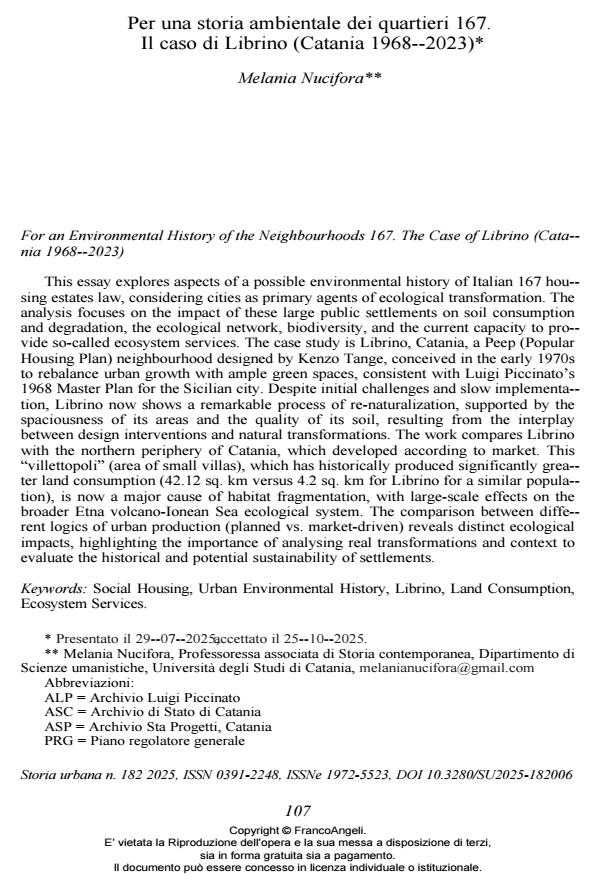
This essay explores aspects of a possible environmental history of Italian 167 housing estates law, considering cities as primary agents of ecological transformation. The analysis focuses on the impact of these large public settlements on soil consumption and degradation, the ecological network, biodiversity, and the current capacity to provide socalled ecosystem services. The case study is Librino, Catania, a Peep (Popular Housing Plan) neighbourhood designed by Kenzo Tange, conceived in the early 1970s to rebalance urban growth with ample green spaces, consistent with Luigi Piccinato’s 1968 Master Plan for the Sicilian city. Despite initial challenges and slow implementation, Librino now shows a remarkable process of renaturalization, supported by the spaciousness of its areas and the quality of its soil, resulting from the interplay between design interventions and natural transformations. The work compares Librino with the northern periphery of Catania, which developed according to market. This “villettopoli” (area of small villas), which has historically produced significantly greater land consumption (42.12 sq. km versus 4.2 sq. km for Librino for a similar population), is now a major cause of habitat fragmentation, with largescale effects on the broader Etna volcanoIonean Sea ecological system. The comparison between different logics of urban production (planned vs. marketdriven) reveals distinct ecological impacts, highlighting the importance of analysing real transformations and context to evaluate the historical and potential sustainability of settlements.
Keywords: Social Housing, Urban Environmental History, Librino, Land Consumption, Ecosystem Services.
Melania Nucifora, Per una storia ambientale dei quartieri 167. Il caso di Librino (Catania 1968--2023) in "STORIA URBANA " 182/2025, pp 107-136, DOI: 10.3280/SU2025-182006