Politics and the Temporalities of Indignation: Mably between Reason and the Passions
Journal title RIVISTA DI STORIA DELLA FILOSOFIA
Author/s Matteo Marcheschi
Publishing Year 2026 Issue 2026/1
Language English Pages 19 P. 132-150 File size 157 KB
DOI 10.3280/SF2026-001009
DOI is like a bar code for intellectual property: to have more infomation
click here
Below, you can see the article first page
If you want to buy this article in PDF format, you can do it, following the instructions to buy download credits
FrancoAngeli is member of Publishers International Linking Association, Inc (PILA), a not-for-profit association which run the CrossRef service enabling links to and from online scholarly content.
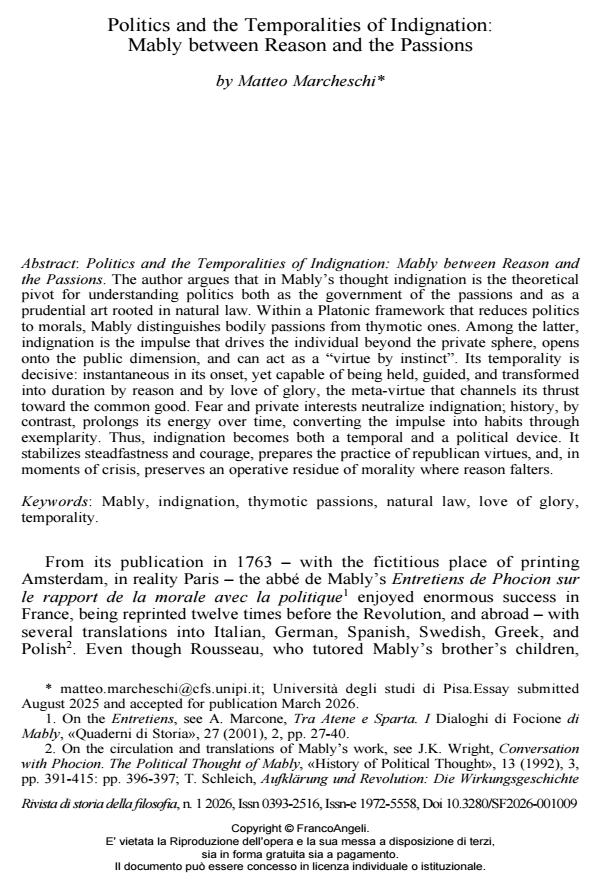
The author argues that in Mably’s thought indignation is the theoretical pivot for understanding politics both as the government of the passions and as a prudential art rooted in natural law. Within a Platonic framework that reduces politics to morals, Mably distinguishes bodily passions from thymotic ones. Among the latter, indignation is the impulse that drives the individual beyond the private sphere, opens onto the public dimension, and can act as a “virtue by instinct”. Its temporality is decisive: instantaneous in its onset, yet capable of being held, guided, and transformed into duration by reason and by love of glory, the meta-virtue that channels its thrust toward the common good. Fear and private interests neutralize indignation;; history, by contrast, prolongs its energy over time, converting the impulse into habits through exemplarity. Thus, indignation becomes both a temporal and a political device. It stabilizes steadfastness and courage, prepares the practice of republican virtues, and, in moments of crisis, preserves an operative residue of morality where reason falters.
Keywords: Mably, indignation, thymotic passions, natural law, love of glory, temporality.
Matteo Marcheschi, Politics and the Temporalities of Indignation: Mably between Reason and the Passions in "RIVISTA DI STORIA DELLA FILOSOFIA" 1/2026, pp 132-150, DOI: 10.3280/SF2026-001009