Smith and Indignation: Appropriateness and Conservativism
Journal title RIVISTA DI STORIA DELLA FILOSOFIA
Author/s Francesco Toto
Publishing Year 2026 Issue 2026/1
Language Italian Pages 30 P. 151-180 File size 204 KB
DOI 10.3280/SF2026-001010
DOI is like a bar code for intellectual property: to have more infomation
click here
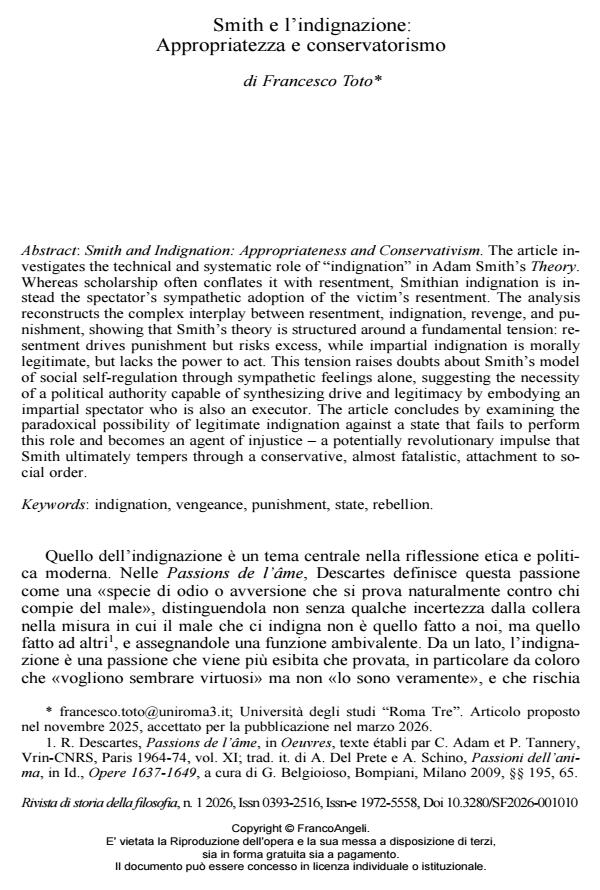
Below, you can see the article first page
If you want to buy this article in PDF format, you can do it, following the instructions to buy download credits
FrancoAngeli is member of Publishers International Linking Association, Inc (PILA), a not-for-profit association which run the CrossRef service enabling links to and from online scholarly content.
The article in- vestigates the technical and systematic role of “indignation” in Adam Smith’s Theory. Whereas scholarship often conflates it with resentment, Smithian indignation is in- stead the spectator’s sympathetic adoption of the victim’s resentment. The analysis reconstructs the complex interplay between resentment, indignation, revenge, and pu- nishment, showing that Smith’s theory is structured around a fundamental tension: re- sentment drives punishment but risks excess, while impartial indignation is morally legitimate, but lacks the power to act. This tension raises doubts about Smith’s model of social self-regulation through sympathetic feelings alone, suggesting the necessity of a political authority capable of synthesizing drive and legitimacy by embodying an impartial spectator who is also an executor. The article concludes by examining the paradoxical possibility of legitimate indignation against a state that fails to perform this role and becomes an agent of injustice – a potentially revolutionary impulse that Smith ultimately tempers through a conservative, almost fatalistic, attachment to so- cial order.
Keywords: indignation, vengeance, punishment, state, rebellion.
Francesco Toto, Smith e l’indignazione: Appropriatezza e conservatorismo in "RIVISTA DI STORIA DELLA FILOSOFIA" 1/2026, pp 151-180, DOI: 10.3280/SF2026-001010