The problem of the negative therapeutic reaction
Journal title PSICOTERAPIA E SCIENZE UMANE
Author/s Karen Horney
Publishing Year 2026 Issue 2026/2
Language Italian Pages 20 P. 219-238 File size 356 KB
DOI 10.3280/PU2026-002002
DOI is like a bar code for intellectual property: to have more infomation
click here
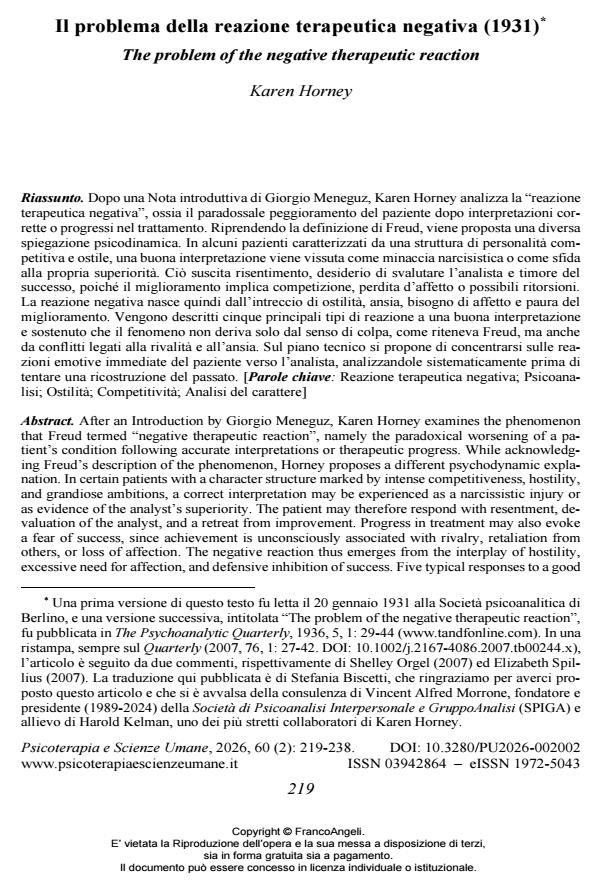
Below, you can see the article first page
If you want to buy this article in PDF format, you can do it, following the instructions to buy download credits
FrancoAngeli is member of Publishers International Linking Association, Inc (PILA), a not-for-profit association which run the CrossRef service enabling links to and from online scholarly content.
After an Introduction by Giorgio Meneguz, Karen Horney examines the phenomenon that Freud termed “negative therapeutic reaction”, namely the paradoxical worsening of a pa-tient’s condition following accurate interpretations or therapeutic progress. While acknowledg-ing Freud’s description of the phenomenon, Horney proposes a different psychodynamic expla-nation. In certain patients with a character structure marked by intense competitiveness, hostility, and grandiose ambitions, a correct interpretation may be experienced as a narcissistic injury or as evidence of the analyst’s superiority. The patient may therefore respond with resentment, de-valuation of the analyst, and a retreat from improvement. Progress in treatment may also evoke a fear of success, since achievement is unconsciously associated with rivalry, retaliation from others, or loss of affection. The negative reaction thus emerges from the interplay of hostility, excessive need for affection, and defensive inhibition of success. Five typical responses to a good interpretation are described, and hostility toward the analyst is seen not merely a superficial re-action but a central element of the patient’s character structure. Technically, it is recommended to focus on the patient’s immediate emotional reactions toward the analyst and to interpret these dynamics before turning to reconstructions of early childhood experience.
Keywords: Negative therapeutic reaction; Psychoanalysis; Hostility; Competitiveness; Character analysis
- Abraham K. (1921). Forme di manifestazione del complesso femminile di evirazione. In: Opere, vol. I. Torino, Boringhieri, 1975, pp. 107-135.
- Alexander F. (1937). Book Review: “The Neurotic Personality of Our Time, by Karen Horney. New York: Norton, 1937”. Psychoanalytic Quarterly, 6, 4: 536-555. DOI: 10.1080/21674086.1937.11925336
- Cremerius J. (1982). Die Bedeutung des Dissidenten für die Psychoanalyse. Psyche, 36, 6: 481-514 (trad. it.: L’importanza dei dissidenti per la psicoanalisi. Psicoterapia e Scienze Umane, 1983, 17, 3: 3-37. Anche in: Cremerius J., Limiti e possibilità della tecnica psicoanalitica. Torino: Bollati Boringhieri, 1991, pp. 82-110).
- Feigenbaum D. (1934). Clinical fragments. Psychoanalytic Quarterly, 3, 3: 363-390.
- Fenichel O. (1940). Book Review: “New Ways in Psychoanalysis, by Karen Horney, M.D. New York: Norton, 1939”. Psychoanalytic Quarterly, 9, 1: 114-156. DOI: 10.1080/21674086.1940.11925412
- Fenichel O. (1945). The Psychoanalytic Theory of the Neurosis. New York: Norton (trad. it.: Trattato di psicoanalisi delle nevrosi e delle psicosi. Roma: Astrolabio, 1951).
- Fenichel O. (1934-45 [1998]). 119 Rundbriefe. A cura di Johannes Reichmayr & Elke Mühlleit-ner. Frankfurt a.M.: Stroemfeld, 1998.
- Freud S. (1922 [1923]). L’Io e l’Es. Opere, 9: 471-520. Torino: Boringhieri, 1977.
- Freud S. (1924). Il problema economico del masochismo. Opere, 10: 5-16. Torino: Boringhieri, 1978.
- Freud S. (1925). Alcune conseguenze psichiche della differenza anatomica tra i sessi. Opere, 10: 205-217. Torino: Boringhieri, 1978.
- Freud S. (1932 [1933]). Introduzione alla psicoanalisi (nuova serie di lezioni). Lezione 31: La scomposizione della personalità psichica. Opere, 11: 170-190. Torino: Boringhieri, 1979.
- Funk R. (1983). Eric Fromm. Mit Selbstzeugnissen und Bilddokumenten. Reinbeck bei Hamburg: Rowohlt (trad. it.: Eric Fromm. La vita e il pensiero. Bolsena (VT): Erre Emme, 1997).
- Green M. (1964). Clara Thompson: A Biographic note. In: Thompson C.M., Interpersonal Psy-choanalysis. Edited by Maurice Green. New York: Basic Books, 1964. Anche in: Contem-porary Psychoanalysis, 1964, 1, 1: 80-82.
- Hale N.G.Jr. (1995). The Rise and Crisis of Psychoanalysis in the United States. Freud and the Americans, 1917-1985. Oxford, UK: Oxford University Press.
- Horney K. (1922). Zur Genese des weiblichen Kastrationskomplexes. Internationale Zeitschrift für Psychoanalyse, 2023, 9: 12-26 (trad. inglese: On the genesis of the castration complex in women. International Journal of Psychoanalysis, 1924, 5, 1: 50-65; trad. it.: Sulla genesi del complesso di castrazione femminile. In: Psicologia femminile [1922-37]. Roma: Armando, 1973, pp. 59-93).
- Horney K. (1931). The problem of the negative therapeutic reaction. Psychoanalytic Quarterly, 1936, 5, 1: 29-44. Ristampa: 2007, 76, 1: 27-42.
- (trad. it.: Il problema della reazione terapeutica negativa. Psicoterapia e Scienze Umane, 2026, 60, 2: 219-238. DOI: 10.3280/PU2026-002002)
- Horney K. (1935). Conceptions and misconceptions of the analytical method. Journal of Nervous and Mental Disease, 81, 4: 399-410. DOI: 10.1097/00005053-193504000-00003
- Horney K. (1937). The Neurotic Personality of Our Time. New York: Norton (trad. it.: La per-sonalità nevrotica del nostro tempo. Roma: Newton Compton, 1976).
- Horney Eckardt M. (1976). Organizational schism in American psychoanalysis. In: Quen J.M. & Carlson E.T., editors, American Psychoanalysis: Origins and Development. The Adolf Meyer Seminars. New York: Brunner-Mazel, 1978, pp. 141-161.
- Kardiner A. (1939). The Individual and His Society. The Psychodynamics of Primitive Social Organization. New York: Columbia University Press.
- Kurzweil E. (1989). The Freudians. A Comparative Perspective. New Haven, CT: Yale Univer-sity Press.
- Makari G. (2008). Revolution in Mind. The Creation of Psychoanalysis. New York: HarperCol-lins (trad. it. della prefazione in versione ampliata: La rivoluzione nella mente: sulla storia della psicoanalisi, 1870-1945. Psicoterapia e Scienze Umane, 2009, 43, 4: 455-462).
- Meneguz G. (2011). Il mondo degli psicoanalisti. Formazione psicoanalitica e qualità dei rap-porti tra colleghi. Napoli: Liguori.
- Orgel S. (2007). Commentary on “The problem of the negative therapeutic reaction” by Karen Horney. Psychoanalytic Quarterly, 76, 1: 43-58.
- Quinn S. (1987). A Mind of Her Own: The Life of Karen Horney. New York: Addison-Wesley. Reich W. (1933). Charakteranalyse. Technik und Grundlagen für studierende und praktizierende
- Analytiker. Wien: Internationaler Psychoanalytischer Verlag (trad. it.: Analisi del carattere. Milano: SugarCo, 1973).
- Rubins J.L. (1978). Karen Horney: Gentle Rebel of Psychoanalysis. New York: The Dial Press. Sayers J. (1991). Mothers of Psychoanalysis. New York: Norton.
- Smith H.F. (2007). 1932-2007: Our 75th Anniversary Year. Psychoanalytic Quarterly, 76, 1: 1-7.
- Spillius E. (2007). On the influence of Horney’s “The problem of the negative therapeutic reac-tion”. Psychoanalytic Quarterly, 76, 1: 59-74.
Karen Horney, Il problema della reazione terapeutica negativa (1931) in "PSICOTERAPIA E SCIENZE UMANE" 2/2026, pp 219-238, DOI: 10.3280/PU2026-002002