Generative Artificial Intelligence in post-session clinical reflection. The risk of gentle collusion
Journal title PSICOTERAPIA E SCIENZE UMANE
Author/s Sabrina Signorini
Publishing Year 2026 Issue 2026/2
Language Italian Pages 18 P. 239-256 File size 331 KB
DOI 10.3280/PU2026-002003
DOI is like a bar code for intellectual property: to have more infomation
click here
Below, you can see the article first page
If you want to buy this article in PDF format, you can do it, following the instructions to buy download credits
FrancoAngeli is member of Publishers International Linking Association, Inc (PILA), a not-for-profit association which run the CrossRef service enabling links to and from online scholarly content.
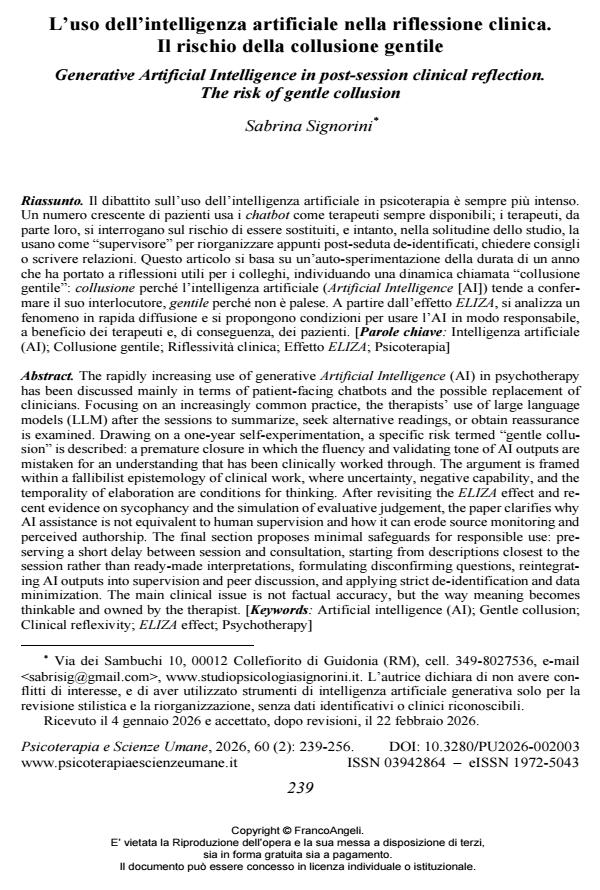
The rapidly increasing use of generative Artificial Intelligence (AI) in psychotherapy has been discussed mainly in terms of patient-facing chatbots and the possible replacement of clinicians. Focusing on an increasingly common practice, the therapists’ use of large language models (LLM) after the sessions to summarize, seek alternative readings, or obtain reassurance is examined. Drawing on a one-year self-experimentation, a specific risk termed “gentle collusion” is described: a premature closure in which the fluency and validating tone of AI outputs are mistaken for an understanding that has been clinically worked through. The argument is framed within a fallibilist epistemology of clinical work, where uncertainty, negative capability, and the temporality of elaboration are conditions for thinking. After revisiting the ELIZA effect and recent evidence on sycophancy and the simulation of evaluative judgement, the paper clarifies why AI assistance is not equivalent to human supervision and how it can erode source monitoring and perceived authorship. The final section proposes minimal safeguards for responsible use: preserving a short delay between session and consultation, starting from descriptions closest to the session rather than ready-made interpretations, formulating disconfirming questions, reintegrating AI outputs into supervision and peer discussion, and applying strict de-identification and data minimization. The main clinical issue is not factual accuracy, but the way meaning becomes thinkable and owned by the therapist.
Keywords: Artificial intelligence (AI); Gentle collusion; Clinical reflexivity; ELIZA effect; Psychotherapy
- Alter A.L. & Oppenheimer D.M. (2009). Uniting the tribes of fluency to form a metacognitive nation. Personality and Social Psychology Review, 13, 3: 219-235. DOI: 10.1177/1088868309341564
- Bassett C. (2019). The computational therapeutic: Exploring Weizenbaum’s ELIZA as a history of the present. AI & Society, 34, 4: 803-812.
- Bion W.R. (1962). Learning from Experience. London: Heinemann (trad. it.: Apprendere dall’esperienza. Roma: Armando, 1972).
- Bollas C. (1987). The Shadow of the Object: Psychoanalysis of the Unthought Known. New York: Columbia University Press (trad. it.: L’ombra dell’oggetto. Psicoanalisi del conosciuto non pensato. Roma: Borla, 1989).
- Brown A.S. & Murphy D.R. (1989). Cryptomnesia: Delineating inadvertent plagiarism. Journal of Experimental Psychology: Learning, Memory, and Cognition, 15, 3: 432-442. DOI: 10.1037/0278-7393.15.3.432
- Draxler F., Werner A., Lehmann F., Hoppe M., Schmidt A., Buschek D. & Welsch R. (2024). The AI ghostwriter effect: When users do not perceive ownership of AI-generated text but self-declare as authors. ACM Transactions on Computer-Human Interaction, 31, 2: 1-40 (Article 25). DOI: 10.1145/3637875
- Galli P.F. (2009). L’identità terapeutica nel regno dell’incertezza. Psicoterapia e Scienze Umane, 43, 1: 47-58.
- Hsieh L.-H., Liao W.-C. & Liu E.-Y. (2024). Feasibility assessment of using ChatGPT for training case conceptualization skills in psychological counseling. Computers in Human Behavior: Artificial Humans, 2, 2: 100083.
- Johnson M.K. (1997). Source monitoring and memory distortion. Philosophical Transactions of the Royal Society of London. Series B: Biological Sciences, 352, 1362: 1733-1745.
- Johnson M.K., Hashtroudi S. & Lindsay D.S. (1993). Source monitoring. Psychological Bulletin, 114, 1: 3-28. DOI: 10.1037/0033-2909.114.1.3
- Langs R. (1975). Therapeutic misalliances. International Journal of Psychoanalytic Psychotherapy, 4: 77-105.
- Langs R. (1985). Madness and Cure. Emerson, NJ: New Concept Press (trad. it.: Follia e cura. Prefazione di Paolo Migone. Torino: Bollati Boringhieri, 1988).
- Lindsay D.S. (2014). Memory source monitoring applied. In: Perfect T. & Lindsay D.S., editors, The SAGE Handbook of Applied Memory. London: Sage, 2014, pp. 59-75.
- Loru E., Nudo J., Di Marco N., Santirocchi A., Atzeni R., Cinelli M., Cestari V., Rossi-Arnaud C. & Quattrociocchi W. (2025). The simulation of judgment in LLMs. Proceedings of the National Academy of Sciences of the United States of America, 122, 42, e2518443122.
- Parasuraman R. & Manzey D.H. (2010). Complacency and bias in human use of automation. Human Factors, 52, 3: 381-410. DOI: 10.1177/0018720810376055
- Pennycook G., Cannon T.D. & Rand D.G. (2018). Prior exposure increases perceived accuracy of fake news. Journal of Experimental Psychology: General, 147, 12: 1865-1880.
- Perc M. (2025). Counterfeit judgments in large language models. Proceedings of the National Academy of Sciences of the United States of America, 122, 48, e2528527122.
- Reber R., Schwarz N. & Winkielman P. (2004). Processing fluency and aesthetic pleasure: Is beauty in the perceiver’s processing experience? Personality and Social Psychology Review, 8, 4: 364-382.
- Schafer R. (1992). Retelling a Life: Narration and Dialogue in Psychoanalysis. New York: Basic Books (trad. it.: Rinarrare una vita. Narrazione e dialogo in psicoanalisi. Roma: Fioriti, 1999).
- Sharma M., Tong M., Korbak T., Duvenaud D., Askell A., Bowman S.R., Cheng N., Durmus E., Hatfield-Dodds Z., Johnston S.R., Kravec S., Maxwell T., McCandlish S., Ndousse K., Rausch O., Schiefer N., Yan D., Zhang M. & Perez E. (2024). Towards understanding sycophancy in language models. In: Proceedings of the International Conference on Learning Representations (ICLR 2024), https://arxiv.org/abs/2310.13548.
- Signorini S. & Paganin W. (2026a). Artificial intelligence as a digital analytic third: The SADAR framework for reflective supervision in psychotherapy. Frontiers in Psychology, 17, 1690291.
- Signorini S. & Paganin W. (2026b). Practical AI for clinicians: The Sistema Autoesplorativo Dialogico Autentico Relazionale (SADAR) 3-2-1 post session method. Practice Innovations, advance online publication.
- Spence D.P. (1982). Narrative Truth and Historical Truth: Meaning and Interpretation in Psychoanalysis. New York: Norton (trad. it.: Verità narrativa e verità storica. Significato e interpretazione in psicoanalisi. Firenze: Martinelli, 1987).
- Stade E.C., Stirman S.W., Ungar L.H., Boland C.L., Schwartz H.A., Yaden D.B., Sedoc J., DeRubeis R.J., Willer R. & Eichstaedt J.C. (2024). Large language models could change the future of behavioral healthcare: A proposal for responsible development and evaluation. npj Mental Health Research, 3, 1: 12.
- Weizenbaum J. (1966). ELIZA, a computer program for the study of natural language communication between man and machine. Communications of the ACM, 9, 1: 36-45. DOI: 10.1145/365153.365168
- Weizenbaum J. (1976). Computer Power and Human Reason: From Judgment to Calculation. San Francisco: W.H. Freeman (trad. it.: Il potere del computer e la ragione umana. I limiti dell’intelligenza artificiale. Torino: Edizioni Gruppo Abele, 1987).
Sabrina Signorini, L’uso dell’intelligenza artificiale nella riflessione clinica. Il rischio della collusione gentile in "PSICOTERAPIA E SCIENZE UMANE" 2/2026, pp 239-256, DOI: 10.3280/PU2026-002003