Immortal star and accountant. Household accounting practices according to Enrico Caruso
Journal title CONTABILITÀ E CULTURA AZIENDALE
Author/s Valerio Antonelli, Emanuela Mattia Cafaro, Raffaele D’Alessio, Carlo Torre
Publishing Year 2026 Issue 2025/2
Language English Pages 26 P. 9-34 File size 134 KB
DOI 10.3280/CCA2025-002002
DOI is like a bar code for intellectual property: to have more infomation
click here
Below, you can see the article first page
If you want to buy this article in PDF format, you can do it, following the instructions to buy download credits
FrancoAngeli is member of Publishers International Linking Association, Inc (PILA), a not-for-profit association which run the CrossRef service enabling links to and from online scholarly content.
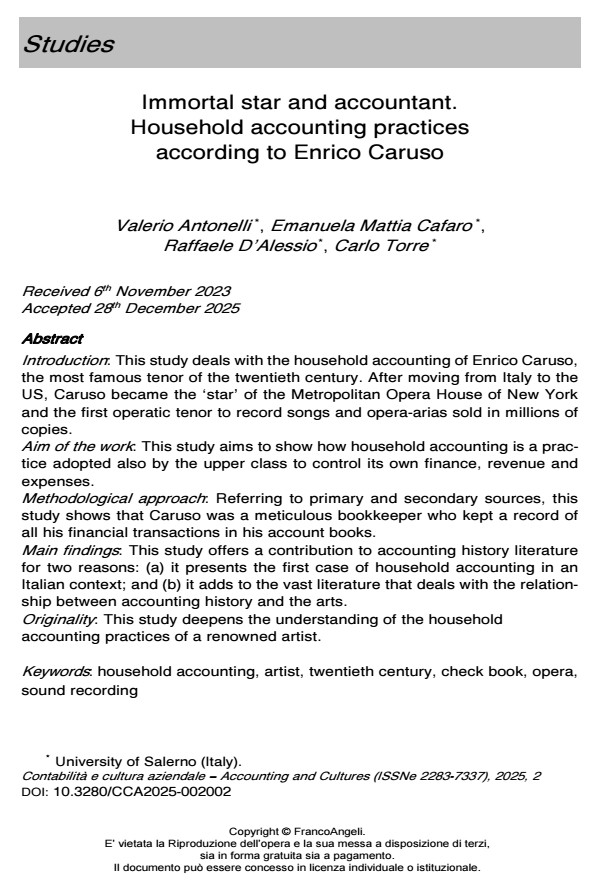
Introduction: This study deals with the household accounting of Enrico Caruso, the most famous tenor of the twentieth century. After moving from Italy to the US, Caruso became the ‘star’ of the Metropolitan Opera House of New York and the first operatic tenor to record songs and opera-arias sold in millions of copies. Aim of the work: This study aims to show how household accounting is a practice adopted also by the upper class to control its own finance, revenue and expenses. Methodological approach: Referring to primary and secondary sources, this study shows that Caruso was a meticulous bookkeeper who kept a record of all his financial transactions in his account books. Main findings: This study offers a contribution to accounting history literature for two reasons: (a) it presents the first case of household accounting in an Italian context; and (b) it adds to the vast literature that deals with the relationship between accounting history and the arts. Originality: This study deepens the understanding of the household accounting practices of a renowned artist.
Keywords: household accounting, artist, twentieth century, check book, opera, sound recording
- Landes J.B. (2003). Further thoughts on the public/private distinction Journal of Women’s History, 15: 28-39.
- Llewellyn S., Walker S.P. (2000). Household accounting as an interface activity: the home, the economy and gender. Critical Perspectives on Accounting, 11: 447-478.
- Adamo S., Schipa T., Fasiello R., Alexander D. (2022). The musical, cultural and financial life and legacy of Tito Schipa. Contabilità e cultura aziendale, 22: 53-89.
- Aliprandi E. (1874). Compendio di contabilità domestica, commerciale ed agraria. Soresina: Tonani.
- Antonelli V., D’Alessio R., Iuliano G. (2007). Art and Accounting History: The Teatro San Carlo of Naples, 1737-1786. Accounting, Business & Financial History, 17: 165-186.
- Artieri G. (1980). Napoli, punto e basta? Divertimenti, avventure, biografie, fantasie per napoletani e non. Milano: Mondadori.
- Baker C.R. (2019). What can Thomas Jefferson’s accounting records tell us about plantation management, slavery, and Enlightenment philosophy in colonial America?. Accounting History, 24: 236-252.
- Balluchi F., Lazzini A., Torelli R. (2021). Accounting and music: The role of Giuseppe Verdi in shaping the nineteenth-century culture industry. Accounting History, 26: 612-639.
- Bigoni M., Funnell W., Deidda Gagliardo E., Pierotti M. (2021). Accounting for control of Italian culture in the Fascist Ethical State: the Alla Scala Opera House. Accounting, Auditing & Accountability Journal, 34: 194-222.
- Boys P.G. (1995). Samuel Pepys’s personal accounts. Accounting, Business & Financial History, 5: 308-320.
- Buckmaster D., Buckmaster E. (1999). Studies of accounting and commerce in Chaucer’s Shipman’s Tale. A review article. Accounting, Auditing & Accountability Journal, 12: 113-128.
- Carnegie G.D., Napier C.J. (1996). Critical and interpretive histories: insights into accounting’s present and future through its past. Accounting, Auditing & Accountability Journal, 9: 7-39.
- Carnegie G.D., Walker S.P. (2007a). Household accounting in Australia: Prescription and practice from the 1820s to the 1960s. Accounting, Auditing & Accountability Journal, 20: 41-73.
- Carnegie G.D., Walker S.P. (2007b). Household accounting in Australia: a micro-historical study. Accounting, Auditing & Accountability Journal, 20: 210-236.
- Caruso D. (1945). Enrico Caruso. His life and death. New York: Simon & Schuster.
- Caruso E., Farkas A. (1997). Enrico Caruso. My father and my family. Portland: Amadeus.
- Dorsi F., Rausa G. (2000). Storia dell’opera italiana. Milano: Pearson.
- Fagerberg D. (1954). Spotlight on Personal Accounting. The Accounting Review, 29: 355-364.
- Fucito S., Beyer B.J. (1922). Caruso and the art of singing. New York: Stokes.
- Gaisberg F.W. (1942). The music goes round. New York: The Mcmillan Company.
- Gargano P. (1997). Una vita, una leggenda: Enrico Caruso, il più grande tenore del mondo. Milano: Mondadori.
- Giovannoni E., Giorgino M.C., Di Pietra R. (2023). Accountability and music: accounting, emotions and responses to the 1913 concert for Giuseppe Verdi. Accounting, Auditing & Accountability Journal, 36: 135-160.
- Giorgino M.C. (2024). “And yet it moves!” An institutional analysis of the Immobili’s motion towards hybridity. Journal of Management History, 30: 87-115.
- Goode W.J. (1960). Norm Commitment and Conformity to Role-Status. American Journal of Sociology, 66: 246-258.
- Hopwood A.G. (1994). Accounting and everyday life: an introduction. Accounting, Organizations and Society, 19: 299-301.
- Jeacle I. (2009a). Going to the movies: accounting and twentieth century cinema. Accounting, Auditing & Accountability Journal, 22: 677-708.
- Jeacle I. (2009b). Accounting and everyday life: towards a cultural context for accounting research. Qualitative Research in Accounting & Management, 6: 120-136.
- Jeacle I. (2012). Accounting and popular culture: framing a research agenda. Accounting, Auditing & Accountability Journal, 25: 580-601.
- Jeacle I. (2021). Accounting and entertainment: An introduction. Accounting history, 26: 3-8.
- Jeacle I., Miller P. (2016). Accounting, culture, and the state. Critical Perspectives on Accounting, 37: 1-4.
- Jenkins R. (2008). Social Identity. New York: Routledge.
- Key P.V.R., Zirato B. (1922). Enrico Caruso, a Biography. Boston: Brown & Co.
- Kirkham L.M., Loft A. (2001). The lady and the accounts: missing from accounting history?. Accounting Historians Journal, 28: 67-90.
- Kolodin I. (1940). The Metropolitan Opera 1883-1939. New York: Oxford University Press.
- Komori N. (2012). Visualizing the negative space: Making feminine accounting practices visible by reference to Japanese women’s household accounting practices. Critical Perspectives on Accounting, 23: 451-467.
- Komori N., Humphrey C. (2000). From an envelope to a dream note and a computer – the award-winning experiences of post-war Japanese household accounting practices. Accounting, Auditing & Accountability Journal, 13: 450-474.
- Maddock L. (2018). Shakespeare was indisputably an accountant!, Accounting, Auditing & Accountability Journal, 31(8): 2249-2260.
- Maltby J. (1997). Accounting and the soul of the middle class: Gustav Freytag’s Soll und Haben. Accounting, Organizations and Society, 22: 69-87.
- Manetti G., Bellucci M. and Bagnoli L. (2020). The construction of Brunelleschi’s dome in Florence in the fifteenth century: between accountability and technologies of government. Accounting History Review, 30: 141-169.
- Manetti G., Bellucci M., Nitti C., Bagnoli L. (2023). A study of Michelangelo's David from an accountability perspective: Antecedents of dialogic accounting in the early Florentine Renaissance. Accounting History, 28: 30-57.
- Marchesini G. (1894). Elementi di contabilità commerciale, domestica e rurale a scrittura semplice e doppia. Udine: Del Bianco.
- McBride K. (2022). ‘And one man in his time plays many parts’ – Samuel Pepys business administrator, accomptant and auditor. Business History, 64: 1369-1387.
- McBride K. (2023). It’s a gift – Samuel Pepys and Sir William Warren, an account of gifts, bribes and kickbacks. Accounting, Auditing & Accountability Journal, 36: 913-932.
- McKinstry S., Fletcher M. (2002). The personal account books of Sir Walter Scott. The Accounting Historians Journal, 29: 59-89.
- Miley F., Read A. (2021). Entertainment as an archival source for historical accounting research. Accounting History, 26: 146-167.
- Moore D.L. (1974). Lord Byron Accounts Rendered. London: John Murray.
- Napier C.J. (1991). Aristocratic Accounting: The Blue Estate in Glamorgan, 1814-1880. Accounting and Business Research, 21: 163-174.
- Napier C.J., Giovannoni E. (2021). Accounting for heritage assets: Thomas Holloway’s picture collection, 1881-2019. The British Accounting Review, 53, 100944.
- Northcott D., Doolin B. (2000). Home accountants: exploring their practices, Accounting, Auditing & Accountability Journal, 13: 475-501.
- Parker R.H. (1999). Searching the British accounting literature 1179-1998. The British Accounting Review, 31: 15-30.
- Parker R.H., Meehan M. (1999). Accounting in Chaucer’s Canterbury Tales. Accounting, Auditing & Accountability Journal, 12: 92-112.
- Parkinson J.M. (1986). Daniel Defoe: Accountant. Accounting History, 2: 33-49.
- Pedrazzi A. (2009). Qualcosa da leggere. New York: Lulu.
- Previts G.J., Parker L.D., Coffman E.N. (1990). An accounting historiography: subject matter and methodology. Abacus, 26: 136-158.
- Rentschler R., Lee B., Subramaniam, N. (2021). Calculative practices and socio-political tensions: A historical analysis of entertainment, arts and accounting in a government agency. Accounting History, 26: 80-101.
- Rossi R., Funnell W. (2024). ‘Accounting for the Music’. Institutional logics in the Regio Teatro Carolino of Palermo at the beginning of the nineteenth century. Accounting History Review, 34: 79-107.
- Rutterford J., Maltby J. (2006). Frank must marry money: men, women, and property in Trollope’s novels. Accounting Historians Journal, 33: 169-199.
- Sanjek R. (1988). American Popular Music and Its Business: The First Four Hundred Years. Oxford: Oxford University Press.
- Schultz S.M., Hollister J. (2004). Single-entry accounting in early America: the accounts of the Hasbrouck family. Accounting Historians Journal, 31: 141-174.
- Shinoto R. (2023). Good wives and wise mothers: Establishing the foundations of modern Japan through women's accounting education. Accounting History, 28: 442-467.
- Spruill W.G., Wootton C.W. (1995). The struggle of women in accounting: the case of Jennie Palen, pioneer accountant, historian and poet. Critical Perspectives on Accounting, 6: 371-389.
- Vickery A. (1998). The Gentleman’s Daughter: Women’s Lives in Georgian England. London: Yale University Press.
- Vickery A. (2006). His and hers: gender, consumption and household accounting in eighteenth-century England. Past and present, 1: 12-38.
- Virtanen A. (2009). Accounting, gender and history: the life of Minna Canth. Accounting History, 14: 79-100.
- Vollmers G.L., Tyson T.N. (2004). A personal account book of Joseph E. Bell: a record of survival in nineteenth century rural America. Accounting History, 9: 89-109.
- Walker S.P. (1998). How to secure your husband’s esteem. Accounting and private patriarchy in the British middle-class household during the nineteenth century. Accounting, Organizations and Society, 23: 485-514.
- Walker S.P. (2008). Accounting histories of women: beyond recovery? Accounting, Auditing & Accountability Journal, 21: 580-610.
- Walker S.P., Llewellyn S. (2000). Accounting at home: some interdisciplinary perspectives. Accounting, Auditing & Accountability Journal, 13: 425-449.
- Walker S.P., Carnegie G.D. (2007). Budgetary earmarking and the control of the extravagant woman in Australia, 1850-1920. Critical Perspectives on Accounting, 18: 232-261.
- Warnock K. (2008). Auditing Bloom, editing Joyce: accounting and accountability in Ulysses. Accounting, Business & Financial History, 18: 81-95.
Valerio Antonelli, Emanuela Mattia Cafaro, Raffaele D’Alessio, Carlo Torre, Immortal star and accountant. Household accounting practices according to Enrico Caruso in "CONTABILITÀ E CULTURA AZIENDALE" 2/2025, pp 9-34, DOI: 10.3280/CCA2025-002002