The monumental Roman tomb at the Church of the Carmine: a neglected site of the Agathan tradition?
Journal title ARCHIVIO STORICO PER LA SICILIA ORIENTALE
Author/s Corrado Rubino
Publishing Year 2026 Issue 2025/1-2
Language Italian Pages 16 P. 77-92 File size 161 KB
DOI 10.3280/ASSO2025-001007
DOI is like a bar code for intellectual property: to have more infomation
click here
Below, you can see the article first page
If you want to buy this article in PDF format, you can do it, following the instructions to buy download credits
FrancoAngeli is member of Publishers International Linking Association, Inc (PILA), a not-for-profit association which run the CrossRef service enabling links to and from online scholarly content.
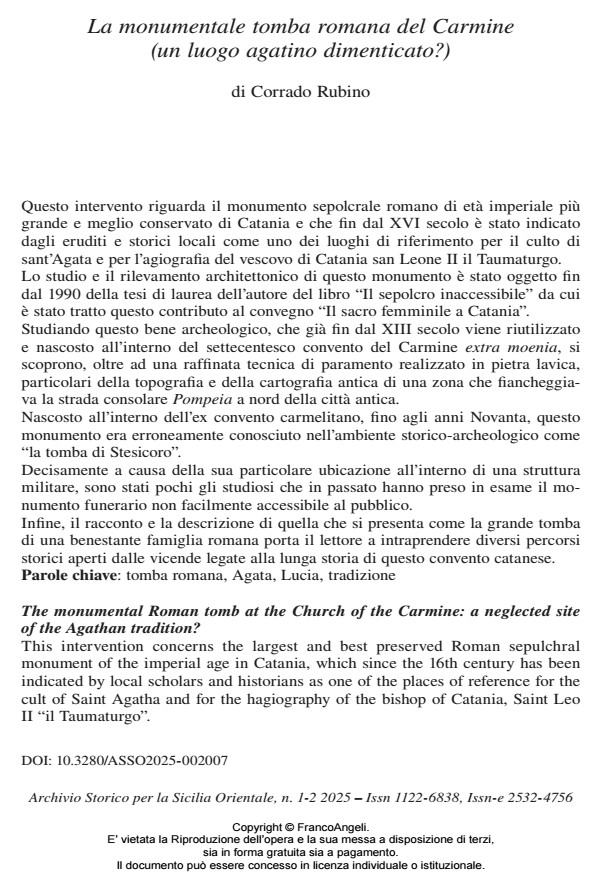
This intervention concerns the largest and best preserved Roman sepulchral monument of the imperial age in Catania, which since the 16th century has been indicated by local scholars and historians as one of the places of reference for the cult of Saint Agatha and for the hagiography of the bishop of Catania, Saint Leo II “il Taumaturgo”. The study and architectural survey of this monument has been the subject of the degree thesis of the author of the book “Il sepolcro inaccessibile” since 1990, from which this contribution to the conference “Il sacro femminile a Catania” was drawn. By studying this archaeological asset, which has been reused and hidden inside the 18thcentury convent of Carmine extra moenia since the 13th century, one discovers, in addition to a refined technique of facing made of lava stone, details of the topography and ancient cartography of an area that flanked the “Pompeia” consular road to the north of the ancient city. Hidden inside the former Carmelite convent, until the 1990s, this monument was mistakenly known in the historicalarchaeological environment as “the tomb of Stesichorus”. Decidedly due to its particular location inside a military structure, few scholars in the past have examined the funerary monument not easily accessible to the public. Finally, the story and description of what appears to be the large tomb of a wealthy Roman family, leads the reader to undertake various historical paths opened by the events linked to the long history of this Catania convent.
Keywords: Roman burial, Agatha, Lucy, tradition
Corrado Rubino, La monumentale tomba romana del Carmine (un luogo agatino dimenticato?) in "ARCHIVIO STORICO PER LA SICILIA ORIENTALE" 1-2/2025, pp 77-92, DOI: 10.3280/ASSO2025-001007