The conclusion of systemic therapy with young adults and the particular case of therapist-induced interruption
Journal title TERAPIA FAMILIARE
Author/s Laura Colangelo
Publishing Year 2026 Issue 2026/140
Language Italian Pages 23 P. 33-55 File size 177 KB
DOI 10.3280/TF2026-140003
DOI is like a bar code for intellectual property: to have more infomation
click here
Below, you can see the article first page
If you want to buy this article in PDF format, you can do it, following the instructions to buy download credits
FrancoAngeli is member of Publishers International Linking Association, Inc (PILA), a not-for-profit association which run the CrossRef service enabling links to and from online scholarly content.
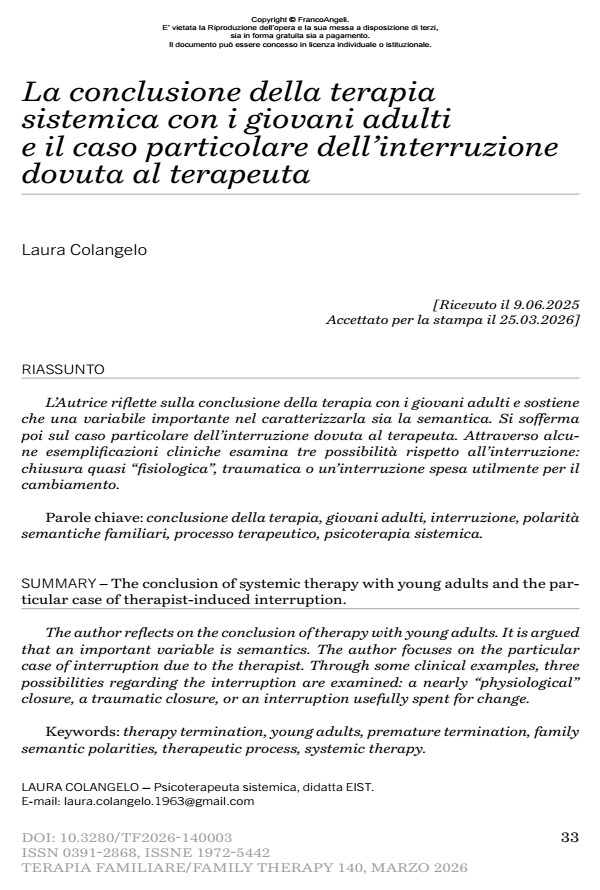
The author reflects on the conclusion of therapy with young adults. It is argued that an important variable is semantics. The author focuses on the particular case of interruption due to the therapist. Through some clinical examples, three possibilities regarding the interruption are examined: a nearly “physiological” closure, a traumatic closure, or an interruption usefully spent for change.
Keywords: therapy termination, young adults, premature termination, family semantic polarities, therapeutic process, systemic therapy.
- Baldascini L. (2002). Legami terapeutici. Il terapeuta della famiglia nella psicoterapia individuale sistemica. Milano: FrancoAngeli.
- Bowlby J. (1982). Costruzione e rottura dei legami affettivi. Milano: Raffaello Cortina Editore.
- Cambiaso G. & Mazza R. (2022). Si può chiudere la terapia? Frattali, 5: 7181. Canevaro A. (2009). Quando volano i cormorani. Roma: Borla.
- Colangelo L. (2008). Le emozioni delle pazienti e la memoria del terapeuta. Il follow up come équipe riflessiva. Connessioni, 21.
- Colangelo L. (2013). I pesci e la loro acqua: come pazienti e terapeuta sperimentano il cambiamento attraverso un’esperienza di followup. Terapia Familiare, 103: 931. DOI: 10.3280/TF2013103002
- Colangelo L. (2015). Profili del cambiamento: relazioni terapeutiche e pattern emergenti degli helpful factors attraverso la prospettiva di un follow up. Psicobiettivo, 1. DOI: 10.3280/PSOB2015001010
- Colangelo L. (2017). Relazioni terapeutiche: il modo di significare la relazione terapeutica come variabile chiave nella valutazione retrospettiva dei fattori di cambiamento. Psicobiettivo, 1. DOI: 10.3280/PSOB2017001006
- Delbrouck M. (2016). La relation thérapeutique en médicine et en psychothérapie. Louvain: DeBoeck Supérieur.
- Denis J., Tosi S., Meriaux M. & Rimini T. (2020). Come si pensa e si organizza la fine di una psicoterapia? Rivista di psicoterapia Relazionale, 51(1): 7399. DOI: 10.3280/PR2020051006
- FivazDepeursinge E. & CorbozWarnery A. (1999). Il triangolo primario. Milano: Raffaello Cortina Editore.
- Foddis C. & Grasso M. (2008). La conclusione delle psicoterapie nei servizi pubblici di Salute mentale: un’indagine sulla rappresentazione narrativa del processo clinico in un gruppo di operatori. Giornale di Psicologi, 2(3): 159178.
- Jacobs F. (1983). Il gioco dei possibili. Milano: Mondadori.
- Hilsenroth M.J. (2017). An introduction to the special issue on psychotherapy termination. Psychotherapy, 54(1): 13.
- Holmes J. (2004). Psicoterapia per una base sicura. Milano: Raffaello Cortina Editore.
- Labaki C. (2017). Soigner la clotûre. Thérapie Familiale, 38: 247254.
- Lancini M. & Madeddu F. (2014). Giovane adulto. Milano: Raffaello Cortina Editore. Loriedo C. (2000). La relazione come terapia: problemi e risorse nella dimensione sistemicorelazionale del rapporto terapeutico. In Loriedo C. & Santilli W. (a cura di), La relazione terapeutica. Milano: FrancoAngeli.
- Rober P. (1999). The therapist’s inner conversation in family therapy practice: some ideas about the self of the therapist, therapeutic impasse and the process of reflection. Family Process, 38(2): 209228.
- Scabini E. & Cigoli V. (2000). Il Famigliare. Milano: Raffaello Cortina Editore. Siebold C. (2007). Everytime we say goodbye: forced termination revisited, a commentary. Clinical Social Work Journal, 35: 9195. bre – Brescia.
- The Boston Change Process Study Group (2012). Il cambiamento in psicoterapia, Milano: Raffaello Cortina Editore.
- Thurin J.M. & Thurin M. (2010). Psychanalyse et thérapies systémiques: écarts et complémentarité. Cahiers Critiques de Thérapie Familiale et de Pratiques de Réseaux, 45: 6789.
- Tronick E. & Cohn J.F. (1989). Infantmother facetoface interaction: age and gender differences in coordination and the occurence of miscoordination. Child Development, 60: 8592.
- Ugazio V. (1998/2012). Storie permesse, storie proibite. Polarità semantiche familiari e psicopatologie. Milano: Bollati Boringhieri.
- Ugazio V. & Ferrario M. (1991). Le esperienze falsificanti. Terapia familiare, 36: 3752.
- White M. (1992). La terapia come narrazione. Roma: Astrolabio
Laura Colangelo, La conclusione della terapia sistemica con i giovani adulti e il caso particolare dell’interruzione dovuta al terapeuta in "TERAPIA FAMILIARE" 140/2026, pp 33-55, DOI: 10.3280/TF2026-140003