Quality of working life and subjective well-being
Journal title QUADERNI DI ECONOMIA DEL LAVORO
Author/s Giacomo Degli Antoni, Pietro A. Vagliasindi
Publishing Year 2026 Issue 2023/117
Language Italian Pages 32 P. 9-40 File size 178 KB
DOI 10.3280/QUA2023-117002
DOI is like a bar code for intellectual property: to have more infomation
click here
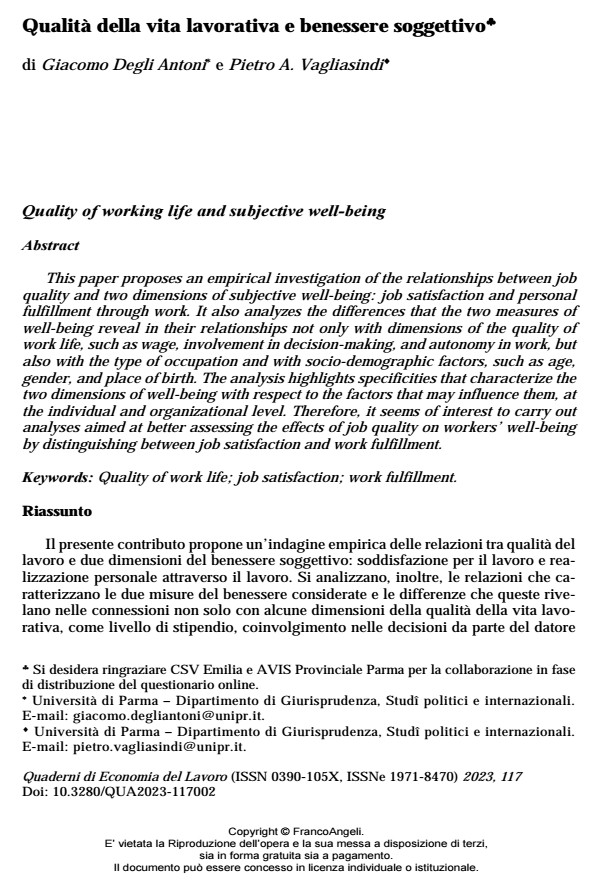
Below, you can see the article first page
If you want to buy this article in PDF format, you can do it, following the instructions to buy download credits
FrancoAngeli is member of Publishers International Linking Association, Inc (PILA), a not-for-profit association which run the CrossRef service enabling links to and from online scholarly content.
This paper proposes an empirical investigation of the relationships between job quality and two dimensions of subjective well-being: job satisfaction and personal fulfillment through work. It also analyzes the differences that the two measures of well-being reveal in their relationships not only with dimensions of the quality of work life, such as wage, involvement in decision-making, and autonomy in work, but also with the type of occupation and with socio-demographic factors, such as age, gender, and place of birth. The analysis highlights specificities that characterize the two dimensions of well-being with respect to the factors that may influence them, at the individual and organizational level. Therefore, it seems of interest to carry out analyses aimed at better assessing the effects of job quality on workers’ well-being by distinguishing between job satisfaction and work fulfillment.
Keywords: Quality of work life; job satisfaction; work fulfillment.
- Ahmad S. (2013). Paradigms of quality of work life. Journal of Human Values, 19(1): 73-82.
- Bagtasos M.R. (2011). Quality of work life: A review of literature. DLSU Business & Economics Review, 20(2): 1-8.
- Benz M. (2005). Not for the Profit, but for the Satisfaction? – Evidence on Worker Well-Being in Non-Profit Firms. Kyklos, 58(2): 155-176.
- Borzaga C. e Tortia E. (2006). Worker motivations, job satisfaction, and loyalty in public and nonprofit social services. Nonprofit and voluntary sector quarterly, 35(2): 225-248.
- Clark A. (1997). Job satisfaction and gender: why are women so happy at work?. Labour Economics, 4: 341-72.
- Clark A. (2005). What Makes a Good Job? Evidence from OECD Countries. In: Bazen S., Lucifora C., Salverda W., a cura di, Job quality and Employer Behaviour. New York: Palgrave McMillan.
- Degli Antoni G. (2022). Lavoro, fiducia e motivazioni intrinseche. Quaderni di Economia del Lavoro, 113.
- Dessler G. (2016). Fundamentals of Human Resource Management, 5th ed. Massachusetts, MA, USA: Pearson.
- Frey B.S. (1997). Not Just for The Money. An Economic Theory of Personal Motivation. Cheltenham, UK and Brookfield, USA: Edward Elgar.
- Gazioglu S., Tansel A. (2006). Job satisfaction in Britain: individual and job related factors, Applied Economics, 38: 1163-1171.
- Guest D. (2022, 22 novembre). Quality of Working Life. Oxford Research Encyclopedia of Psychology. Retrieved 28 Dec. 2023, -- from https://oxfordre.com/psychology/view/10.1093/acrefore/9780190236557.001.0001/acrefore-9780190236557-e-904.
- Goode D.A. (1989). Quality of life, quality of work life. In: Kiernan W.E. e Schalock R.L., a cura di, Economics, Industry and Disability: A Look Ahead, pp. 337-349. Baltimore: Paul H. Brookes.
- Hechanova M.R.M., Alampay R.B.A. e Franco E.P. (2006). Psychological empowerment, job satisfaction and performance among Filipino service workers. Asian journal of social psychology, 9(1): 72-78.
- Hoy W.K. (1996). Science and theory in the practice of educational administration: A pragmatic perspective. Educational Administration Quarterly, 32(3): 366-378.
- Lawler E.E. III (1975). Measuring the psychological quality of working life: The why and how of it. In: Davis L.E. e Cherns A.B., a cura di, The Quality of Working Life, vol. 1, pp. 123-133. New York: Free Press.
- Martel J.P. e Dupuis G. (2006). Quality of work life: Theoretical and methodological problems, and presentation of a new model and measuring instrument. Social indicators research, 77: 333-368.
- Osborn R.N., Schermerhorn J.R. e Hunt J.G. (1972). Managing Organizational Behavior, 5th ed. New York, NY, USA: Wiley.
- Oshagbemi T. e Hickson C. (2003). Some aspects of overall satisfaction: a binominal logit model. Journal of Managerial Psychology, 18(4): 357-367.
- Pugno M. e Depedri S. (2010). Job performance and job satisfaction: an integrated survey. Economia politica, 27(1): 175-210.
- Quilty L.C., Van Ameringen M., Mancini C., Oakman J. e Farvolden P. (2003). Quality of life and the anxiety disorders. Journal of anxiety disorders, 17(4): 405-426.
- Robbins S.P. e Judge T.A. (2018). Essentials of Organizational Behavior, 14th ed. New York, NY, USA: Pearson.
- Saner T. e Eyüpoglu S.Z. (2012). The age and job satisfaction relationship in higher education. Procedia-Social and Behavioral Sciences, 55: 1020-1026.
- Sousa-Poza A. e Sousa-Poza A.A. (2000). Well-being at work: a cross-national analysis of the levels and determinants of job satisfaction. The journal of socio-economics, 29(6): 517-538.
- Tortia E.C. (2008). Worker well-being and perceived fairness: Survey-based findings from Italy. The Journal of Socio-Economics, 37(5): 2080-2094.
- Twenge J.M. e King L.A. (2005). A good life is a personal life: Relationship fulfillment and work fulfillment in judgments of life quality. Journal of Research in Personality, 39(3): 336-353.
- Vui-Yee K. e Paggy K. (2020). The effect of work fulfilment on job characteristics and employee retention: Gen Y employees. Global Business Review, 21(2): 313-327.
Giacomo Degli Antoni, Pietro A. Vagliasindi, Qualità della vita lavorativa e benessere soggettivo in "QUADERNI DI ECONOMIA DEL LAVORO" 117/2023, pp 9-40, DOI: 10.3280/QUA2023-117002