«Edipo danneggiato»: costruire la fantasia inconscia attraverso il suo emergere nella mente dell’analista
Journal title PSICOANALISI
Author/s Francesca Hume
Publishing Year 2026 Issue 2026/1
Language Italian Pages 17 P. 35-51 File size 104 KB
DOI 10.3280/PSI2026-001003
DOI is like a bar code for intellectual property: to have more infomation
click here
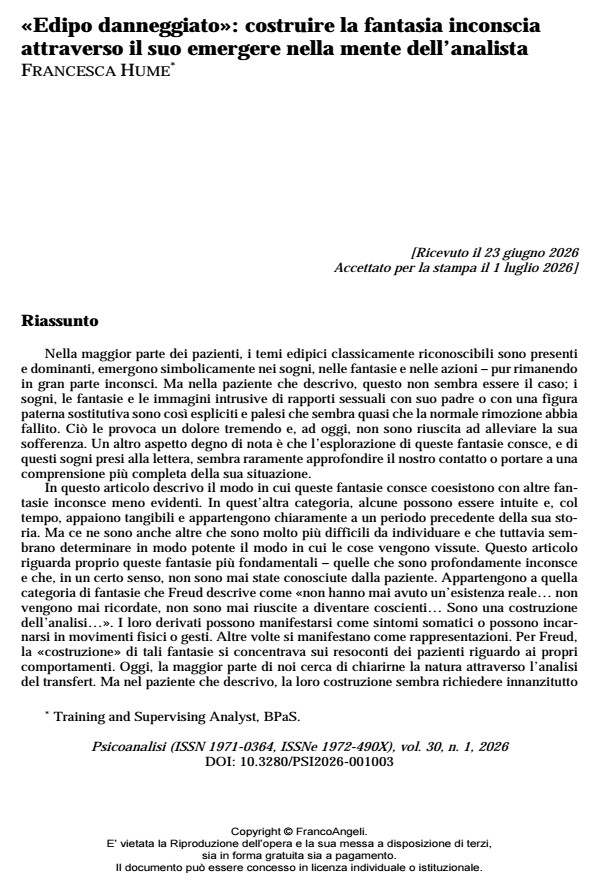
Below, you can see the article first page
If you want to buy this article in PDF format, you can do it, following the instructions to buy download credits
FrancoAngeli is member of Publishers International Linking Association, Inc (PILA), a not-for-profit association which run the CrossRef service enabling links to and from online scholarly content.
In most patients, classically recognisable Oedipal themes are present and dominant, emerging symbolically in dreams, phantasies and actions – but remaining largely unconscious. But in the patient I describe, this appears not to be the case; dreams, fantasies and intrusive images of sexual relations with her father or a father substitute are so explicit and overt that it appears as though ordinary repression has failed. This causes her tremendous pain and to date, I have not been able to alleviate her suffering. Another notable aspect is that exploring these conscious fantasies and dreams at face value rarely seems to deepen our contact or lead to a fuller understanding of her predicament. In this paper I describe the way in which these conscious fantasies sit alongside other less obvious unconscious phantasies. In this other category, some can be divined and over time seem tangible and clearly belong to an earlier period in her history. But there are others too that are much more difficult to arrive at and yet seem to powerfully determine the way in which things are experienced. This paper is about these more fundamental phantasies – ones that are deeply unconscious and in a sense have never been known to the patient. They belong to that category of phantasy that Freud describes as having ‘never had a real existence…it is never remembered, it has never succeeded in becoming conscious…It is a construction of analysis…’ Their derivatives may appear as somatic symptoms or may be embodied in physical movements or gestures. At other times they appear as enactments. For Freud, the ‘construction’ of such phantasies focussed on the patients’ accounts of their behaviours. Today, most of us attempt to elucidate their nature through the analysis of the transference. But in the patient I describe, their construction seems first to require the emergence in the analyst’s mind of elements of the phantasy in a way that is itself an enactment of the phantasy. The long struggle to understand this particular patient has had to wrestle with many things – not least a feeling of unreality about the patient and the transference where the ground is repeatedly felt to shift and slip away. The nebulousness of the contact, paradoxically, is sometimes the most solid experience I can have. I’ve come to see that one thing that interferes with my own functioning is the loss of space caused by certain aspects of her primitive phantasy; resulting in an experience in which I am too much a part of it and unable to be outside and observing it. This more fundamental phantasy although scarcely known to the patient, dominates her experience, in ways that both excite and disturb her, contaminating new relationships and preventing development. Moreover, it serves to protect her from the emergence of other traumatic aspects of her psychic reality that threaten to overwhelm her. Without some recognition of the existence and function of this phantasy, psychoanalysis is conducted on false lines.
Keywords: Oedipus conflict, unconscious phantasy, enactment.
- Birksted-Breen D. (1996). Phallus, penis and mental space. IJPA, 77, 4: 649-657.
- Britton R. et al. (1989). The Missing Link: Parental Sexuality in the Oedipus Complex. In: The Oedipus Complex Today. Clinical Implications. London: Karnac Books.
- Bronstein C. (2015). Finding Unconscious Phantasy in the Session: Recognizing Form. IJPA, 96, 4: 925-944.
- Feldman M. (2009). The problem of conviction in the session. In: Doubt, conviction and the analytic process: Selected papers. London: Karnac Books.
- Freud S. (1908). Hysterical Phantasies and their Relation to Bisexuality. In: S.E. vol. 9, London: Hogart Press.
- Freud S. (1909). Some General Remarks on Hysterical Attacks. In: S.E. vol. 9, London: Hogart Press, pp. 227-234.
- Freud S. (1919). A Child is Beaten: A Contribution to the Study of the Origin of Sexual Perversions. In: S.E. vol. 17, London: Hogart Press, pp. 175-204.
- Freud S. (1937). Constructions in Analysis. In: S.E. vol. 23, London: Hogart Press, pp. 255-270.
- Klein M. (1945) The Oedipus complex in the light of early anxieties. IJPA, 26: 11-33.
- Klein M. (1975). Envy and Gratitude and Other Works 1946–1963. London: Karnac Books.
- Malcolm, R. R. (1999). The Mirror from On Bearing Unbearable States of Mind. London: Published by Taylor & Francis.
- Roth J. (2008). Where Else: considering the Here and Now Conference Paper from The Here and Now Today, University College London, on 13th December 2008.
- Sodre I. (2015). The Perpetual Orgy: Hysterical Phantasies, Bisexuality and the question of Bad Faith. London: Routledge.
Francesca Hume, «Edipo danneggiato»: costruire la fantasia inconscia attraverso il suo emergere nella mente dell’analista in "PSICOANALISI" 1/2026, pp 35-51, DOI: 10.3280/PSI2026-001003