Co-Construction of an Affective and Sexuality Education Pathway: A Participatory Approach for Promoting Well-Being at School
Journal title PSICOLOGIA DELLA SALUTE
Author/s Luigi Russo, Anna Innocente, Matteo Sabato, Irene Manco, Federica Rossetti, Emanuela Mariano
Online First 9/30/2026 Issue 2026/Online First
Language Italian Pages 13 P. 1-13 File size 104 KB
DOI 10.3280/pds2026-21407
DOI is like a bar code for intellectual property: to have more infomation
click here
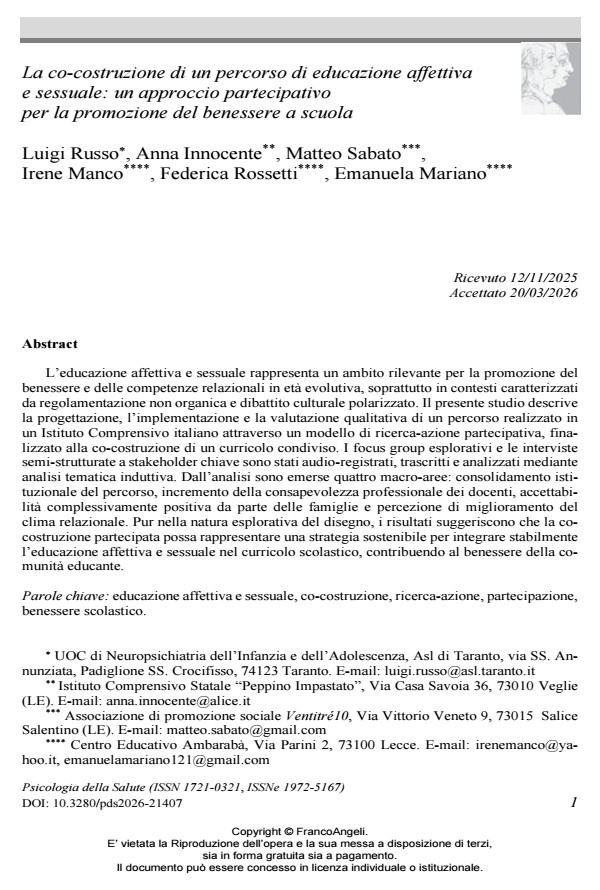
Below, you can see the article first page
If you want to buy this article in PDF format, you can do it, following the instructions to buy download credits
FrancoAngeli is member of Publishers International Linking Association, Inc (PILA), a not-for-profit association which run the CrossRef service enabling links to and from online scholarly content.
Affective and sexuality education represents a relevant domain for the promotion of wellbeing and relational competencies in developmental age, particularly within contexts characterized by fragmented regulation and polarized public debate. The present study describes the design, implementation, and qualitative evaluation of a school-based program developed in an Italian Comprehensive Institute through a participatory action-research framework aimed at the co-construction of a shared curriculum. Exploratory focus groups and semi-structured interviews with key stakeholders were audio-recorded, transcribed verbatim, and analyzed using inductive thematic analysis. Four main thematic areas emerged: institutional consolidation of the program, increased professional awareness among teachers, overall parental acceptability, and perceived improvement in relational climate within classrooms. Although exploratory in nature, the findings suggest that participatory co-construction may represent a sustainable strategy for integrating affective and sexuality education into the regular curriculum, contributing to the well-being of the educational community.
Keywords: affective and sexuality education, co-construction, action research, participation, school well-being.
- Bonino, S., & Cattelino, E. (2022). Adolescenza e sessualità. Percorsi educativi e preventivi. Carocci.
- Braun, V., & Clarke, V. (2006). Using thematic analysis in psychology. Qualitative Research in Psychology, 3(2): 77101.
- Calidoni, M. (2024). Educazione affettiva e sessuale nella scuola italiana: tra linee guida e controversie. Pedagogia e Pratiche Educative, 32(1): 4560.
- Fonner, V. A., Armstrong, K. S., Kennedy, C. E., O’Reilly, K. R., & Sweat, M. D. (2014). Schoolbased sex education and HIV prevention in low and middleincome countries: A systematic review and metaanalysis. PLoS ONE, 9(3): e89692.
- Goldfarb, E. S., & Lieberman, L. D. (2021). Three decades of research: The case for comprehensive sex education. Journal of Adolescent Health, 68(1): 13–27.
- Haberland, N. (2015). The case for addressing gender and power in sexuality and HIV education.
- American Journal of Public Health, 105(5): 891–898. tice. Journal of Adolescent Health, 56(1): S15–S21.
- Lincoln, Y. S., & Guba, E. G. (1985). Naturalistic inquiry. Sage.
- Ministero dell’Istruzione e del Merito. (2023). Linee di indirizzo per l’educazione all’affettività e al rispetto. MIM.
- Morgan, D. L. (1997). Focus groups as qualitative research (2nd ed.). Thousand Oaks, CA: Sage.
- Mortari, L. (2017). La ricerca qualitativa in educazione. Roma: Carocci.
- OMS – Organizzazione Mondiale della Sanità, & BZgA. (2010). Standards for sexuality education in Europe. WHO Regional Office for Europe.
- OMS – Organizzazione Mondiale della Sanità. (2024). Comprehensive sexuality education and adolescent health. World Health Organization.
- UNESCO. (2018). International technical guidance on sexuality education: An evidenceinformed approach (Rev. ed.). https://unesdoc.unesco.org/ark:/48223/pf0000260770
- Trinchero, R. (2009). Metodologia della ricerca educativa. RomaBari: Laterza.
Luigi Russo, Anna Innocente, Matteo Sabato, Irene Manco, Federica Rossetti, Emanuela Mariano, La co-costruzione di un percorso di educazione affettiva e sessuale: un approccio partecipativo per la promozione del benessere a scuola in "PSICOLOGIA DELLA SALUTE" Online First/2026, pp 1-13, DOI: 10.3280/pds2026-21407