Donne e finanza: la partecipazione femminile al mercato del credito tra privati nell’Italia d’età moderna (secoli XVII-XVIII)
Journal title IMPRESE E STORIA
Author/s Marcella Lorenzini
Publishing Year 2026 Issue 2024/50
Language Italian Pages 12 P. 213-224 File size 95 KB
DOI 10.3280/ISTO2024-050014
DOI is like a bar code for intellectual property: to have more infomation
click here
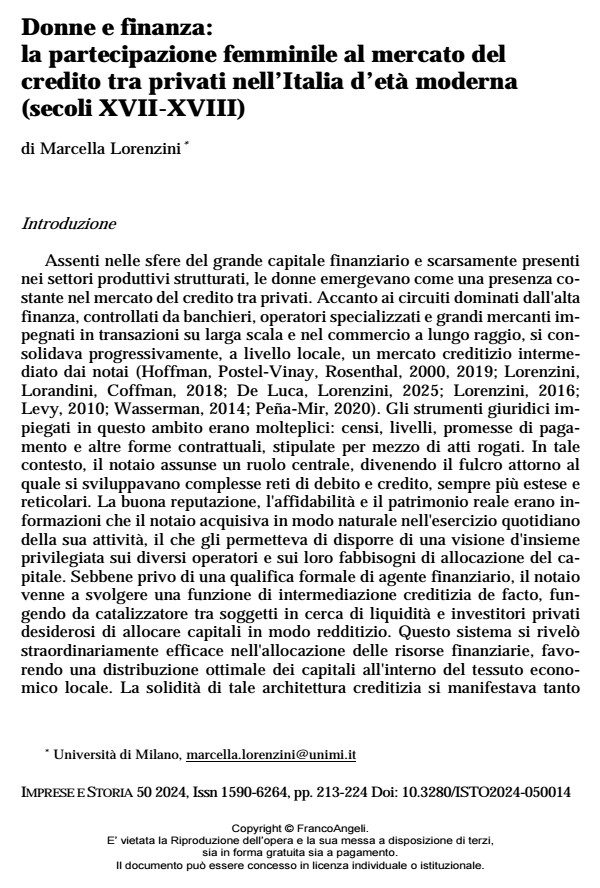
Below, you can see the article first page
If you want to buy this article in PDF format, you can do it, following the instructions to buy download credits
FrancoAngeli is member of Publishers International Linking Association, Inc (PILA), a not-for-profit association which run the CrossRef service enabling links to and from online scholarly content.
- Carlos, A., Neal, L. (2004). Women investors in early capital markets, 1720–1725. Financial History Review, 11, 197-224.
- De Luca, G. (1996). Commercio del denaro e crescita economica a Milano tra Cinque e Seicento. Milano: Il Polifilo.
- De Luca, G., Lorenzini, M. (2025). Notary lending networks in Northern Italy in the 18th and 19th centuries. In E. Dermineur, M. Pompermaier (Eds.), A Social Network Analysis Approach (pp. 323-358). London: Palgrave Macmillan.
- De Maddalena, A. (1974). Prezzi e mercedi a Milano dal 1701 al 1860. Milano: Banca Commerciale italiana.
- Dermineur, E. (2009). Female Peasants, Patriarchy and the Credit Market in Eighteenth-Century France. Proceedings of the Western Society for French History, 37, 71.
- Dermineur, E. (2014). Single Women and the Rural Credit Market in Eighteenth-Century France. Journal of Social History, 48(1), 175-199.
- Dermineur, E. (Ed.) (2018). Women and Credit in Pre-Industrial Europe. Turnhout: Brepols.
- Fontaine, L. (2011). Il posto delle donne nella piccola economia finanziaria in Europa, in età moderna. Quaderni Storici, 46, 513-532.
- Fontana, P. (2018). Donne, credito e potere contrattuale nell'Italia moderna. Milano: FrancoAngeli.
- Hoffman, P.T., Postel-Vinay, G., Rosenthal, J.-L. (2000). Priceless Markets. The Political Economy of Credit in Paris, 1660-1870. Chicago: The University of Chicago Press.
- Hoffman, P.T., Postel-Vinay, G., Rosenthal, J.-L. (2019). Dark Matter Credit: The Development of Peer-to-Peer Lending and Banking in France. Princeton: Princeton University Press.
- Lanaro, P., Varanini, G.M. (2009). Funzioni economiche della dote nell'Italia centro-settentrionale (tardo medioevo/inizio età moderna). In S. Cavaciocchi (Ed.), La famiglia nell'economia europea, secc. XIII-XVIII (p. 85). Firenze: Firenze University Press.
- Laurence, A., Maltby, J., Rutterford, J. (Eds.) (2012). Women and their Money 1700-1950. London: Routledge.
- Leverotti, F. (2001). Donne e denaro. Patrimoni femminili e potere economico in età moderna. Quaderni storici, 108, 573-603.
- Levy, J. (2010). Notaries and credit markets in nineteenth-century Mexico. Business History Review, 84, 459-478.
- Licini, S. (2009). Women's wealth and finance in nineteenth-century Milan. In A. Laurence, J. Maltby, J. Rutterford (Eds.), Women and their money, 1700-1950. Essays on women and finance (pp. 271-289). London: Routledge.
- Licini, S. (2011). Assessing female wealth in nineteenth century Milan, Italy (pp. 35-54).
- Licini, S. (2020). Women, business and finance in XIXth century Milan. Journal of Modern Accounting and Auditing, 16, 117-129.
- Lorenzini, M. (2016). Credito e notai. Capitali per l'economia veronese del secondo Seicento. Bologna: Il Mulino.
- Lorenzini, M. (2018). Borrowing and Lending Money in Alpine Areas During the Eighteenth century: Trento and Rovereto Compared. In M. Lorenzini, C. Lorandini, D'M. Coffman (Eds.), Financing in Europe: Evolution, Coexistence and Complementarity of Lending Practices from the Middle Ages to Modern Times (pp. 105-132). New York: Palgrave MacMillan.
- Lorenzini, M., Lorandini, C., Coffman, D'M. (Eds.) (2018). Financing in Europe: Evolution, Coexistence and Complementarity of Lending Practices from the Middle Ages to Modern Times. New York: Palgrave MacMillan.
- Ogilvie, S. (2003). A Bitter Living: Women, Markets, and Social Capital in Early Modern Germany. Oxford: Oxford University Press.
- Pazzaglia, M., Vallerani, M., Esposito, A. (Eds.) (2012). Dare credito alle donne. Presenze femminili nell'economia tra medioevo ed età moderna (pp. 117-140). Roma: Viella.
- Peña-Mir, J.L. (2020). How Well Were Creditors' Rights Protected in Early Modern Spain? The Case of the Public Mortgage Registry in Malaga. Revista de Historia Económica - Journal of Iberian and Latin American Economic History, 40(1), 35-65.
- Pompermaier, M. (2021). A complicated puzzle: spinsters, widows and credit in Sweden (1790-1910). Financial History Review, 29, 1-23.
- Shepard, A. (2015). Minding Their Own Business: Married Women and Credit in Early Eighteenth-Century London. Transactions of the Royal Historical Society, 25, 53-74.
- Wasserman, M.L.E. (2014). Diseño institucional, prácticas y crédito notarial en Buenos Aires durante la primera mitad del siglo XVII. Investigaciones de Historia Económica - Economic History Research, 10, 1-12.
Marcella Lorenzini, Donne e finanza: la partecipazione femminile al mercato del credito tra privati nell’Italia d’età moderna (secoli XVII-XVIII) in "IMPRESE E STORIA" 50/2024, pp 213-224, DOI: 10.3280/ISTO2024-050014